Skip to content


Noteworthy News – July 30, 2012

Economy:

Get A Job: The Craigslist Experiment – Thought Catalog

The Hangover: How Las Vegas Explains the Past and Future of the Economy – The Atlantic

What garbage can tell us about the direction of the economy — in 1 chart – Washington Post

Why Capitalism Has an Image Problem – Wall Street Journal

U.S. Growth Falls to 1.5%; a Recovery Seems Mired – New York Times

Markets:

Capital gains: American profits have been high but the trend may not last – Economist


Politics:

ECB thinks the unthinkable, action likely weeks away – Reuters

Carbon tax gets unusual support – CNN Money

ECB on course to act strongly or disappoint mightily – Reuters

Banks:

JPMorgan subsidiary accused of manipulating California electric market – Sacramento Bee

Barclays Sorry For Libor-Rigging As Profit Beats Estimates – Bloomberg
Posted in Economics, Markets, Media, Politics.


The Tipping Point

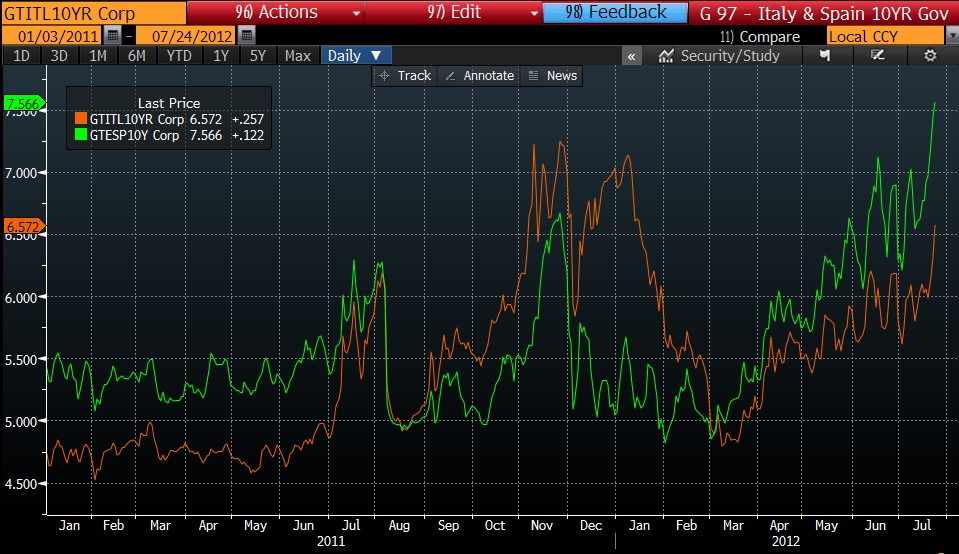
The funding costs of European sovereigns has been moving one ways  since March.  Spain has hit 7.5% on its 10 year bonds while Italy is at 6.57%.  These are two levels that are unsustainable over the long run considering current deficits and weak economies:

Ray Dalio, the head of one of the most well respected hedge funds in the world sees more pain to come:

“The breadth of this slowdown creates a dangerous dynamic because, given the inter-connectedness of economies and capital flows, one country’s decline tends to reinforce another’s, making a self-reinforcing global decline more likely and a reversal more difficult to produce…We think that the popular assumption that the Germans and the ECB (which requires agreement of the key factions within it) will come through with money to make all of these debts good should not be taken for granted,” Bridgewater said. “We think there are good reasons to doubt that the European bank and sovereign deleveragings will be prevented from progressing to the next stage in a disorderly way.

With this as the backdrop, does anyone see a discrepancy between where the Dollar, the US 10 year yield and the S&P are trading?

The equity market expects QE 3, but the equity market will not get QE 3 until Mr. Bernanke gets deflation – which would imply lower levels on the S&P 500 as one measure and at the very least lower measures on breakeven inflation rates:

I think the drug addict needs to go through a bit of withdrawal before he gets another shot of heroin.  A few shakes and tremors might be expected.


Posted in Economics, Markets, Politics.

Tagged with , , , , , , , .


Noteworthy News – July 23, 2012

Economy:

US poverty on track to rise to highest since 1960s – Yahoo! News

Our Ridiculous Approach to Retirement – New York Times

How the Elites Built America’s Economic Wall – Bloomberg

Economic history: Muddled models – Economist

Goldman: The rest of you should invest in America – Reuters

Many use payday loans to cover food, rent – MSNBC

Markets:

Silicon Valley Surgeons Risk ‘Moral Authority’ For 200% Returns – Bloomberg

Arming for the Syrian War: Do Soaring Prices Predict Escalating Conflict? – New York Times

Crops suffer as drought intensifies in U.S. breadbasket – Reuters

Drought Conditions Driving Corn and Soy to The Sky—Will Central Banks Make Things Worse? – Slate

Politics:

The eurozone’s religious faultline – BBC

Korea Feed Group Asks U.S. to Curb Corn, Soybean Use in Biofuel – BusinessWeek

Banks:

The European Stabilization Mechanism, Or How Goldman Sachs Captured Europe – Global Research

From an Unlikely Source, a Serious Challenge to Wall Street – Rolling Stone(Matt Taibbi)

U.S. banks haunted by mortgage demons that won’t go away – Reuters


Posted in Economics, Markets, Media, Politics.


Approaching the Fiscal Cliff

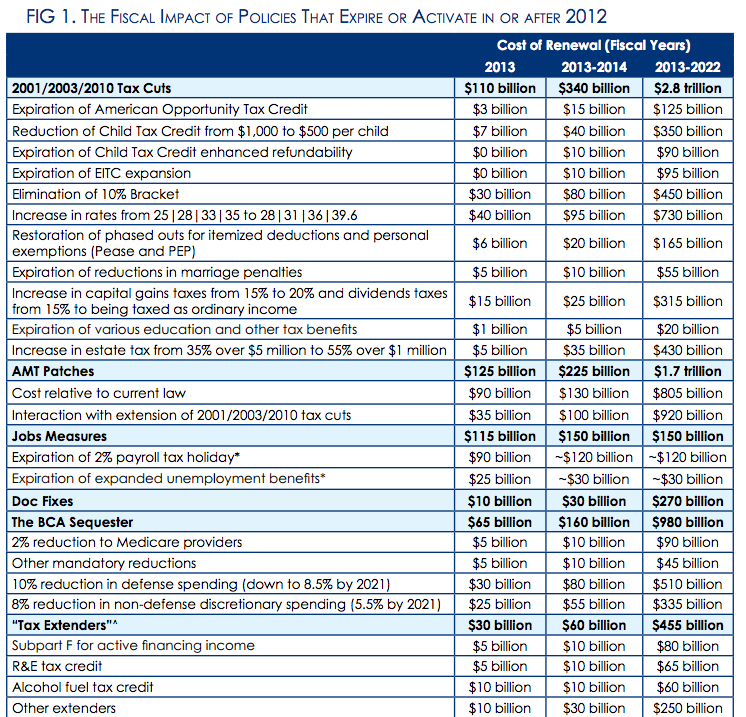
With the coming year many tax breaks will becoming to an end without intervention and agreement between the democrats and republicans. The dollar amount is staggering and all stimulus expirations would total about 4% of GDP which would mean that the US economy would immediately enter into a recession.

What about the debt ceiling?  You might feel like we just went through that debate but it turns out we will probably be hitting that wall some time in mid September:

The treasury can play some accounting shell shuffle in the few months after we hit the debt ceiling as timmy did in 2011, but this time around we will watch the politicians battle it out over the debt ceiling and all of the expiring tax cuts and stimulus.  This could be political brinkmanship at its ugliest.


Posted in Economics, Markets, Politics.

Tagged with , .


Corporations Sitting on $5 Trillion of Cash

According to Reuters, new IRS release shows that non-financial US corporations held $4.8 Trillion of cash and liquid assets in 2009, which equates to $5.1 Trillion of cash in today’s dollars.


Is this a case of the chicken or the egg?  Companies are not spending cash because they do not see good investments due to a lack of demand.  The lack of demand is due to a lack of jobs and wage growth so who moves first?  Seems like incentives for US corporations to invest, hire and raise wages would be a good start… On the flip side, the policies that cause uncertainties about future corporate expenses (medicare) or future legislation and taxes should be put to bed so that the companies stop hoarding. At the very least, the companies should be distributing that cash in dividends to the shareholders if they truly cannot find good investments. Unfortunately they will probably throw the money at poorly planned acquisitions and share buybacks (Yes, share buybacks are technically equivalent to dividends but not in reality).

I realize that this topic is a binary conversation with most readers. Most either believe corporations are insidious monsters that steal from the poor and keep the man down or they believe that corporations are the only rational entities in true capitalism and that they are doing their shareholders justice by shielding their assets from government induced malinvestment. I would like to agree with both sides and try to reach a middle ground. Government policies and taxes have contributed to and possibly created the problem, but corporations hoarding cash only exacerbates it under the current conditions. What is wealth if the foundation is crumbling around you?

Posted in Economics, Markets, Media, Politics.

Tagged with , .


Copyright © 2009-2013 SurlyTrader DISCLAIMER The commentary on this blog is not meant to be taken as an investment advice. The author is not a registered investment adviser. There is no substitute for your own due diligence. Please be aware that investing is inherently a risky business and if you chose to follow any of the advice on this site, then you are accepting the risks associated with that investment. The Author may have also taken positions in the stocks or investments that are being discussed and the author may change his position at any time without warning.

Yellow Pages for USA and Canada SurlyTrader - Blogged

ypblogs.com