Skip to content


Gold Mining Stocks Continue to Disappoint But Not For Long

Guest Post from Chris Vermeulen at TheGoldandOilGuy.com

It is an endless debate for investors interested in gold. Should they buy a direct play on the gold price, either gold bullion itself or even so-called paper gold with an ETF such as the SPDR Gold Shares(NYSEArca: GLD)? Or should they invest into gold equities, particularly the larger, higher quality gold mining companies?

Recent history suggests the answer is gold itself. According to Citigroup, physical gold has outperformed global gold equities 120% percent of the time over the past 5 years. Stocks of the bigger gold mining firms seem to react adversely to bad news (which is normal), but the problem is they react with no more than a yawn to good news. These type of stocks are contained in the Market Vectors Gold Miners ETF (NYSEArca: GDX).

Gold Mining Stocks ETF – GDX

Evidence of this trend can been see in the latest news to hit the industry…the slowdown in expansion as recently signaled by the world’s largest gold producer, Barrick Gold (NYSE: ABX). The company’s stock has fallen by more than 30 percent over the last year due to cost overruns at major projects. The latest blowup in costs of up to $3 billion occurred in its estimate for development of its flagship Pascua-Lama project on the border of Chile and Argentina. The project may now cost up to $8 billion.

In addition, Barrick decided to shelve the $6 billion Cerro Casale in Chile and the $6.7 billion Donlin Gold project in Alaska. Barrick is not alone in its thinking among the major gold producers. The CEO ofAgnico-Eagle Mines (NYSE: AEM), Sean Boyd, recently said “The era of gold mega-projects may be fading. The industry is moving into an era of cash flow generation, yields and capital discipline.”

Fair enough. But are gold mining companies’ management walking the walk about yields or just talking the talk? Last year, many of the larger miners made major announcements that they would be focusing on boosting their dividends to shareholders in attempt to attract new stockholders away from exchange traded vehicles such as GLD, which have siphoned demand away from gold equities. Barrick, for example, did boost its dividend payout by a quarter from the previous level. Newmont Mining (NYSE: NEM), which has also cut back on expansion plans, has pledged to link its dividend payout to the price of gold bullion.

So in effect, the managements at the bigger gold mining companies (which are having difficulties growing) are trying to move away from attracting growth-only investors to enticing investors that may be interested in high dividend yields. This is a logical move.

But rising costs at mining projects may put a crimp into the plans of gold mining companies’ as they may not have the cash to raise dividends much. And they have done a poor job of raising dividends for their shareholders to date. In 2011 the dividend yields for gold producers globally was less than half the average for the mining sector as a whole at a mere 1.3 percent. Their yields are below that of the base metal mining sector and the energy sector.

It seems like management for these precious metal companies have the similar emotional response shareholders have when they are in a winning position. When the investor’s brain has experienced a winning streak and is happy it automatically goes into preservation/protection mode. What does this mean? It means management is going to tight up their spending to stay cash rich as they do not want to give back the gains during a time of increased uncertainty. Smaller bets/investments are what the investor’s brain is hard wired to do which is not always the right thing to do…

Looks like there is still a lot work to be done by gold mining companies’ to improve returns to their shareholders. But with all that set aside it is important to realize that when physical gold truly starts another major rally. These gold stocks will outperform the price of gold bullion drastically for first few months.
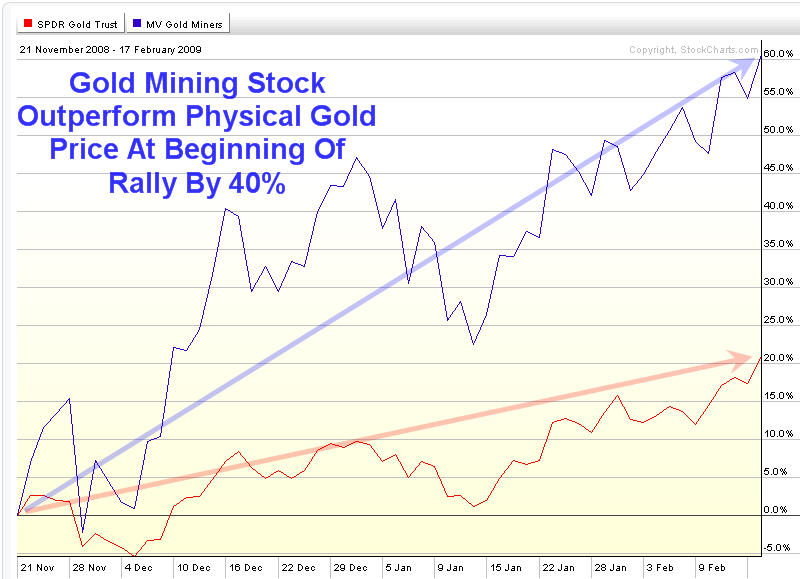
Gold Stock Rally


Gold Miner Trading Conclusion:

In short, it seems gold has been forming a major launch pad for higher prices over the past year. Gold bullion has held up well while gold miner stocks have given up over 30% of their gains. If/when gold starts another rally I do feel gold miner stocks will be the main play for quick big gains during the first month or two of a breakout. The increased price in gold could and value of the mining companies reserves could be enough to get management to start paying their investors a decent dividend which in turn would fuel gold miner shares higher.

Both gold and silver bullion prices remain in a down trend on the daily chart but are trying to form a base to rally from which may start any day now. Keep your eye on precious metals going into year end.


Posted in Markets, Technical Analysis.

Tagged with , , .


Noteworthy News – August 13, 2012

Economy:

Boston Has a Bigger Economy Than Greece – Atlantic

Resource Rich, Cash Poor – Slate

Google searches give central banks new tool – SFGate

China’s slowing economy could complicate relationship with U.S. – Washington Post

Bank cuts growth forecast close to zero – BBC

Markets:

Are You Worth More Dead Than Alive? – New York Times

The next great oil crisis – Miami Herald

US drought threatens food price surge – Financial Times

The college-cost calamity: Many American universities are in financial trouble – Economist

Politics:

A controlled break-up of the euro would be hugely risky and expensive. So is waiting for a solution to turn up – Economist

Alan Greenspan on His Fed Legacy and the Economy – Bloomberg

Banks:

Goldman Sachs Will Not Face Criminal Charges: Justice Department – Huffington Post

Posted in Economics, Markets, Media, Politics.


The Difficulty in Adding Vega Exposure – Tenor

Trading option contracts allows you to not only place bets on the direction of the market, but also on the volatility of the market.  For the option traders out there, this obviously goes without saying.  The problem is that implementing the trades actually become more difficult when you think about potential outcomes and costs.

If you want the cleanest and simplest way to add volatility or vega exposure by using options, you would generally buy a straddle.  A straddle will purchase the same amount of calls as puts with the same strike, time to maturity, and the same expiration.  With this position, you basically want the market to move a lot in one direction.  A pure long volatility strategy would delta hedge the straddle so that you can capture all large up and down moves in the market over the duration of the position (by scalping gamma).

Let us be simplistic in our thinking and only consider the vega of the position, or the change in the market value of the options due to a change in implied volatility.  You see that the VIX is at fairly low levels and you want to make a bet that implied volatility is going to jump from 17% to 30% in the next three months.  You think that this has to be a high probability trade so why not place the bet?  You feel that it is hardly likely that implied volatility will fall below 12% and are willing to lose $250 on the trade.  Therefore you want to be long a vega position of $50 per 1 vol point change in implied volatility.

You look at the 3 month options and you figure you can buy a put and a call on the SPY for about a 17% implied volatility.  The issues that you will find are 1) your vega position declines as the straddle ages and 2) the vega profile is fairly peaked – meaning your vega position declines rapidly as the market moves away from the straddle strike:

Think about some market scenarios:

1) The market grinds upward away from your strike and your vega declines by 1/3 or more.   Nothing happens for the next month, your option decays quickly with its fast theta and then the market drops quickly in the last month of trading.

2) The market fades slowly downward for 2 months as complacency sets in.  Market drops quickly thereafter, but at that point your vega is small and the strikes (and what is left of the vega exposure hump) are much higher than the market’s current price.

So you go back to the drawing board and try to figure out how to get a smoother vega distribution with less time decay.  Maybe adding to the maturity of the options will fix your problems:

Not really…  A five year option has a great and flat vega profile, but you pay dearly for it.  Instead of paying 17% as you did with the 3 month options, you are paying 24%.  The one year is priced at 21% with a fairly flat vega exposure, but that only introduces one more issue…your options are not only ageing through their theta, but their market value is declining as it rolls down the term structure of implied volatility.  The option that you bought for one year was priced using an implied volatility of 21%, but after 9 months it will be priced using an implied volatility of 17% (This is similar to why shorting VXX and going long VXZ usually works)

There are ways around these issues that will be explored later.

Posted in Derivatives, Markets.

Tagged with , , , , .


Noteworthy News – August 6, 2012

Economy:

No Copyright Law: The Real Reason for Germany’s Industrial Expansion? – Spiegel

The Fed’s Dilemma: Low Inflation Means Low Growth – The Fiscal Times

The Dinged-Up, Broken-Down, Fender-Bended Economic Recovery Plan – New York Times

The jobs report in six – nay, seven! – charts – Washington Post

Markets:

Corn’s 60% Surge Is More Dangerous Than Euro Mess – Bloomberg

Knight Capital Says Trading Glitch Cost It $440 Million – DealBook

Politics:

Merkel Coalition Members Show Acceptance Of ECB Bond-Buying – Bloomberg

Banks:

Why Big Banks Are Above the Law – US News

Posted in Economics, Markets, Media, Politics.


The Federal Reserve, Gold, Oil, & the Dollar’s Demise

Guest Post from Chris Vermeulen at thetechnicaltraders.com


“We have, in this country, one of the most corrupt institutions the world has ever known. I refer to the Federal Reserve Board. This evil institution has impoverished the people of the United States and has practically bankrupted our government. It has done this through the corrupt practices of the moneyed vultures who control it”.

~ Congressman Louis T. McFadden in 1932 (Rep. Pa) ~

The above quote coming from the Honorable Louis T. McFadden is a quite prescient statement as it relates to arguably the most evil enterprise in American history.

The Federal Reserve through its various monetary mechanisms has a major impact on the value of the U.S. Dollar and over time has destroyed the purchasing power of the fiat base currency used in the United States.

Interestingly enough, the following quote comes directly from the Federal Reserve’s website regarding one of its primary mandates, “In setting monetary policy, the Committee seeks to mitigate deviations of inflation from its longer-run goal and deviations of employment from the Committee’s assessment of its maximum level.”

The chart below illustrates the horrific job the Federal Reserve has done of protecting the purchasing power of the U.S. Dollar since its creation.


In light of the longer-term malaise seen above, the Dollar Index futures have recently rallied sharply higher as Europe continues to flail in a slow and agonizing decline which will ultimately lead to a complete fiscal disaster.

Sovereign debt concerns continue to mount regardless of what the European technocrats spew publicly and the U.S. Dollar has been the primary beneficiary of these seemingly growing concerns.

This brings me to the purpose of this article. Most of the articles I write are focused on option based trades, but I decided it was time to put forth a more comprehensive scenario that could unfold over the next few years as a result of excessive monetary stimulus through various quantitative easing mechanisms developed by the Federal Reserve Bank.  “A mild change” to say the least . . .

As discussed above, the U.S. Dollar Index futures have moved higher throughout most of 2012. Any significant increase in the U.S. Dollar is a growing concern among central bankers as it correlates toward deflation. Deflation is the Fed’s biggest enemy, besides themselves of course.

Next week the Federal Reserve will release statements relating to the economic condition of the United States. Furthermore, the Fed also will discuss if it will initiate another dose of monetary crack for a capital market place that is addicted to cheap money and zero interest rates. At this point, the so-called marketplace is the antithesis of free by all standard measures.

Consider the long-term monthly chart of the U.S. Dollar Index futures illustrated below:


The U.S. Dollar Index futures are in an uptrend that dates back to mid 2011. The orange line illustrates the uptrend and represents a key price level for the U.S. Dollar Index. For those unfamiliar with basic technical analysis, the rising orange trendline will act as buying support until the Dollar eventually breaks down through it signaling the bullish move higher has ended.

This brings us to a rather interesting potential observation. Today Mario Draghi, Chairman of the European Central Bank (ECB), made public comments regarding the readiness of the ECB to act if need be to safeguard the European Union. The Dollar Index Futures plummeted on the statement and remained under selling pressure most of the trading session on Thursday.

If a mere comment from the ECB can have such a damaging impact on the valuation of the Dollar, what would happen to the Dollar if the Fed initiated a new easing mechanism?

The answer is simple, the U.S. Dollar would immediately be under selling pressure. Selling pressure in the U.S. Dollar Index generally leads to a rally in risk assets such as equities and oil futures. Over the longer-term, a weak Dollar is also positive for precious metals and other hard assets.

As an example to illustrate the power of Quantitative Easing as it relates to the price of both gold and oil, consider the following chart:


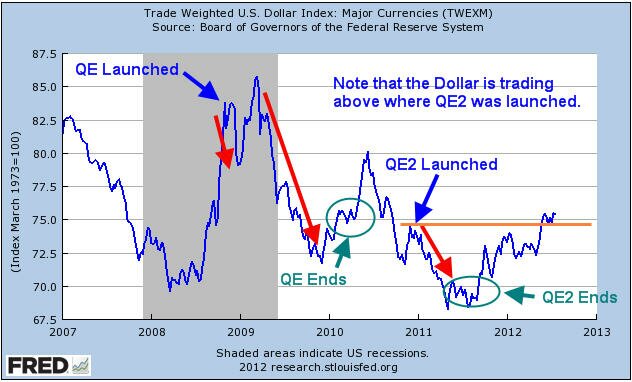
Obviously the price action is pretty clear that Quantitative Easing has a positively correlated impact on the price performance of hard assets, specifically gold and oil. Now consider a price chart of the Dollar Index shown below courtesy of the Federal Reserve Bank, the annotations are mine.

The chart above tells an interesting story about the impact that Quantitative Easing has on the Dollar. How can the Federal Reserve claim to be protecting the purchasing power of the U.S. Dollar when its actions have a direct negative correlation to the greenback’s price?

Furthermore, based on the chart above I am of the opinion that Quantitative Easing III is a foregone conclusion. The current price of the Dollar Index is clearly above the previous high where QE2 was launched.

So far, the rally in the Dollar Index has not pushed equity prices considerably lower. However, should the Federal Reserve refrain from initiating additional easing measures it is likely based on the chart above that the U.S. Dollar Index will rally.

Upon the conclusion of both QE and QE2, the Dollar Index rallied sharply higher. With the Fed announcement coming closer by the hour, financial pundits will attempt to predict the future action of the Fed.

I have no interest in making predictions about what the Fed will do. It is a certainty that QE3 will take place at some point in the future whether it be sooner or later.

The Federal Reserve simply has no choice, otherwise the Dollar would continue to rally and we would begin to go through a deflationary period which the Federal Reserve simply cannot tolerate.

The scenario that I would urge inquiring minds to consider would be as follows. If the Fed does nothing we can likely assume that the U.S. Dollar Index will continue to rally to the upside.

Based on the price chart of the U.S. Dollar Index shown above, we can expect that sellers would certainly step in around the 86 – 88 price range based on previous resistance.

If the U.S. Dollar makes it anywhere near the 86 – 88 price range without the Federal Reserve initiating QE3 it would be expected that risk assets would be under considerable selling pressure somewhere along the way.

Should the Fed act to break the Dollar’s rally either through more easing or “other” mechanisms, the result would be a potentially monster rally for risk assets, at least initially.

Equities, oil, and precious metals would rally on a falling Dollar as shown above. The question then becomes what if this is the last gasp rally before a monster selloff ensues in the Dollar Index?

If the Fed breaks the rally early or initiates a monster-sized easing program, the initial reaction will be quite positive, especially for equities. As the selloff in the Dollar Index worsens, equities would eventually begin to underperform as oil prices would surge putting pressure on the economy.

In addition to oil rallying on the weaker Dollar, we could also see sellers start to show up in droves dumping U.S. Treasury’s to any buyer left standing. International debt holders would especially have incentive to sell Treasury’s as the real purchasing power of the bonds’ interest payments would decline as the Dollar fell in value.

The way I see it, whether the Fed launches QE3 now or later, the outcome will not change. An extremely weak Dollar could wreak havoc across a variety of assets and the broader economy. Imagine where gasoline prices would be if oil prices hit $125 / barrel. The average price in the U.S. would be well above $5 / gallon based on current prices and possibly higher.

What happens to the economy if interest rates start to react violently to the price action in the Dollar? What if Treasury’s start to sell off viciously and interest rates start to rise wildly and volatility among bond holdings runs rampant?

Are we to believe that the very entity that has created boom and bust cycles through easy monetary policies and has been oblivious to the bubbles that it has created is capable of solving the issues that would potentially arise from a currency crash in the U.S. Dollar?

The track record of the Federal Reserve is quite clear. They are generally late to the party and rarely are able to forecast events in the future with any clarity. Do you really think they will know what to do? The free market wants to destroy debt through deflationary pressure and price discovery and the Federal Reserve continues to get in the way.

The free market will win as it always does, but the American people will lose. This process may take months, years, or even decades to play out. Eventually the game will end.

There is only one certainty should any portion of the scenario discussed above come to fruition, when the Dollar is inevitably broken the only safe place to hide during the potential currency crash will be in physical gold and silver. Paper money and paper assets will come under extreme selling pressure and in some cases will simply . . . disappear.

Here’s to hoping I am totally wrong!


Posted in Economics, Markets, Politics, Technical Analysis.


Copyright © 2009-2013 SurlyTrader DISCLAIMER The commentary on this blog is not meant to be taken as an investment advice. The author is not a registered investment adviser. There is no substitute for your own due diligence. Please be aware that investing is inherently a risky business and if you chose to follow any of the advice on this site, then you are accepting the risks associated with that investment. The Author may have also taken positions in the stocks or investments that are being discussed and the author may change his position at any time without warning.

Yellow Pages for USA and Canada SurlyTrader - Blogged

ypblogs.com