Skip to content


The Tangled Web of Collateral Swaps

Bloomberg recently published an article about “collateral transformation” and how risky traders were going to get around pesky Dodd-Frank collateral requirements on derivatives trades by borrowing high quality assets from banks and posting lower quality assets to the banks.  This really is not a Dodd-Frank only phenomena, so let me explain the tangled web of logistics a bit better…

Collateral is what a firm, institution, hedge fund, or even an individual posts to a counterparty as security for a loan.  When you buy a house with a mortgage, the house is collateral for the loan.  When you enter into a derivative transaction with a counterparty and the value of that derivative moves against you, then you need to post collateral against the negative value that you owe to the counterparty.  You do not necessarily need to “true up”, you just need to provide your counterparty with some security to keep the position open.   Think of this as a poker game in a movie where the underdog runs out of money, but “promises” to pay the other in a few weeks in order to continue the game.  The player with the upper hand will ask, “what-cha got?”, and the underdog opponent might pledge his wedding ring or the keys to his car….it has been played out in more than a few sitcoms or movies.

Now back to the Bloomberg collateral article.  They are really talking about what clearinghouses or exchanges require for collateral in exchange traded derivatives contracts.  In general, an exchange such as the Chicago Mercantile Exchange requires much higher quality collateral than an institution like Bank of America or Goldman Sachs.  The insinuation is that the risky traders do not have high quality collateral to post, so they are required to “borrow” higher quality collateral from banks to post to the clearinghouse to comply with Dodd-Frank regulations.

“Collateral Transformation” is a new phrase to me.  I have generally known it as a “Collateral Swap”.  The issue of not having high quality assets is not an issue limited to traders and hedge funds.  Think of it from the perspective of a Spanish bank that is seeing tremendous withdrawals and stresses to its own liquidity needs.  The Spanish bank needs to weather the storm, so they sell higher quality liquid assets to fund current liquidity needs but are then left with a balance sheet of illiquid, lower quality assets that they do not want to or cannot sell because they have not marked them down on their own balance sheet and/or because there might not be a market for the assets at all.  Therefore they need to lend out their illiquid assets and borrow higher quality assets in order to access cash.  The Spanish bank will lend a big bank such as Large European Bank A  $200M of illiquid, lower quality assets and borrow $100M of higher quality liquid assets.  In addition, the Spanish bank will agree to pay Bank A 5% for the privilege of borrowing money when no one else would lend them money.  So UBS is overcollateralized in the transaction while receiving a hefty financing rate while the Spanish bank has access to the liquidity it desperately needs.  In reality, this collateral swap is really a liquidity swap.  You lend me liquidity for a fee and I will lend you illiquidity.  Nice and tidy.

Now take this one step further.  Where does Bank A get the high quality collateral for the Spanish bank and why would Bank A want to hold these low quality Spanish securities on its balance sheet?  Quite simply, it doesn’t.  Bank A wants to be a middleman in the transaction and find a sucker on each side.  Bank A goes to a know nothing instititution in the United States and says, “Hey, how would you like to earn an additional 1% on your high quality fixed income portfolio?  All I need to do is borrow your securities for a short amount of time and I will post a ton of collateral against it.  You don’t have to worry because you are overcollateralized by 40%.  If you are still worried, I promise that my stalwart institution, Bank A, will make you whole if anything happens.”

Mr. “Know-Nothing” institution in the United States says this sounds like a great deal!  He can earn an additional 1% on his entire portfolio with seemingly no risk!  In a world of investing 10 year corporate bonds at 2.5%, this sounds like a risk-free gift.

So now Mr. “Know-Nothing” institution as unwittingly posted his high security bonds to a Spanish bank.  If the Spanish bank and many others go under (as these things are likely to unfold), then Mr. Know Nothing is left holding a bunch of useless overcollateralization worth pennies on the dollar while knocking on the unresponsive doors of European Bank A.
Posted in Derivatives, Markets.

Tagged with , , .


Silver at Multi-Month High

Guest Post from Chris Vermeulen at TheGoldAndOilGuy.com

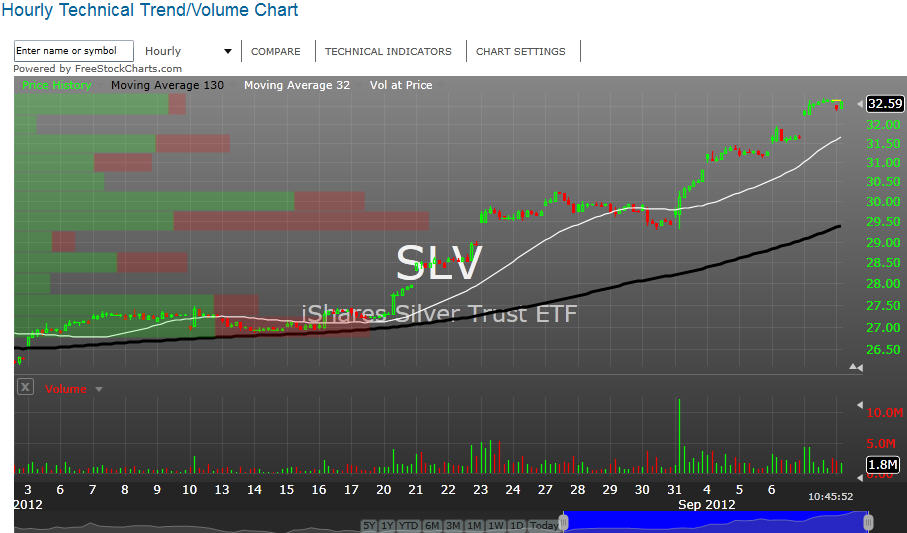
The price of silver reached a 5-month high this past week as investor interest seems to have been rekindled in both gold and silver as belief in financial markets increases that the latest round of monetary easing from the Federal Reserve – QE3 – will soon be on its way. Many investors had largely stayed away from silver in recent months after some had got caught up in its volatility. Silver had touched a 30-year high in April 2011 before plunging 35 percent in a few short weeks.

Now the volatility is back – but on the upside – as prices have climbed more than 20 percent in less than a month. The gains have outpaced that of gold which rose roughly 10 percent during the same time frame. Importantly for investors, the ratio between the two precious metals has moved about 10 percent in silver’s favor since mid-August. This is the first time silver has outperformed gold since the start of 2012.

For non-futures investors, the two precious metals can easily be tracked through the use of exchange traded funds (ETFs). The most liquid ETFs for the two precious metals are the iShares Silver Trust(NYSE Arca: SLV) and the SPDR Gold Shares (NYSE Arca: GLD) respectively.

Silver Bullion Spot Price

Gold Bullion Spot Price

You can take a look at my long term outlook analysis from last week here:http://www.thetechnicaltraders.com/gold-standard-to-be-reinstated-through-the-back-door/

Some may wonder why has silver outperformed gold in the past several weeks? The answer goes deeper than just confidence that QE3 is coming soon, but it is still rather a simple one. The sharp rally in silver was fueled largely by short-covering. That is, some investors (hedge funds, etc.) had made rather large bets that silver would continue falling and were caught off-guard by its recent rise. According to data from the Commodities Futures Trading Commission, the silver market during the week of August 27-31 saw the largest amount of short-covering since May 2011. At the same time. Bloomberg reported that hedge funds were the least bullish on silver in almost four years.

It is unknown for how long silver will outperform gold. But even some long-term fundamental investors such as legendary commodities investor Jim Rogers has said that he believes silver right now is a better investment than gold. He points to the fact that historically gold has been worth about 12 to 15 times what silver is worth, but that recently it has been worth roughly 50 times silver’s value. Silver is also the only major commodity not to have reached a new all-time high in the decade-long commodity bull market and is still cheaper than it was 32 years ago.

So it may be worth a look. But since silver is so volatile, wait for a downward spike before initiating or adding to a long position.


Posted in Markets, Technical Analysis.

Tagged with , .


Noteworthy News – September 10, 2012

Economy:

Sock City’s decline may reveal an unravelling in China’s economy – The Guardian

Share of Men in Labor Force at All-Time Low – New York Times

The Reason Why The Unemployment Rate Dropped: The Labor Participation Rate Is At Fresh 31 Year Lows – ZeroHedge

U.K. July Industrial Production Surges Most in 25 Years – Bloomberg

Markets:

ECB Plan Said to Pledge Unlimited, Sterilized Bond-Buying – Bloomberg

What $3,500 gets you in SF single-family homes – SFGate

Give The Gold Standard Its Due – Forbes

U.S. Yields Rise From Lowest in a Month; Debt Tops $16T – Bloomberg

US home prices rise in July by most in 6 years – DenverPost

Politics:

Fate of eurozone rests in the hands of German judges – The Guardian

Banks:

Swiss bank vows to hold franc down – Financial Times

Big banks weigh risks, rewards of California’s new CO2 market – Reuters

Posted in Economics, Markets, Media, Politics.


Gold Standard To Be Reinstated Through The Back Door

Guest Post from Chris Vermeulen at TheGoldAndOilGuy.com


For the first time in over 30 years, talk of a return to the gold standard has become part of mainstream politics in the United States. Part of the official Republican policy adopted it at the recent Republican Convention and called for the commission to look at reestablishing the link between gold and the U.S. dollar. No doubt that plank was added to soothe supporters of Texas Congressman Ron Paul.

However, gold bugs holding gold bullion or even those holding gold ETFs such as the SPDR Gold Shares (NYSE: GLD) shouldn’t hold their breath in anticipation of the gold standard returning. There was a similar commission – the Gold Commission – set up in 1981 by President Ronald Reagan. After a lot of ‘commissioning’, the decision was made to go with the status quo of using fiat Federal Reserve dollars.

Any commission set up under the current president would likely come to the same conclusion. There are simply too many practical obstacles to return to a full-fledged gold standard. Even pro-gold advocates including the World Gold Council and the Gold Anti-Trust Action Committee (GATA) don’t see a gold standard returning.

The key problem would be at what price of gold would the United States peg its currency. Great Britain returned to the gold standard in 1925, after going off it in 1914, at the 1914 peg price. This was a mistake made by Winston Churchill (he called it the biggest he ever made) since it basically ignored the vast inflation in the British pound in those intervening years. The result was a vast overvaluation of the pound and deflation and high unemployment soon followed.

What price would a new Gold Commission set as the “correct” price of the U.S. dollar versus gold? $1,000? $2,000? $5,000? The answer is that there is no “correct” price. Whatever price is set will eventually be tested by the financial markets and fail much as the pegged currencies system failed. So there will be no return to the gold standard.

But that does not mean there will not be a ‘back-door’ gold standard. The move to such as a system is already underway as central banks all over the world are rebuilding their stockpiles of gold. After two decades of heavy selling, central banks became net buyers of gold in 2010 and the momentum has built since. Gold will likely end up being used as ‘good’ collateral by global central banks, as opposed to the shaky collateral sovereign bonds are turning into.

Central bank purchases, led by the emerging markets, are on track this year to hit a record high according to the World Gold Council. China alone in 2011 bought around 490 tons of gold. Other countries including Russia, Turkey and South Korea have added gold to their official holdings in recent months. This buying showed up as central bank purchases in the second quarter of 2012 were more than double the level reported a year earlier at 157.5 metric tons. If the buying continues at current levels, central banks gold purchases would total around 500 tons this year, easily surpassing last year’s 458 tons.

The bottom line for investors from the global central banks’ buying of gold? The gold standard is working its way back into the international monetary system through the back door. This should, in the long-term, put a floor under gold and help maintain it on its steady upward path.

Just last week we started to see gold bullion, silver bullion and gold miner share prices start to breakout to the upside of a 12 month consolidation pattern. This could be the start of the next major rally in precious metals as future uncertainty fears continue to rise. The large bullish technical pattern we see on the gold chart points to much higher prices over the coming 24 months. But keep in mind this is a monthly chart and it could still take months to truly breakout to new highs and start another rally.


Posted in Economics, Markets, Politics.

Tagged with , , .


Noteworthy News – September 4, 2012

Economy:

Michael Woodford may have written the year’s most important academic paper. Here’s why – Washington Post

When Capitalists Cared – New York Times

Summertime blues: The slowdown is spreading around the world – Economist

The Euro Crisis Is Back From Vacation – New York Times

Markets:

How Volcker Launched His Attack on Inflation – Bloomberg

Fed Moves Toward Open-Ended Bond Purchases To Satisfy Bernanke – Bloomberg

Gold to Break $1,700/Ounce Level: Analysts – CNBC

Cigarettes: The Most Stable International Currency – Bloomberg

Dollar Drops As Bernanke Makes Case For More Monetary Stimulus – Bloomberg

Politics:

EU pushes 40% quota for women on boards – Financial Times

Financial crisis: the printing press has reached its limits – Telegraph

Banks:

BofA Merrill Lynch Has Looked Into Sending Truckloads Of Cash To Greece – Business Insider

Spain To Recapitalize Bankia After 4.5 Billion-Euro Loss – Bloomberg

Posted in Economics, Markets, Media, Politics.


Copyright © 2009-2013 SurlyTrader DISCLAIMER The commentary on this blog is not meant to be taken as an investment advice. The author is not a registered investment adviser. There is no substitute for your own due diligence. Please be aware that investing is inherently a risky business and if you chose to follow any of the advice on this site, then you are accepting the risks associated with that investment. The Author may have also taken positions in the stocks or investments that are being discussed and the author may change his position at any time without warning.

Yellow Pages for USA and Canada SurlyTrader - Blogged

ypblogs.com