Skip to content


Noteworthy News – January 14, 2013

Economy:

Our Economic Pickle – New York Times

Eurozone unemployment hits new high – Guardian

One-child policy: China’s army of little emperors: The one-child policy has fundamentally changed the psychology of a generation – The Independent

Why Economists Failed to Predict the Financial Crisis – Knowledge@Wharton

Has the ideas machine broken down? – Economist

Yes, Money Does Buy Happiness: 6 Lessons from the Newest Research on Income and Well-Being – Atlantic

Markets:

The one chart about oil’s future everyone should see – Christian Science Monitor

What is Holding Back Natural Gas as the Transportation Fuel of the Future? – Economonitor

Politics:

The End of Britain – Moneyweek

Treasury, Fed kill idea of $1 trillion platinum coins to avert debt crisis – Reuters

Japan PM says Bank of Japan must set 2 percent medium-term inflation goal – Reuters

Banks:

Wads of Cash Squeeze Bank Margins – Wall Street Journal

Why No Glass-Steagall II? – Project Syndicate

What’s Inside America’s Banks? – Atlantic


Posted in Economics, Markets, Media, Politics.


Truth About Inflation

From Peter Schiff at Business Insider:

The truth has not been exposed through the economic reporting that these outlets provide, but in the prices that are permanently fixed to their covers. For instance, from 1999 to 2002 the Bureau of Labor Statistic’s (BLS) “Newspaper and Magazine Index” (a component of the CPI) increased by 37.1%. But a perusal of the cover prices of the 10 most popular newspapers and magazines (WSJ, Washington Post, Time, Sports Illustrated, U.S. News & World Report, Newsweek, People, NY Times, USA Today, and the LA Times) over the same time frame showed an average cover price increase of 131.5% (3.5 times faster than the BLS’ stats). This is not even in the same ballpark.

Another stunning example is found in health insurance costs, which is a major line item for most families. According to the BLS we can all breathe easy on that front because their “Health Insurance Index” increased a mere 4.3% (total) in the four years between 2008 and 2012. Interestingly, over the same time, the Kaiser Survey of Employer Sponsored Health Insurance showed that the cost of family health insurance rose 24.2% (5.5 times faster). But even if the BLS had reported higher costs, it wouldn’t have made much of a difference in the CPI itself. Believe it or not, health insurance costs are assigned a weighting of less than one percent of the overall CPI. In contrast, the Kaiser Survey revealed that in 2012 the average total cost for family health insurance coverage was $15,745, or almost one third of the median family income.


Posted in Economics, Markets.

Tagged with , , , .


Secrets and Lies

Matt Taibbi of Rolling Stone came out with another article that shines a bright light on the TARP bailouts of the financial crisis:

It was all a lie – one of the biggest and most elaborate falsehoods ever sold to the American people. We were told that the taxpayer was stepping in – only temporarily, mind you – to prop up the economy and save the world from financial catastrophe. What we actually ended up doing was the exact opposite: committing American taxpayers to permanent, blind support of an ungovernable, unregulatable, hyperconcentrated new financial system that exacerbates the greed and inequality that caused the crash, and forces Wall Street banks like Goldman Sachs and Citigroup to increase risk rather than reduce it.

With regard to the $1.4 Trillion that banks currently hold at the Fed versus the $2B of excess reserves that the banks held at the Fed in August 2008 before the bailouts and before the Fed started paying interest on those reserves:

…it’s all just evidence of what most Americans know instinctively: that the bailouts didn’t result in much new business lending. If anything, the bailouts actually hindered lending, as banks became more like house pets that grow fat and lazy on two guaranteed meals a day than wild animals that have to go out into the jungle and hunt for opportunities in order to eat.

He quite correctly shows the death of true capitalism in financial firms through the implicit backing from the Fed:

This episode underscores a key feature of the bailout: the government’s decision to use lies as a form of monetary aid. State hands over taxpayer money to functionally insolvent bank; state gives regulatory thumbs up to said bank; bank uses that thumbs up to sell stock; bank pays cash back to state. What’s critical here is not that investors actually buy the Fed’s bullshit accounting – all they have to do is believe the government will backstop Regions either way, healthy or not. “Clearly, the Fed wanted it to attract new investors,” observed Bloomberg, “and those who put fresh capital into Regions this week believe the government won’t let it die.”

Through behavior like this, the government has turned the entire financial system into a kind of vast confidence game – a Ponzi-like scam in which the value of just about everything in the system is inflated because of the widespread belief that the government will step in to prevent losses.

The full article is definitely worth the read.


Posted in Economics, Markets, Politics.

Tagged with , , , , , , , .


VIX: Seller Beware

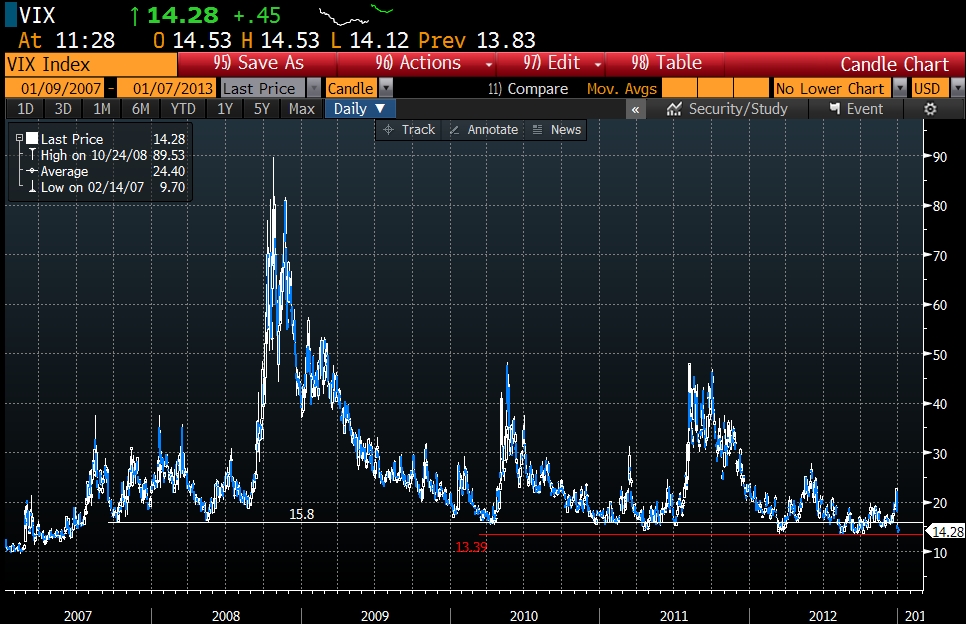
It is amazing what a new year and abundant investor liquidity can do.  Despite the tax increase that really does nothing material to balance the budget, the markets have sighed a major relief rally early in 2013.  One of the most striking results has been a significant decline in the VIX:

On Friday, the VIX hit an intra-day low of 13.64 which is a hair away from the multi-year low of 13.39.  This occured despite historic realized 10 day volatility of about 19%, 20 day volatility of 15.4% and 50 day volatility of about 14%.

With the debt ceiling debate coming to the forefront, I would imagine that a decline in the VIX from here is exceedingly unrealistic.

Posted in Markets.

Tagged with , , .


Noteworthy News – January 7, 2012

Economy:

The curious predictability of the payrolls report – Reuters

Growers and shrinkers – Economist

Monetary Rage – New York Times (Krugman)

Markets:

Japan bluefin tuna fetches record $1.7m – BBC

S&P 500 Rises to Highest Level Since 2007 on Jobs Data – Bloomberg

Gold Heads for Longest Run of Weekly Losses Since 2004 – Bloomberg

Politics:

The Stealth Tax Hike: Why the new $450,000 income threshold is a political fiction – Wall Street Journal

Wishful Thinking and Middle-Class Taxes – New York Times

Can a $1 Trillion Coin End Debt Ceiling Crisis? – CNN Money

McConnell Takes Taxes Off the Table in Debt Limit Discussion – Bloomberg


Banks:

Top Regulators Give Banks a Bit of Breathing Room – New York Times

Breaking Up Banks Is Easy When They Aren’t Failing – Bloomberg

Posted in Economics, Markets, Media, Politics.


Copyright © 2009-2013 SurlyTrader DISCLAIMER The commentary on this blog is not meant to be taken as an investment advice. The author is not a registered investment adviser. There is no substitute for your own due diligence. Please be aware that investing is inherently a risky business and if you chose to follow any of the advice on this site, then you are accepting the risks associated with that investment. The Author may have also taken positions in the stocks or investments that are being discussed and the author may change his position at any time without warning.

Yellow Pages for USA and Canada SurlyTrader - Blogged

ypblogs.com