Green Shoots! My favorite term…
That will be a 50% retracement from the bottom. Jump on board!
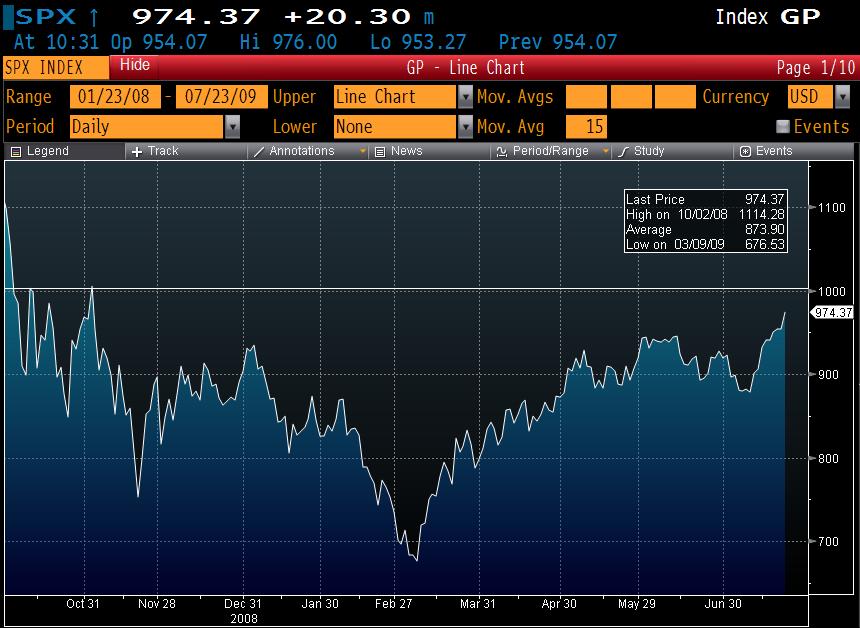
Rocketship!
A cynical look at our financial markets and the governments that support them
Green Shoots! My favorite term…
That will be a 50% retracement from the bottom. Jump on board!
Rocketship!
Posted in Markets.
Comments Off on 1000 Here We Come!
– July 23, 2009
Ron Paul may be viewed as zany by some, but he certainly does not mince words. Here is his opening statement to the Fed hearing yesterday on 7/21/2009.
Posted in Politics.
Comments Off on Ron Paul’s Opening Statement
– July 22, 2009
Bloomberg reports:
“CIT, the 101-year-old commercial lender struggling to retire
$1 billion of debt maturing next month, agreed to pay a 5 percent
fee to the creditors and annual interest of at least 13 percent.
On top of that, the New York-based company pledged assets worth
more than five times the amount of the loan as collateral.”
Obviously they are fighting for their survival, but this just seems ridiculous. A 5% fee along with interest of 13% backed by assets of a size 5 times the loan amount. Unless these assets are shaky (which I highly doubt) PIMCO and Centerbridge Partners are taking CIT to the cleaners. Blood in the water.
Where is the ethical line here? Shouldn’t the CIT board of directors say that such terms of a loan are not in the company’s or the shareholder’s best interest? Wouldn’t a bankruptcy filing be a better scenario than providing a risk-free loan with a 5% fee and 13% interest rate? The CEO Jeffrey Peek even stated that the loan does not solve the funding problems that CIT has.
Posted in Markets.
Comments Off on CIT Group, Continued…
– July 22, 2009
In 2002 Warren Buffett stated in his annual letter to Berkshire Hathaway shareholders that derivatives are “weapons of mass destruction”. Ever since then, the term has been utilized in the media ad nauseam. I cannot count the number of times I heard the statement “credit derivatives caused the credit crisis”. The “jump on the bandwagon” part of human nature can really get underneath my skin so I would like to rationally explain both sides of the story. I do believe that derivatives can cause massive damage to individuals and firms, but so can a lot of other financial instruments in widespread use when throwing caution to the wind.
I will not try to explain how all of the different derivatives work as that information would be best placed elsewhere, but a derivative is generally a contract that *derives* its price based upon the price of something else. This something else can be a grain such as wheat, a currency such as the yen, or a stock such as General electric. This contract can also make a reference to a basket of any of the above in complicated ways with equations that can greatly vary the outcome. That is not the important piece to fully understand, just know that derivatives can get as complex as a creator wants them to be. The other key to understand is that most derivatives involve large amounts of leverage. So instead of paying $100 to buy one share of xyz stock, put down $10 on a xyz futures contract which gives you the same economic outcome as putting the $100 in the first place. Obviously if xyz goes down by $20 and you only have $10 in total, then you are by definition bankrupt. This aspect scares a lot of people, but that is not really where the trouble comes from.
Now that we have an idea of what a derivative is, what are they actually used for? The original purpose for many derivative contracts was to hedge economic exposures within firms or investment portfolios. The classic example is that of a farmer. The soy bean farmer plants a crop with a certain set of expenses in May and will not yield the fruits of his labor until September. The problem for the farmer is that if the price of soybeans drops by September then he will not make as much money as he would like. The solution is to enter into a forward contract in May to lock in the price of his expected crop yield in September, thereby hedging his economic exposure to soybean prices and letting him sleep easy. Makes sense. So who is taking the other side of this contract? Generally speculators and/or investors who think that the price of soybeans is going to go up by September and want to go long at that forward price. There could also be a producer of soybean oil (using soybeans as his input) who is worried that soybean prices are going to rise and increase his cost of production. Therefore he would naturally want to hedge his exposure by going long soybean contracts. This is a simplistic example, but it shows the natural reason that one might want to use derivatives to hedge economic exposures or use the contract as an investment tool.
So the natural progression to this conversation is: “yeah, no one is questioning commodity futures – what about these nasty credit derivatives that destroyed the market?!” Credit derivatives also served a very natural purpose in the markets. JP Morgan Bank was the leader in developing credit derivatives and their reasoning was perfectly rational. JP Morgan Bank makes a lot of money by offering loans to businesses. The problem arose when JP Morgan felt that they had too much exposure to one particular credit. They did not want to necessarily tell the customer that they had to go to another bank because they did not believe in the customer’s credit worthiness enough to make another loan, so they thought about it and came up with the concept of a credit default swap. A credit default swap (CDS) is nothing more than an insurance policy on a company’s solvency. JP Morgan buys (goes long) a $20 million credit default swap on company ABC of which they have $40 million in loans outstanding. The seller of that $20 million credit default swap may be a bank or investor who would like to gain exposure to company ABC. JP Morgan agrees to pay the seller of the CDS 2% per year for this credit default swap. If the company defaults then the seller would pay for the full value of the loan ($20M) or the value of the loan minus an expected recovery value of the loan (many loans are backed by company assets and generally are worked out at about 40% of PAR for senior obligations). Might be a little confusing, but look at the diagrams below:

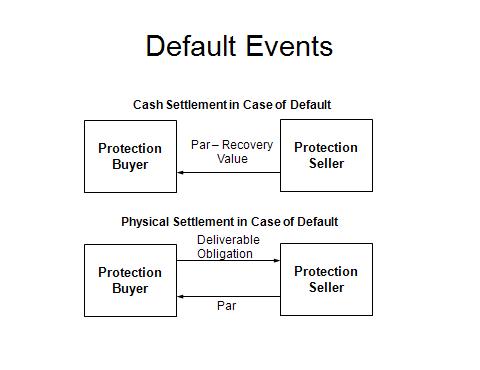
So you are thinking this does not sound so bad, JP Morgan gets rid of half of their economic exposure to ABC and the hedge fund or asset manager basically gets the credit component of a regular $20M bond. In fact, if the investor sold protection on ABC for a contract length of 5 years and then went out and purchased a $20M position in a 5 year government treasury security, then the investor would have synthetically replicated a 5 year bond on company ABC. Nifty.
The trouble did not come with regular credit default swaps, the trouble came when investment banks tried to be “creative” by “innovating”. The banks started creating what are referred to as Collateralized Debt Obligations or (CDO’s). The CDO’s were baskets of different instruments, sometimes just residential mortgages, sometimes baskets of credit card loans, sometimes CDS on specific companies, sometimes CDS on baskets of securities, sometimes a mixture of all of the above. It really did not matter, the problem arises in the complexity of the basket and the structure of the product. A CDO has what is referred to as “waterfall cashflows” which means the basket is split into different “tranches”. The different tranches take losses and receive cashflows in different order. The top tranche is considered the safest, the bottom (equity tranche) is considered the riskiest. Each one of these tranches was rated by a rating agency such as S&P, Fitch or Moody’s. The good ratings “AAA” on the top tranches allowed insurance companies, banks, and foreign central banks to invest in the top tranches of these CDO’s. Why did they want to invest in them? Because these “AAA” tranches paid higher yields than they could get on any other AAA security and therefore they could expect to make more money on their investments.
So where is the problem? The problem is that there is no “free lunch”. If you earn 12% on one investment and 3% on another you are taking on more risk in the 12% investment than the 3% investment. The risk can come in many different forms from large tail event loss of principle to larger swings in value, etc. Then why did the rating agencies give these tranches high quality ratings? For two reasons: 1) They were being paid by the investment banks to rate the tranches and 2) They really had a hard time measuring the risk in the products based upon the information available. Number 1 is fraud and it is unfortunate that there was not more action taken against the rating agencies for their actions as there was for Arthur Anderson and their involvement with Enron. Number 2 is more complicated. The structure of these products introduces a lot of needed assumptions as inputs. The first was to figure out what the probability of loss was on every security within the CDO. That might be easier to do with individual companies where you have annual financial statements available and generally decent transparency but it becomes incredibly difficult with a portfolio of residential mortgages where the mortgage broker received no verification of the applicants’ incomes and took their word for their ability to pay. So now we are left with a slew of loans for which we have no underlying credit information. ON top of that, we have been seeing housing prices increase and could never contemplate seeing a 10-30% drop in home prices and therefore will not build that assumption into the valuation model because it could never happen. ON top of that, how are all of these loans within this large complex basket related? What is the correlation between every single security within the basket? Just because people in California defaulted surely does not mean that people in New York are going to default…
And what happened when insurance companies and banks could not get enough yield from the regular CDO’s? The brokers lowered their standards to give mortgages to even more unqualified buyers and the banks created CDO’s of CDO’s (CDO^2) or CDO’s of CDO^2 (CDO^3) so that the insurance companies and banks could seemingly hit their 7% yield targets.
So how did this all start? The federal reserve was giving the economy and banks in particular cheap credit for a prolonged period as a *cure* to the internet bubble of 2000. This gave banks plenty of cheap money that they needed to lend out and lend out they did. Lend out and lend out and lend out until every consumer within the rolodex is filled to the brim.
So to recap:
So yes, derivatives can cause problems as we will see in part II, but the Credit Crisis was not caused by derivatives – it was caused by the same old culprits: stupidity greed, fraud, and an underlying lack of ethical standards.
Posted in Derivatives, Economics, Educational, Markets, Politics.
– July 21, 2009
Anyone else find these Bloomberg headlines comical? Cannot make August payment without successful tender, may have to seek bankruptcy protection, equity shares UP 6.4% when trading resumes….
“CIT had some awful news out this morning. The stock was halted right after the opening and once reopened it tanked almost 50%. But then a magical thing happened, the stock traded back to $1 from a lowof $0.75. What is so magical about $1? Any stock that trades under $1 is not eligible for a liquidty rebate from the exchanges/ecn’s. The cost to trade sub $1 stocks is FREE but you don’t get the rebate. Butif the stock gets over $1, the the liquidity rebates which could be as high as $.003/share kick in. So, it appears that the high frequency traders will be desperate to keep this stock above $1 today so they can keep collecting those rebates. There is no fundamental valuation for $1, it is simply a matter of high frequency economics. “
Posted in Markets.
Comments Off on CIT Group Saga Continues
– July 21, 2009

Buy the print book in color and get the Kindle version for free along with all examples in a spreadsheet tutorial!


