Skip to content


MOVE Index Versus the VIX

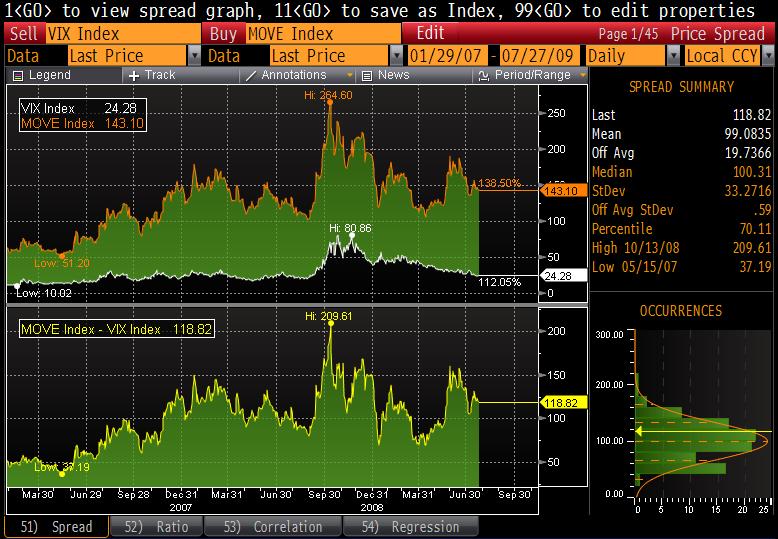
The Merrill lynch Option Volatility Estimate (MOVE) Index is a yield curve weighted index of the normalized implied volatility on 1-month Treasury options which are weighted on the 2, 5, 10, and 30 year contracts.   I am bringing this index up because its seems to me that there is a discrepancy between Treasury option volatility and Equity option volatility.  We have watched the VIX slowly grind down to pre-Lehman bankruptcy levels in a very methodical way whereas the implied volatility and realized volatility in the Treasury market has remained fairly elevated and the volatility of volatility has been quite large as well.  I have a general understanding of why the treasury market has been volatile – because concerns over inflation, deflation, and a massive rolling of Government debt has the market freaked out and they do not know which direction to expect.  Good news comes out and inflation fears spike, bad news comes out and treasury yields drop.  The moves have been dramatic in the treasury and swap markets.  What I do not understand is the equity market’s rather ambivalence towards the subject.  I would think that inflation or deflation fears should put the fear of god into the equity markets as well.  I am not suggesting that equities cannot rally, but at the very least the volatility of equities should take into consideration the fear of inflation or deflation.

The MOVE keeps on Moving

The MOVE keeps on Moving

Now let’s look at the correlation:

As further proof of decoupling, the correlation has gone negative for the first time since 2007

As further proof of decoupling, the correlation has gone negative for the first time since 2007

Posted in Markets.

Tagged with , , , , , .


Transparency in the CDS Market (part II)

In the first part of this post, I framed how CDS could be abused in the market by unethical investors.  It is questionable how often these devious plans have worked out or how widespread their fraudulent use has become, but it is pretty clear that it is occurring behind the scenes.  Insider trading is difficult to stop in the public markets on the major exchanges, but it is impossible to stop it in opaque derivatives markets between dealers and private investors/institutions.

A CDS contract by itself is not an evil instrument.  I would also argue that leveraged credit default swaps on single names, by themselves, do not cause a systemic risk for the financial system.  A credit default swap is nothing more than the credit risk of a corporate name.  The genesis of this market came about with the benign need from banks to hedge over-exposures to certain credit on their books.  The investors willing to take the other side of this transaction were investors who wanted corporate credit exposure from these same particular issuers.  A CDS seemed to work for both sides of the transaction: to hedge the exposure of those who did not want it and to efficiently provide credit exposure to those who did.  One might argue that these investors who wanted exposure to the credit should have simply invested in the bonds, but the truth is that some corporate names are difficult to gain exposure to because they do not issue debt often and/or the investors who own the debt are hesitant to part ways with it.  The CDS market provided a facility for investors to gain exposure to names that they otherwise could not invest in. It also provided an efficient facility for investors and speculators to short the credit of names they did not like, which is one key element of an efficient market with true price discovery.

A credit default swap market on individual names increases the transparency and liquidity of the fixed income markets in general.  You no longer have to wait for a cash security of a name to trade on the market, you could now infer the price of the bond based upon the price of the traded CDS.  The level of the CDS was chosen by market participants as there are two sides to every transaction.  If investor A is happy to sell GE credit risk at 200bps per year while investor A would like to short GE credit risk at 300 bps per year they can easily agree on 250bps as a transaction price.   Now we have better and more frequent information regarding the credit worthiness of companies trading in the CDS space.

So what would cause the whole CDS market to break down and stop working?  I think the key issues to address are:

  1. Transparency
  2. Collateral Management/Exposure Concentrations

When addressing transparency it is easy to see issues such as the one I presented in part I.  If market participants do not know the economic exposure of a certain player in the market, outright fraud and insider trading is permitted to occur.  There needs to be a watchdog that monitors the activity in the CDS market to ensure that certain players are not butchering companies and spreading rumors for their own benefit or making use of insider knowledge in a market that goes unmonitored.  Knowing positions also stops “runaway” markets in that one player can not seemingly drive a market in one direction.  If the player was known, then the other market participants would know that any move was driven by the one player and not underlying fundamentals.

Collateral management is a hallmark of derivatives exchanges.  The CME opened the day after October 19, 1987 without incident.  The key in establishing a stable market is to effectively manage the margins and collateral that should be posted by all participants.  The futures exchanges have been effective in managing positions by requiring daily mark to market, initial margin, and variation margin.  Right now, many hedge funds and institutions can have outstanding negative balances that are $50M and more between the institution and the investment bank before being required to post anything on a trade.  In addition, they can have potential exposures that far outstrip any capital that they could possibly raise in a distressed situation (LTCM).

Leverage is not a bad thing by itself, but as is always the case, it must be utilized prudently.  The lack of transparency never allowed the investment banks to figure out how leveraged AIG really was.  If you are sitting at the desk of merrill lynch and you bought $200M of protection on GM bonds, how do you know whether AIG sold another $1B to other assorted investment banks?  If AIG instead had to go to a central clearing house, then no one in their right mind would allow one firm to sell unlimited protection on corporate names because they would know that the agreements would be worthless; that AIG could never make all of the claims that it was promising.  The reality is that AIG was allowed to sell large quantities of protection and leverage its financial products company to a ridiculous level only because no one knew exactly how much AIG was selling except for AIG itself.

Now to a philosophical point – The purchase of debt protection through a CDS contract on GM is very similar to purchasing a very far out of the money put option on GM stock.  Most will not say that buying naked put options on a company is inherently wrong, so there is no fundamental reason that purchasing CDS on a company is wrong.  It is akin to saying that no one should be allowed to sell a stock that he/she does not own.  These rules could be put in place, but I think we would have even larger asset bubbles than we saw in 2000 and 2007.  If you are only allowed to buy debt, buy stocks, buy calls, sell cds protection…then prices tend to go up very easily…until things come crashing down again.  Be wary of throwing the baby out with the bathwater.

Posted in Derivatives, Educational, Markets, Media, Politics.

Tagged with , , , , , , , , , .


Spitzer: Federal Reserve is ‘a Ponzi scheme, an inside job’

Looks like Spitzer has finished hiding from the spotlight.  Spitzer argues for more oversight, maybe a regulatory body over the fed will actually get some traction this time around…

Posted in Media, Politics.

Tagged with , .


Transparency in the CDS Market

Of course the government goes to the extreme and is talking about “Banning ‘Naked’ Default Swaps“.  Let me first say that Barney Frank is a bloody idiot.  He kind of sounds like Elmer Fudd and his face makes you wonder just how corrupt our government is.

Credit Default Swaps are pretty simple instruments and I explained how they worked in “Financial Weapons of Mass Destruction and the Credit Crisis“.  The problem in the CDS market is also rather simple to solve, but the way in which the market has been manipulated is quite complex.  A credit default swap allows an investor to own a significant amount of a company’s debt, say General Electric, and hedge out all of the credit risk.  First you buy $100,000,000 of GE debt, then you call up an investment bank and purchase $100,000,000 of CDS protection on GE with a similar underlying bond and similar maturity.  Now you effectively own $100M of treasuries.  Nifty.  The complexity comes with the question: what if you buy $100M of GE debt, $500M of CDS protection on GE?  Now the investor has a negative economic interest in General Electric debt, but they still have their rights as a bondholder such as putting the bond back, demanding repayment upon the breaking of a covenant, negotiations in restructuring the debt, a seat in bankruptcy court etc.

Let’s take this one massive step further.  What would happen if you bought bonds, bought a ton of CDS protection, bought a bunch of stock, and sold a ton of equity forwards.  Whoa, that’s a lot of transactions…let’s break that out:

  1. Buy $3B CIT Group Bonds
  2. Buy $6B CIT Group CDS
  3. Buy $1B CIT Group Stock
  4. Sell $2B CIT Group Equity Forwards

Let’s pick a point in time that this transaction could have occurred (but more reasonably it would be built up over time).  Let’s just say it happened January 1, 2008.  Five year CDS was trading at 383bps or 3.83% per year.  The stock was trading at 23.84 meaning the market cap was about $9.3B at the time.  So what we are saying is that Investor X has bought $3B in CIT bonds but overhedged that position and bought an 11% stake in CIT’s stock but overhedged that position as well.  This means that Investor X has a negative economic exposure to CIT’s stocks and bonds, but a powerful say in how the company is managed.  This idea was really brought to light by Henry Hu’s research paper “Debt, Equity, and Hybrid Decoupling: Governance and Systemic Risk Implications“.

How many companies have actually been brought to their knees by predators using derivatives to overhedge long positions?  Could it be possible that Goldman had a $3B revolving loan facility but overhedged that position and actually would benefit from a CIT bankruptcy?

Posted in Conspiracy, Derivatives, Educational, Markets, Media, Politics.

Tagged with , , , , , , , , , .


Picking up Nickels in front of a Steamroller

Being an option seller is all about volatility arbitrage.  If you sell options naked, then you hope that over time realized volatility is less than implied volatility.  Realized volatility is the path that the underlying stock, index, commodity etc. took between the time that you sold the option and the time that the option expired.  Implied volatility is the volatility that was implied by the option price at the time that you sold the option.  If you perfectly delta hedge the option on a daily basis, then at maturity the difference between what you were paid when you sold the option and what you had left when the option expired is mostly attributable to the difference between implied volatility and realized volatility.

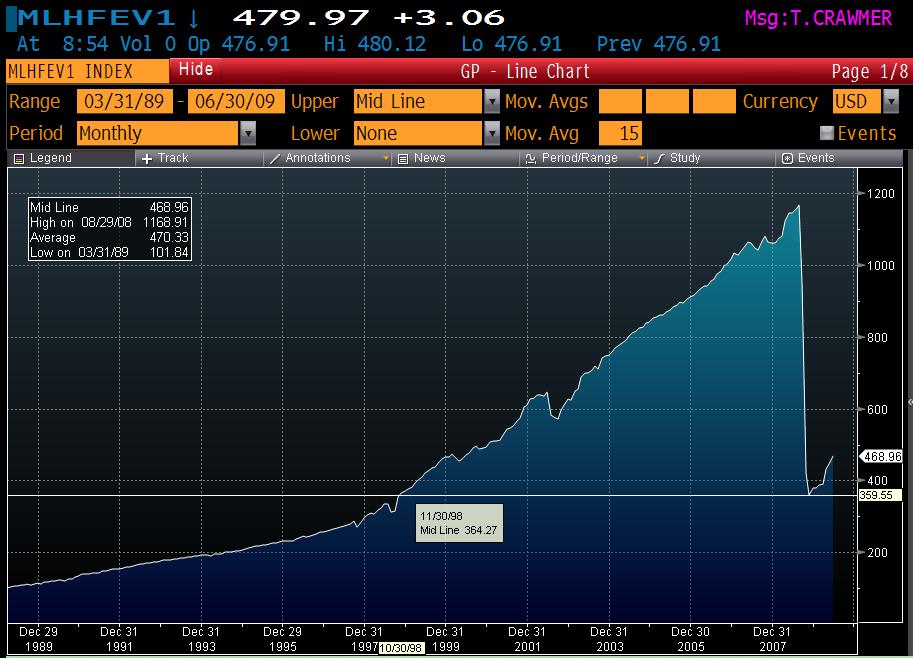
There are many individuals who consider option selling as “picking up nickels in front of a steamroller”.  You collect a steady small profit most of the time, but every once in a while you get walloped by roaring realized volatility.  That has been the big argument from academics such as Nassim Taleb in Black Swan or Fooled by Randomness.  I will say that I agree, options are not always priced correctly, but later I will add some additional color.  Back in 2007 and spring of 2008 the options market did not appreciate the volatility risk going into the fall of 2008 and it caused massive losses for those who were selling options and delta hedging.  Below is the Merrill Lynch Equity Volatility Arbitrage Index which seeks to generate absolute returns by arbitraging the spread between S&P 500 market implied volatility and subsequent realized volatility.
VolArbitrage

Look out BELOW!!!

So the volatility arbitrage index lost 85% between the end of August 2008 and November 20, 2008.  That is a HUGE loss.  One which most investors would not want to be in front of.  On the other side of the equation let’s look at the S&P 500 over the same time period:
Looks like a Camel

Looks like a Camel

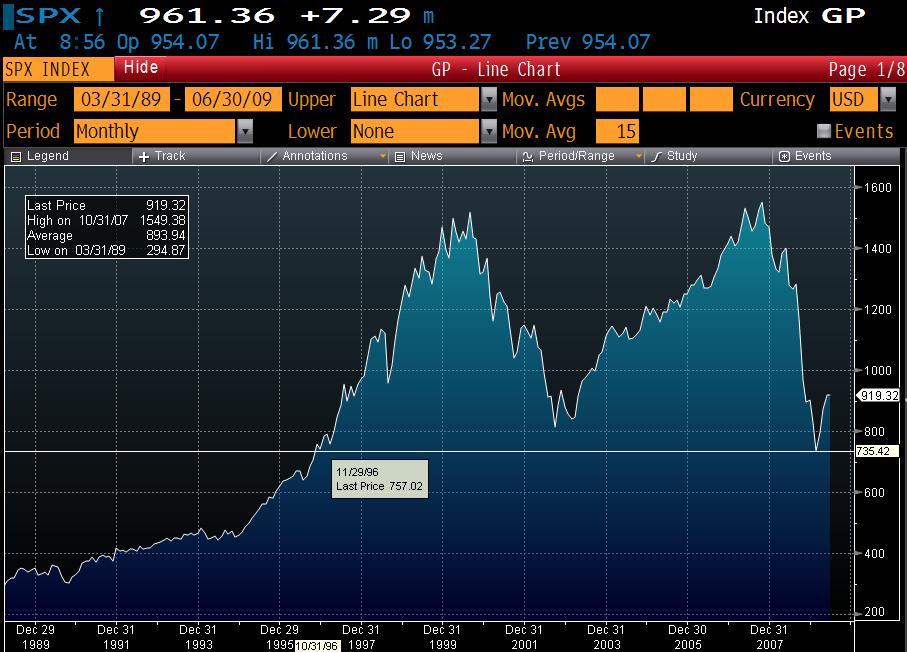
The S&P 500 lost about 53% between May 19, 2008 and March 9, 2009.  A smaller loss over a much longer time period.  Sometimes I would just prefer to take my lumps right away…and that leads me to the point of this article, that yes, volatility hits can be brutal when you stand stubbornly in front of the market but when times are decent volatility arbitrage can be a very rewarding game.

I will make the statement that *most of the time* implied volatility is overpriced.  This means that there is more demand for options than there is supply.  Where does this implied volatility demand come from?  Mostly from institutional buyers.  One set of natural buyers are pension funds, endowments, insurance companies and even high net-worth individuals who are afraid of downside risk.  They might see some instability in the market and want to hedge their equity exposure while maintaining a long position so they go out and buy Put options on equities.  Another (more recently emerged) huge player in the option buying arena are insurance companies.  Life insurance companies have sold massive amounts of variable annuities and equity indexed annuities to individual policyholders that has left the insurance companies with massive unhedged short positions in long-dated puts or call options.  The insurance companies generally do not want to hold that position so many go out into the market and buy options from investment banks to cover potential losses.

Now let’s look at the opposite side of this market…who is a natural seller of options?  Market makers and investment banks?  Maybe hedge funds provide a decent market and I know that even Warren Buffett was a seller back in 2007 before he decided that it was a bad idea…  My general argument is that there are not enough natural sellers of options to absorb the natural demand and for that reason there is an excess risk premium for selling options over time.

So if that is the case, then shouldn’t everyone be selling options?  A simple answer would be yes, but then the risk premium would go away.  I believe that the potential loss of 85% or losses of 500% or more on naked positions has deterred many investors from pursuing this strategy.  Options have leverage and they are fairly complicated.  Options can be over priced or under priced and there are hundreds of different markets to choose from which makes the choice all the more difficult.

Let us go back to the volatility arbitrage index.  The index fell from its lofty 1169 to a low that took it back to November 1998.  From March 1989 to its peak in August 2008, the index had climbed over 1,000%.  Now let’s turn to the S&P 500: from its peak in October 2007 the index fell to a level not seen since November 1996.  In addition, the S&P had climbed just over 425% from 1989 with a tremendous amount more volatility.

Given the two paths, I would choose volatility arbitrage over straight long equities if I were to relive the 20 year period between 1989 and 2009.  We can only speculate what the future will hold, but my money is still on volatility.  I think this last volatility spike has taken out a lot of volatility sellers and it might be better now than it ever has been.  The key is to know when the tide is turning, don’t be the last guy trying to get the last nickel in front of the steamroller.  There will always be a market tomorrow.
Posted in Derivatives, Educational, Markets, Trading Ideas.

Tagged with , , , , , , , .


Copyright © 2009-2013 SurlyTrader DISCLAIMER The commentary on this blog is not meant to be taken as an investment advice. The author is not a registered investment adviser. There is no substitute for your own due diligence. Please be aware that investing is inherently a risky business and if you chose to follow any of the advice on this site, then you are accepting the risks associated with that investment. The Author may have also taken positions in the stocks or investments that are being discussed and the author may change his position at any time without warning.

Yellow Pages for USA and Canada SurlyTrader - Blogged

ypblogs.com