Skip to content


Goldman Sachs: Masters of the Trading Universe

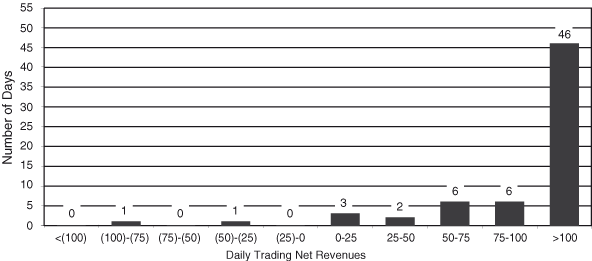
This would be comical if it was not so frightening.  Goldman Sachs had 46 trading days in the 2nd quarter where they earned more than $100M.  That is, 70% of the time Goldman made over $100M from trading activity.  How many days did they lose over $100M?  Zero.

46 Rockstar days, zero terrible days

46 Rockstar days, zero terrible days

Not only did Goldman knock the cover off the ball as far as “trading”, but their VaR remained fairly flat at about $230M.

Wonder if they have a random number generator with mean reversion?

Wonder if they have a random number generator with mean reversion?

What’s my point here?  It is absolutely impossible to have 2/65 negative trading days or lose just 3% of the time in the markets It is also absolutely impossible to have 46 $100M+ days and not have a comparable number of -$100M days. What is so absolutely mind-blowing is that Goldman is selling this as if it’s just a testament to their superior abilities.  This is all impossible without front-running activity in the high-frequency arena, insider trading, gouging of clients or all of the above.  Goldman wonders why they have developed negative attitudes from the public?

Posted in Conspiracy, Derivatives, Markets.

Tagged with , , , , , , .


House Prices and Interest Rates

One thing that I believe has been glossed over in the media are the rising mortgage rates.  As mortgage rates rise, the affordability of homes goes down.  That’s a pretty simple concept.  Just how far mortgage rates increase is critical because a 6.5% mortgage versus a 5% mortgage make a dramatic difference in an investors interest in a home as a rental property.  The May Case-Shiller number was better than expected even on a seasonally adjusted basis, but home prices are still declining.  Since that time, mortgage rates have increased even further and it will be interesting to see if that, combined with coming out of the home-buying season will put further pressure on house prices.  Another important thing to consider is this: a lot of the foreclosures are being bought by “investors” who want to rent out the properties until the property value recovers.  What happens if those investors are bitten by a further decline in house prices and falling rents?  Are those same investors going to come back to the market next year to try it again with 6-7% mortgage rates? Not to mention with 10% unemployment it will be fun to try to collect rents when they run out of unemployment aid.

The fed has done everything in their power to keep long term interest rates low, but it seems that they are losing their grip.

The fed has done everything in their power to keep long term interest rates low, but it seems that they are losing their grip.

Posted in Markets, Media.

Tagged with , , , .


The Reality of Cash for Clunkers

Unfortunately, $1 Billion is thrown around with such negligence that the cash for clunkers program doesn’t even make the average tax-payer bat an eye.  I had previously disclosed the details on this program in a previous post and the reason I did that was because it is a good deal for those who want a new car but are sitting on an old jalopy – pure and simple.  That does not mean that I agree with the program.  I just merely feel that we need to work to the best of our abilities with the cards that we are dealt while critiquing those who are making massive fiscal errors.

What is cash for clunkers for?  The naive response from the preliminary proponents would be: “it helps individuals, it helps automakers, and it’s good for the environment because it gets crappy cars off the road!”  I call BS on all of it.  Cash for clunkers is a subsidy for the automakers which also perversely helps out the middle and upper class who can afford a new car and happen to have an insured jalopy or a jalopy that a teenager is driving.  It would be interesting to see the actual statistics, but I would venture a guess that the majority of this $1B (now being considered for $3B total) is not going to the lower working class individual because I bet A) he probably has more things to worry about besides getting a new car and B) even if he did want a new car, he wouldn’t be able to scrape together the cash or get a bank loan to purchase it.

Since this program is supposed to be so helpful to the environment, each “clunker” turned in is destroyed.  The engine is seized by running some silica and other dastardly things in the engine until it freezes up – all so that these gas guzzlers never touch the pavement again.  What if you took these cars and gave them to those below poverty?  Wouldn’t that give them more job opportunities if they were able to travel to a work site?  What about giving these clunkers to impoverished countries?  These clunkers are not going to fix the world’s emission problems and it seems like a really silly place to start.  Let’s work on shutting down some dirty (non-scrubbing) coal power plants and open up a few nuclear plants?

Let’s just see how many cars sell once the cash for clunkers program ends.  I just hope that the automakers are not stupid enough to start producing more cars because they see a spark in demand.   I would just like congress to ask the 37 million Americans (children included) who are living below the poverty line if they would rather have the $3B disbursed to them in cash ($80 per head).  I think I know the answer.

Posted in Media, Politics.

Tagged with , , , , .


“Policy Outlays and Revenues”

I have been sifting through government data (which is much akin to having teeth pulled) and have found some interesting statistics.  I also greatly appreciate the humorous optimism that seems to pervade the budgetary process.  Does anyone out there expect his/her income to increase by 8% next year, another 15% in 2011 and a further 15% in 2012?  I didn’t think so.  The only comparable downdrafts to the projection in declining tax receipts of -15% in 2009 were 1946 at -13%(probably do not need as much money when you are not fighting a world war) and -23% in 1931 and -38% in 1932 (50% decline in tax revenue over two years..ouch!).  What makes us think that after a 15% projected slide in revenue we are going to see a big jump in 2010?
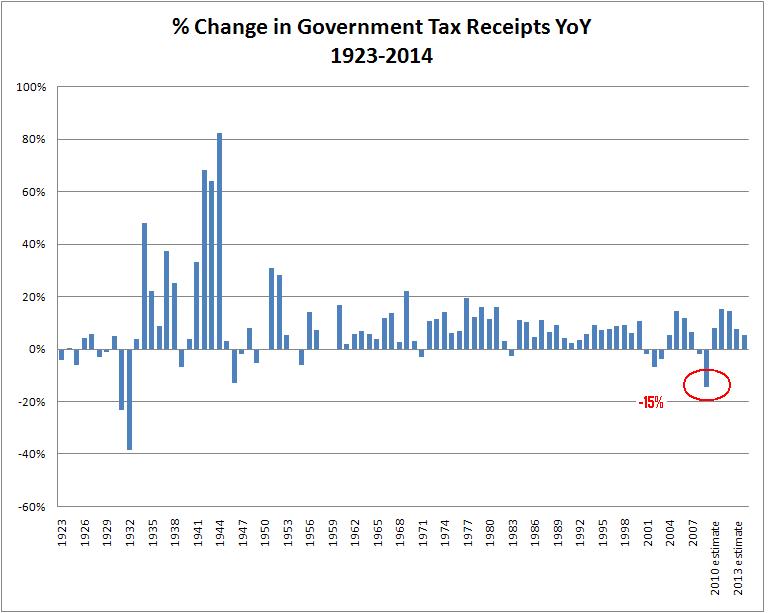
15% projected decline in receipts for 2009

15% projected decline in receipts for 2009

What other goodies can we find in the Office of Management and Budget….  What about where the “outlays” are going? When looking at it from a % of total outlays perspective it’s interesting to see who is getting most of the kitty.  I am not a huge proponent of foreign wars or massive military, but I often see the need.  One can argue that the military reaches an economies of scale whereby any additional military expenditure is a waste (if you can destroy Iran, do you really need to be able to destroy it twice or three times?).  So as GDP grows you would expect the amount spent on military and defense to not keep pace with the overall economy.  Shouldn’t that statement also hold true for the treasury?  Why have they outpaced military growth by so much?

Treasury grabbing more and more

Treasury grabbing more and more

Since we are only covering about 40% of current government expenses, where does the rest of it go?  To the two other biggest budgetary problems, which when combined with the treasury and military account for 81% of all government outlays: Health and Social Security.

These two are going to hit exponential curves pretty soon

These two are going to hit exponential curves pretty soon

And what about the bigger picture?  Well, the gap between surplus and receipts is at its widest since World War II:

A gap of nearly 13%, do they really think that is going to come screaming in?!

A gap of nearly 13%, do they really think that is going to come screaming in?!

And lastly, how is the hole being plugged?  Debt my friend.  And how will the hole supposedly be plugged in the future?  You, my friend and fellow citizen(also more debt, but who is counting?):
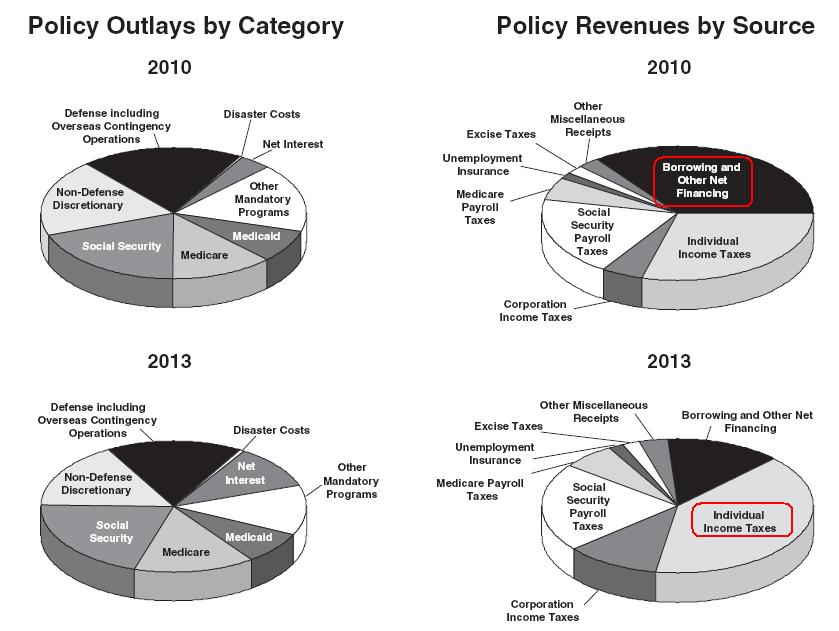
At least they had the sense to color the debt black to represent the true black hole that it is!

At least they had the sense to color the debt black to represent the true black hole that it is!

More to come later…
Posted in Media, Politics.

Tagged with , , , , , , .


Genetically Modified for Your Benefit!

There is an enlightening article in the August issue of Scientific American that discusses the “rights” of agritech companies such as Monsanto, Pioneer and Syngenta.   In order to purchase genetically modified seeds, a customer must sign an agreement which forbids the buyer from doing any independent research.  This means that scientists cannot test these genetically modified seeds to see whether the genetically modified crops cause harm to the environment or the animals and humans which they feed.  In fact, the only research pieces on these genetically modified crops that see the light of day are the ones that paint a positive picture of the product and are blessed by the agritech company itself; all else is blocked from research publications.

The corruption that causes a massive black hole such as the agritech intellectual property “rights” is mind-blowing.  Intellectual property protected by patents is meant for one thing only: to allow those who spent time and effort in developing a new technology the ability to recoup expenses and make a profit off of their labor.  In fact, as soon as a patent is issued the technology generally becomes public knowledge as the patent with a detailed description of the invention now resides in the public domain.  The only reasons that an agritech company would want to have their level of smothering rights over their genetically modified crops is because A) their invention is weak and could easily be mimicked or surpassed with subtle tweaks and/or B) they want to hide any negative effects caused by genetically modified crops.  It’s probably a smattering of both.

In a more insidious “Pinky and the Brain” sort of way, doesn’t the company who controls the world’s food supply effectively control the world?

Posted in Conspiracy, Educational, Media, Politics.

Tagged with , , , , , , .


Copyright © 2009-2013 SurlyTrader DISCLAIMER The commentary on this blog is not meant to be taken as an investment advice. The author is not a registered investment adviser. There is no substitute for your own due diligence. Please be aware that investing is inherently a risky business and if you chose to follow any of the advice on this site, then you are accepting the risks associated with that investment. The Author may have also taken positions in the stocks or investments that are being discussed and the author may change his position at any time without warning.

Yellow Pages for USA and Canada SurlyTrader - Blogged

ypblogs.com