Skip to content


Value Meal Index

The Economist Magazine’s “Hamburger Standard Big Mac Index” tries to compare the value of world currencies with a simple, yet accurate standard.  They compare prices of a McDonald’s hamburger or value meal in different countries around the world.  Since McDonald’s is truly global and has become efficient enough to cut the cost of distributing and managing its stores around the world, McDonald’s serves as a good laboratory for comparing the price of simple goods on a global scale.  The value meal index release on July 16th, 2009 shows that China, Hong Kong, and Malaysia all have currencies that need to increase by about 50% versus the dollar.  All of these countries are focusing on exporting to foreign countries with a particular emphasis on the United States.  It shows just how much these countries have kept their currencies low in order to pump up the demand for their exports.  It also shows just how hand tied China is in buying treasuries.  If China cannot keep its export engine humming now, just imagine what would happen if the price of all of their goods increased by 30-50%…

Asia Pegged to the Dollar
Asia Pegged to the Dollar

Posted in Economics, Markets.

Tagged with , , , , .


States Facing Bankruptcy

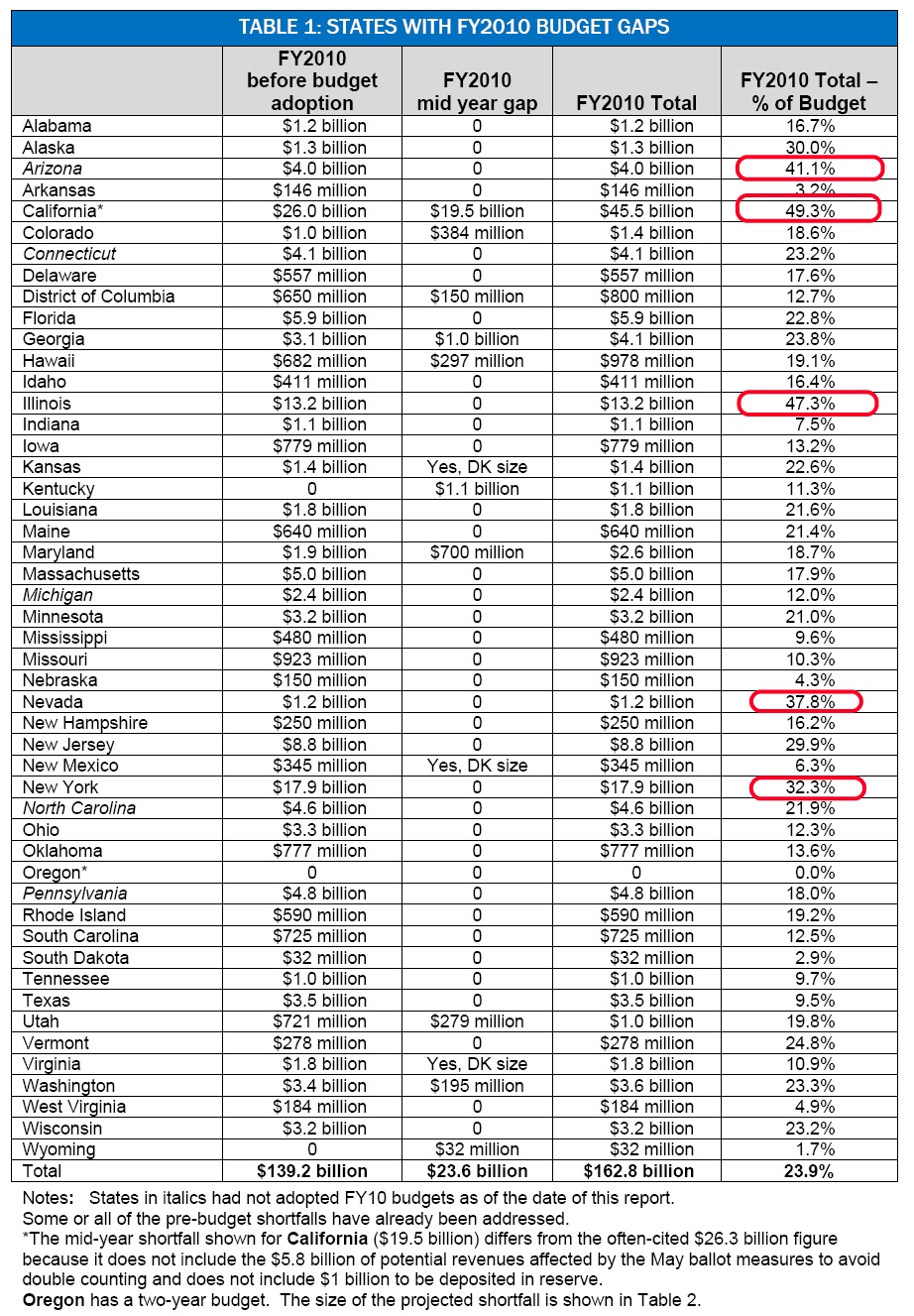
We had previously discussed the problems facing the US Government in handling its budget deficits, but what about the states?  The states are reliant on two things: 1) the receipts of their taxpayers and 2) help from the US Government.  The US Government has a nice little tool in its tool-belt: the ability to print money…something that California and Schwarzenegger are entirely jealous of.  The Center on Budget and Policy Priorities released a piece titled “New Fiscal Year Brings No Relief From Unprecedented State Budget Problems“.  A few of the juicy details:

  • At least 48 states have addressed or still face shortfalls in their budgets for fiscal year 2010.
  • At least 33 states already anticipate deficits for 2011. Initial estimates of these shortfalls total almost $51 billion. As the full extent of 2011 deficits become known, shortfalls are likely to equal $160 to $180 billion.
  • Combined budget gaps for the next two years — state fiscal years 2010 and 2011 — are estimated to total at least $350 billion.

Best of luck to the taxpayers in Arizona, California, New York, Nevada, & Illinois.  Not many are far behind, but the deficits in these states can only mean much higher state taxes.  That should be great for unemployment and job growth…

I hear a tax bill being written...

I hear a tax bill being written...

Posted in Economics, Politics.

Tagged with , .


Volatility Selling Strategies

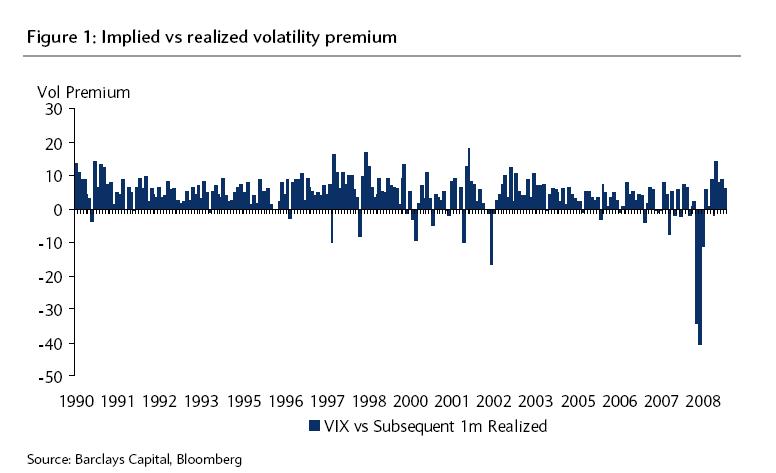
Volatility selling strategies have performed better than one would expect through the 2008 tsunami.  These strategies relate well to my previous article “Picking up Nickels in front of a Steam Roller“.  The first point that they make is that up until 2008, the markets since 1990 have been relatively calm and there has been a consistent option premium that has rewarded option sellers via a positive gap between option implied volatility and actual realized volatility.

Mostly positive until 2008

Mostly positive until 2008

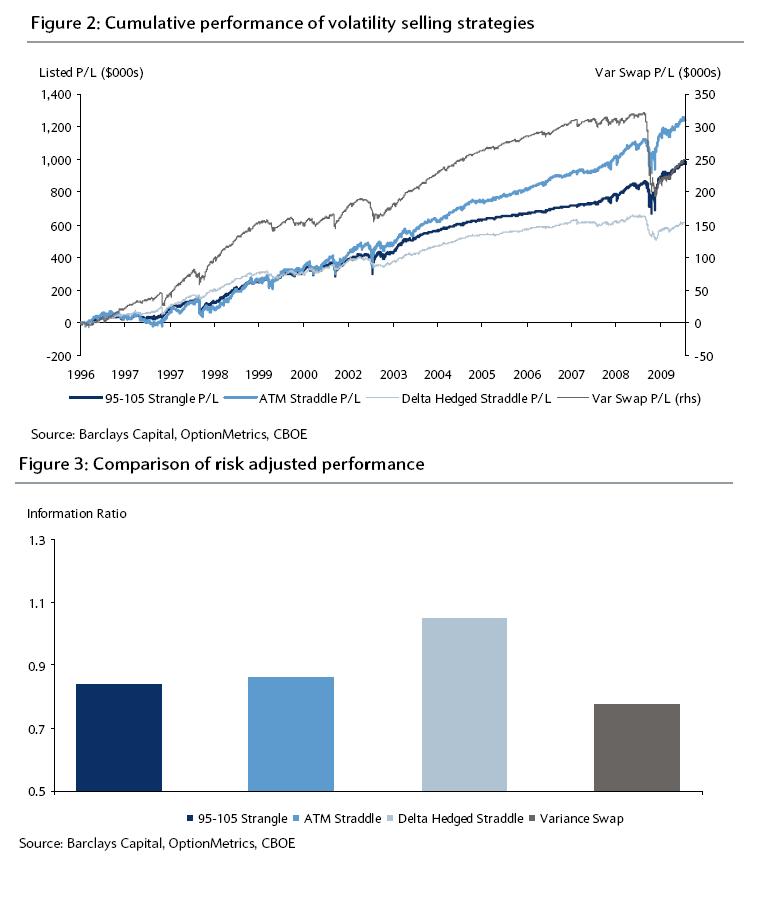
The second part of the piece focused on the relative performance of different volatility strategies.  They explored a 95-105 strangle (sell 5% out of the money put and 5% out of the money call), ATM Straddle (sell a put and a call at the money), Delta Hedged Straddle (sell ATM Straddle and delta hedge the straddle daily), and a recently popular Variance swap which basically pays the difference between realized and implied volatility based upon the swaps terms.

Variance Swaps - Ouch!

Variance Swaps - Ouch!

The first thing that stands out is that a delta hedged strategy has the highest information ratio, just think of this as the return per unit risk (standard deviation).  The second most notable issues is the face that the variance swap wiped out over 5 years of gains due to 2008.   The main reason for this was the incorrect pricing of the convexity premium in the variance swap, which is a fancy way of saying that the distribution of volatility was much more fat tailed than expected.  On the opposite side I was very surprised by the outcome from a Naked ATM Straddle.  Its rebound from the hits it took during the end of 2008 was very fast due to the mean reversion type returns of the S&P 500.  In the past I had been leaning towards a 95-105 strategy, but this certainly adds some validity to the ATM strategy for those who are willing to take the added volatility of returns.

Posted in Derivatives, Markets, Trading Ideas.

Tagged with , , , .


Baltic Dry Index Continues to Slump

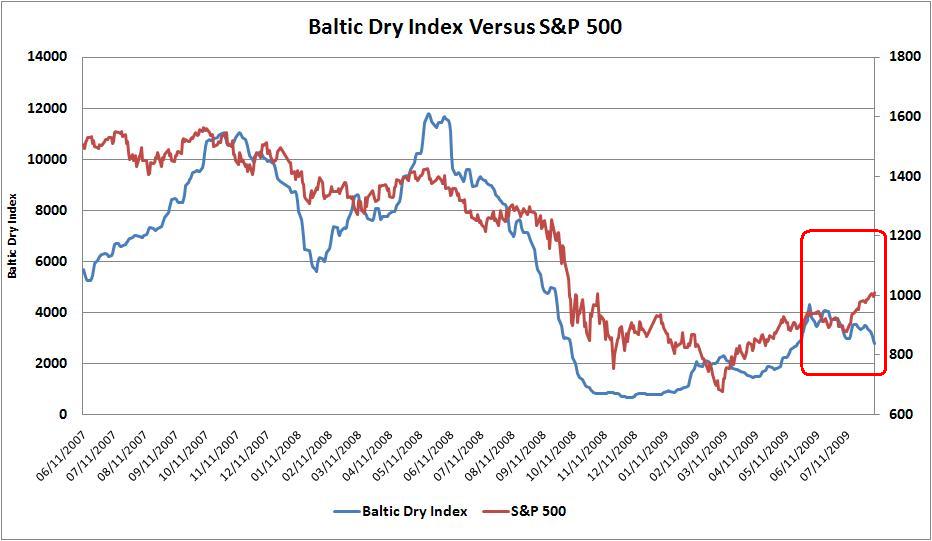
The Baltic Dry Index measures the shipping cost of a group of commodities (a lot of which go to China).  The index is often used as a barometer for global trade as it shows the demand for raw materials.  Since the commodities themselves are usually inputs for the production of finished goods, the dry index is often viewed as a leading indicator for the global economy.  It’s interesting to note that the baltic dry index is off 35% since it peaked at the beginning of June.  Within the last few weeks you can see a sharp divergence from the Baltic Dry Index and the S&P 500.  Last week’s drop of 17% was the worst performance for the Baltic Dry Index since October of 2008.

Baltic Down, S&P UP?

Baltic Down, S&P UP?

Posted in Economics, Markets.

Tagged with , , , , , .


Bear Market Rallies

Just how strong can a bear market rally be?  The great thing about the financial markets is that there is no lack of data.  You can find correlations between the temperature in Zimbabwe and the price of corn in the midwest.  One thing I always found amusing was that the DAX would jump up a few points whenever Germany scored a goal in a big soccer match.

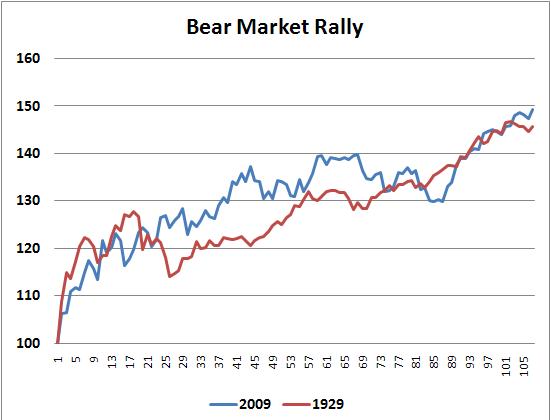
Anyway, there is an interesting comparison between this 50% run-up in 2009 and another similar bear market rally after the first part of the 1929 crash.  105 days in and a correlation of .82.  You draw your own conclusions.

Just another Bear Market Rally?

Just another Bear Market Rally?

During 1929, after a 45% correction in the S&P 500 the market rallied 47% before continuing its slide downward to an abysmal 86% loss.

Posted in Markets.

Tagged with .


Copyright © 2009-2013 SurlyTrader DISCLAIMER The commentary on this blog is not meant to be taken as an investment advice. The author is not a registered investment adviser. There is no substitute for your own due diligence. Please be aware that investing is inherently a risky business and if you chose to follow any of the advice on this site, then you are accepting the risks associated with that investment. The Author may have also taken positions in the stocks or investments that are being discussed and the author may change his position at any time without warning.

Yellow Pages for USA and Canada SurlyTrader - Blogged

ypblogs.com