Skip to content


Demographics

The Social Security Act was put in place in 1935.  At that time, less than 8% of the population was over the age of 65 and the typical 65 year old could expect to live 12 more years.  Today, over 12% of the population is over 65 and today’s typical 65 year old can expect to live over 18 more years.  By 2050 nearly 20% of the population will be over 65 years old.

By looking at the demographic data as given by the US Census, it is very easy to see why there are such large budget deficits ahead due to health care and social security benefits.  These are the two gorillas on the US Government’s balance sheet.

Babies being replaced by old babies.

Babies being replaced by old babies.

Now I can split my time between working for the government and working for my adopted grandparent!

Now I can split my time between working for the government and working for my adopted grandparent!

The fix is rather simple if the greed within the system was ever stifled.  As average longevity increases, benefits should decline in lockstep.  The government should have adjusted the program’s qualifying retirement age to make sure that the program covered less than 10% of the population.  The propagated fallacy is that since people in the past have paid into the system during their whole careers they feel that they should get the same benefits as their parents.  Fine, then we will just have to euthanize you at the average age of death 50 years ago…  Tit for tat.

In addition, the chart below shows just how expensive old people are…
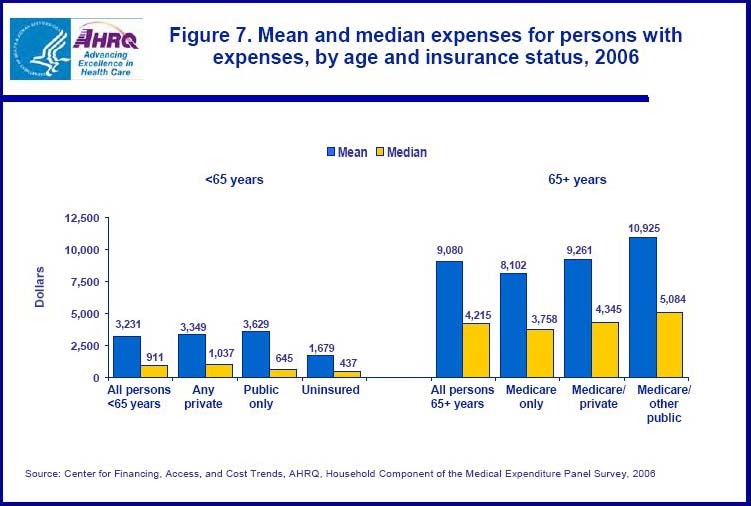
Health expenses explode after age 65.
Health expenses explode after age 65.
Posted in Economics, Politics.

Tagged with , , , .


China Leading US Lower?

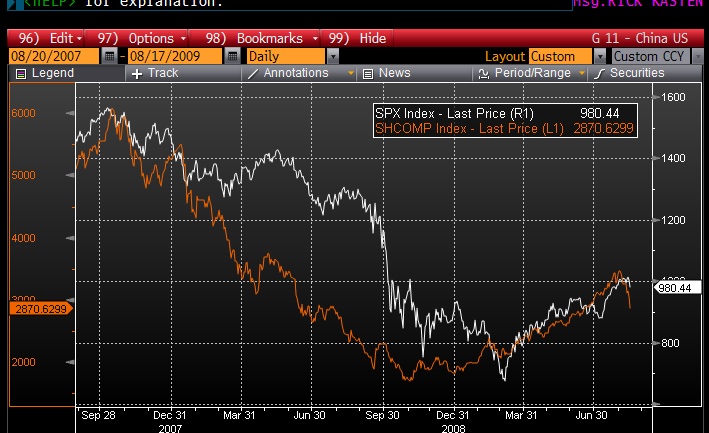
Asian markets were off well over 3% last night in a continuation of the downward trend.  The Shanhai Composite is off over 17% from its high on August 4th.  It is important to note that China led us in its decline during 2007 and it was the first to recover in late 2008.

ChinaUS

China leading the world lower?

Posted in Markets, Trading Ideas.

Tagged with .


Lehman Carcass

Bankruptcy is akin to having your organs harvested by a bunch of black market organ dealers.  There was a breakdown of the bankruptcy legal fees for Lehman Brothers in the Wall-Street Journal:

“Weil, Lehman’s main law firm, earned $49.63 million for the period from Lehman’s Sept. 15, 2008 filing date to the end of January, according to the judge’s order filed late Thursday. That compares with requested total fees for September-January of $55.14 million, when including the 10% held back by the court.

The awarded fees amount to about $357,000 a day for Weil, or nearly $15,000 an hour. For that, Miller helped the fallen financial giant unload most of its deteriorating assets to Barclays in a matter of days, one of the speediest bankruptcy deals on record.”

We all know that bankruptcy provides the vultures of the legal world with a rotting carcass to pick at, but I find the Lehman case even more egregious.  The sale of all of Lehman’s good assets which include its brand, its people, its intellectual property to Barclays for a measly $250M outrageous (Barclayspaid $2.5B for the buildings and data centers).    The one thing that I have learned over this financial crisis is that any “deal” or “transaction” that happens quickly is lined with shady and unethical practices.  The Bear Stearns overnight pillage, Wamu being handed to JP Morgan, Wachovia handed to Wells Fargo, Lehman handed to Barclays…etc.  And to add icing to the mud cake that was served to the stakeholders of Lehman: lawfirm Weil was rewarded for its speedy work.  I wonder if Barclays paid Weil on the sidelines as well…

What is the dire rush anyway?

Posted in Conspiracy, Politics.

Tagged with , , , .


Continued Pressure on the Consumer

We have quickly been led out of many past recessions through the strength of the American Consumer.   Neglecting temporary boosts from government sponsored cash for clunkers programs, I do not believe that is going to be the case this time.  Following the greatest personal wealth destruction since the great depression we have massive required deleveraging of households alongside the onslaught of baby boomer retirement which can only lead to higher personal savings rates.   Walmart just came out with earnings and their EPS slightly beat estimates, but only by slashing inventory 6%.  If people are not buying at Walmart, where are they buying?  Retail sales less Autos came in today at -.6% for July versus a forecast of a .1% increase.  Apparently nowhere.

After decades of declining savings and increasing debt loads, where can we go but up?

After decades of declining savings and increasing debt loads, where can we go but up?

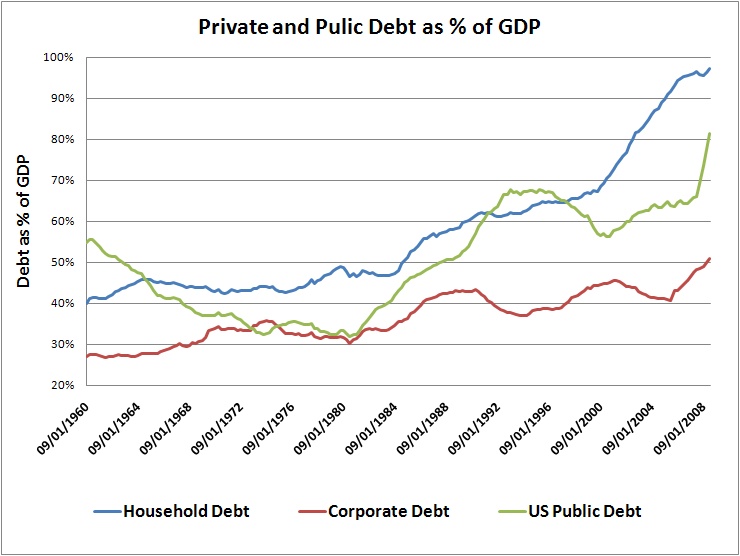
How can 10% unemployment, 100% household debt-to-GDP, and retiring baby boomers with massive underfunding of retirement liabilities lead to anything but an increase in personal savings and slowdown in sales?

The only possible ways to spark consumer demand is to 1) increase consumer lending from banks or 2) decrease unemployment significantly and increase overall income.

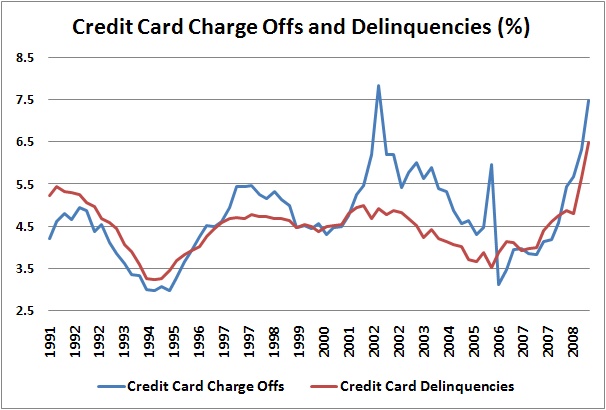
The bad news is that banks continue to take it on the chin and only pictures can tell the story:

Credit Card Metrics continue to get worse

Credit Card Metrics continue to get worse

Case Shiller may have suggested that house price declines slowed a few months ago, but it will be interesting to see what happened after may

Case Shiller may have suggested that house price declines slowed a few months ago, but it will be interesting to see what happened after May

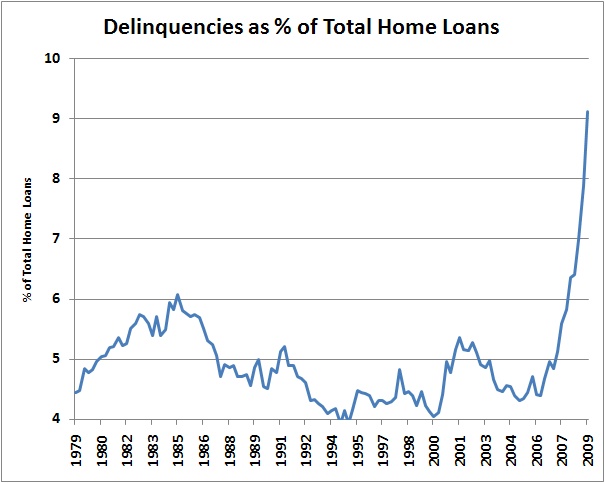
Lastly: foreclosures are high now, but judged on the trend in mortgage delinquencies they have further to go

Lastly: foreclosures are high now, but judged on the trend in mortgage delinquencies they have further to go

What this says to me is that the banks are in no condition to lend to the consumer anytime soon and rightfully so.  That leads to the last solution: create jobs and increase income. Our service based free-market economy is in no condition to increase employment in the near future, but our congressmen are more than happy to dump another few $750B stimulus plans into the system to grab a re-election. This will most likely be the medicine that the government tries to give the economy via government produced jobs.  Those who are unemployed can still vote (and have plenty of time to do so), and it is likely that the 2010 election cycle will produce a massive, clamoring political body that will try to garner votes by addressing the unhappy unemployed.

This could actually speed up a recovery, but at the cost of higher taxes and inflation in the future.

Posted in Economics, Markets, Politics.

Tagged with , , , , , .


Summary of Current Environment

I have gotten some feedback from many individuals about the negative attitude that I have towards the markets, in particular the equity markets going forward.  I do not want to be viewed as a perma-bear or a consistently negative person.  My main reason for having a blog is to try to relay what I see in the markets in the easiest terms possible while being open to conversation and debate.  I had previously addressed the reasons for the credit crisis in the post “Financial Weapons of Mass Destruction and the Credit Crisis“, but let’s just summarize where we are NOW.

So no matter what the stock market is doing, what truly matters?  What should we be focused on: Economic growth, low tax rates, low unemployment, manageable debt burdens, low inflation, high innovation, strong property and IP rights.

Now let’s focus on what has derailed:

Increases in GDP have come not from true economic growth, but a growing debt burden

Increases in GDP have come not from true economic growth, but a growing debt burden

Debt has skyrocketed in the public and private arena since the 1980’s.  The growth in debt has been fueled by the US dollar being the world reserve currency which has allowed the government and private individuals to borrow their way to prosperity.  The growth in household debt to propagate a consumer culture and import society has been the most spectacular.  This is unsustainable.  Whether we are able to keep this ball rolling for another few years is immaterial.  The fact is that whether slowly or quickly, the whole thing needs to be corrected.  This could be through years of slow growth and depreciating assets or a quick collapse of the dollar and effective default on debts(maybe even through equitizing debt).

Now what about the sustainability of the credit bubble in which we continue growing through ever increasing amounts of debt:

Let's first see if foreclosures go down this fall and housing prices indeed bottom

Let's first see if foreclosures go down this fall and housing prices indeed bottom

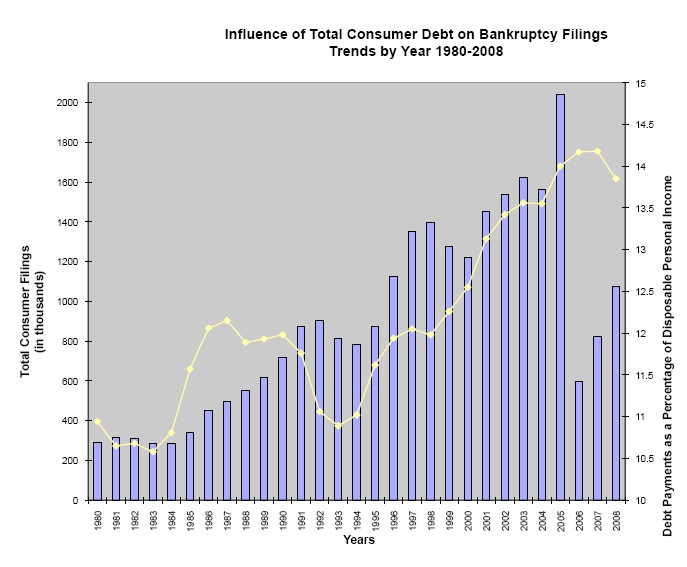
I might be willing to wager quite a bit that bankruptcies will go up considering the foreclosures and debt burden...

I might be willing to wager quite a bit that bankruptcies will go up considering the foreclosures and debt burden...

So look at the simple figures above and tell me what they mean to you…  I would never suggest that the market cannot move further than rationally possible, but it is hard for me to believe that corporations will increase revenues significantly and continue to grow at a decent pace with 10% unemployment, rising foreclosures, an incredible debt burden and rising bankruptcies (corporate and personal).

Nothing has changed since last year except that the government has transferred liabilities from bank balance sheets to the government balance sheet…and ultimately, who fuels the government?  The consumer/tax-payer.  I still see quite a few weak links in the chain and that’s where my pessimism comes from.

Posted in Economics, Educational, Markets, Politics.

Tagged with , , , , , , , .


Copyright © 2009-2013 SurlyTrader DISCLAIMER The commentary on this blog is not meant to be taken as an investment advice. The author is not a registered investment adviser. There is no substitute for your own due diligence. Please be aware that investing is inherently a risky business and if you chose to follow any of the advice on this site, then you are accepting the risks associated with that investment. The Author may have also taken positions in the stocks or investments that are being discussed and the author may change his position at any time without warning.

Yellow Pages for USA and Canada SurlyTrader - Blogged

ypblogs.com