Skip to content


Shock Doctrine

Stephen Roach, an economist from Morgan Stanley that I respect greatly, wrote a good opinion piece in the financial times yesterday questioning the reappointment of Ben Bernanke.  His main point is that, like Greenspan, Bernanke was partly to fault for the runup in housing prices and subsequent fall of all assets tied to it, so why is he being touted as a champion for “saving the world”?

I would like to broaden this approach a little bit further to my own opinion that somewhat falls in line with The Shock Doctrine written by Naomi Klein.   Her approach was more along the lines of using war to expand government.  I think the bigger demon in the system is the use of financial crisis to expand the government.  The government has allowed massive financial institutions to reign unchecked and able to borrow at extremely cheap rates (free money) for nearly two decades.  The banks got reckless and the government did not provide adequate oversight which subsequently caused a systemic crash in the financial markets.  The government responds by saying it is absolutely necessary to expand their monetary/financial institution control systems while funding bailouts and stimulus  in order to save the entire global financial system from utter collapse, thereby increasing the size of the government in general.   It is as if you get a promotion for doing a terrible job in the first place…

All a government needs to do is create mayhem in order to grab more control.  How would you like to run an organization that is capable of causing disasters, printing your own money or collecting more money via taxes (no budget), while controlling a military power that is the strongest in the world?  Where exactly are the checks and balances in this system?  How can I, as a citizen, demand that my currency not be destroyed and that my income not be cut in half or more via taxes and inflation?  I want to work for myself and for our country’s infrastructure, education and defense…not for the corrupt who are in control of the financial house of cards.

"Naturally the common people don’t want war. But after all, it is the
leaders of a country who determine the policy, and it’s always a
simple matter to drag people along whether it is a democracy or a
fascist dictatorship, or a parliament, or a communist dictatorship.
Voice or no voice, the people can always be brought to the bidding of
the leaders.  This is easy.  All you have to do is tell them they are
being attacked, and denounce the pacifists for lack of patriotism and
for exposing the country to danger.  It works the same in every
country.”
   --- Hermann Goering, Hitler’s Reich Marshall, at the Nuremberg
Trials
Posted in Conspiracy, Markets, Media, Politics.

Tagged with , , , .


Amusing Trade

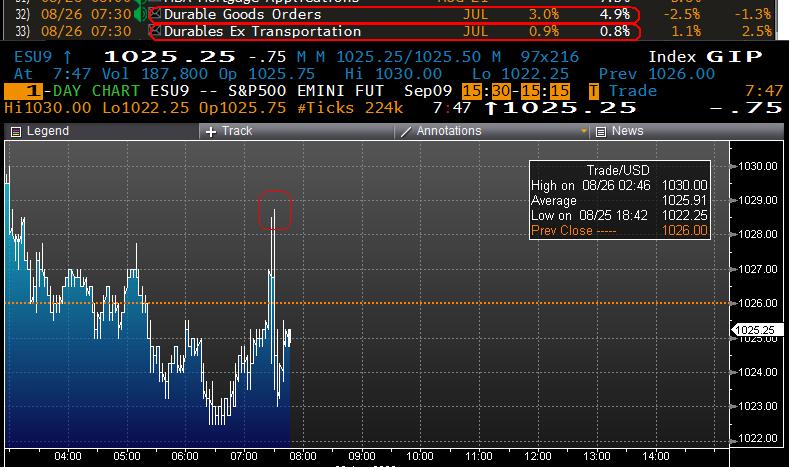
I remember from trading futures on a prop desk being told to “click away!” on a good number (meaning buy as much as you could to go along for the ride).   It was amusing this morning to see the S&P 500 futures rally on, as the wall street journal put it, “Orders for durable goods jumped 4.9% in July, the largest increase in two years!”  Unfortunately, ex-transport, namely government/taxpayer subsidized cash for clunkers, durable goods was below expectations at .8% versus consensus .9%.

Hate to be that guy who didn't think before he bought...

Hate to be that guy who didn't think before he bought...

Posted in Markets, Media, Politics.

Tagged with , .


Tail Wagging the Dog

I had a meeting last night with Wells Fargo/Wachovia that left an eerily bad taste in my mouth.  Wells Fargo has always seemed like a strong and conservative bank that was a traditional deposit institution.  Focus on providing good customer service to clients, lend to high quality individuals and companies, invest in high quality assets.  They maintained their strength through this whole ordeal by maintaining strong lending standards and keeping away from the greed driven sub-prime lending and securitized banking shtick that got most of the other banks in such serious financial trouble.

The outcome of the Wells Fargo – Wachovia transaction is fairly simple: Wachovia has become a “Financial Products Company” (FPC) within Wells Fargo.  They are going to structure products as a yield increasing/reserve reducing solution for Wells Fargo’s more traditional clients.  The FPC salesman stated that Wachovia was able to source long-term volatility at a level that was more competitive than anyone else on the street.  When I asked how they were able to do that and where they were offsetting the risk he bluntly stated that he was repackaging the risk into structured notes and selling it to pension funds and endowments.  Risk that he could not offset was being held onto by Wells Fargo and hedged with short-term volatility, leaving Wells Fargo/Wachovia exposed to the curve risk between short and long-dated volatility.

Is there anything inherently terrible with what this FPC salesman was telling me?  Not really.  What threw me off was that this FPC salesman was clearly echoing what I have heard in the past.  There is no new financial regulation and there is no new-found respect for balance sheet risk.  This guy at “Wells Fargo Securities” was going to do the same exact thing that got us into the 2007/2008 banking mess and he is probably going to make a boatload of money doing it.  It goes something like this:

  1. Source risk – whether it be interest rate risk, equity risk, volatility risk, commodity risk, currency risk, or housing price risk
  2. Create structured notes to sell the sourced risk to the unknowing and naive
  3. Whatever risk you cannot sell to a sucker, you keep on the banks balance sheet and suggest to upper management and the board that it is quite well “hedged”
  4. Collect bonuses, stock options, profit-sharing
  5. When the bonuses start getting thin, increase size with leverage (2008 could never happen again…)
  6. Wait till the next crisis emerges and your bank gets in serious trouble
  7. Rinse yourself off, hide from the taxpayer’s wrath, find another sucker institution and repeat

Not a single large commercial bank has been unwound in this whole mess and that is a scary thought.  If we cannot break apart a Citi Group, what chance do we have in fixing a pool of larger failing institutions?  The failure of Lehman Brothers brought the financial system on the precipice of a massive failure.  We have only made the large institutions bigger by handing them other smaller players.  Bank of America gets Merrill, JP Morgan gets Bear Stearns and Washington Mutual, Barclays get Lehman, PNC gets National City…etc.  There hasn’t been any change in the machine.  The machine will break again, it just depends on when. A more concentrated banking system creates more concentrated pools of risk. What’s even better is that there has been no motive for the banks to de-risk their balance sheets as we have seen from the wild success of Goldman Sachs.  So saddle up boys and let the merry-go-round run off the wheel once more.

Posted in Conspiracy, Markets, Politics.

Tagged with , , , , , , , , , .


Quantitative Easing and Walking on the Edge of a Razor

The federal reserve only has so many levers to pull and for the last year Bernanke has looked like a one man orchestra.  The main method for the Fed has always been the short term interest rate or Fed Funds rate.  Right now it stands at .25% but for all intents and purposes it is truly 0%.  Why does that have such a strong effect: because the banks can borrow at 0% and lend out to consumers at over 5% as money making machines.  In addition, it acts as a disincentive to savers.  Those who keep their money in money market funds or short term securities earn very little interest so they have an artificially created incentive to invest in risky assets.  Both of these facts lead to bubbles – investors plow money into markets and banks extend out credit everywhere and anywhere to bad borrowers.   At some point the tipping point is reached, the bubble bursts and we start this dance all over again.

The other rabbit that the fed pulled out of its hat comes in the rather vague term “quantitative easing”.  In reality, quantitative easing is nothing more than the federal reserve buying financial assets.  Why, pray tell, does the government buy financial assets?  In some sort of cockamamie scheme to lower longer term interest rates and again try to make banks lend out money.  The central bank basically prints money, puts that money into the economy, takes possession of the financial asset, and increases its balance sheet liabilities.

Now let’s think of the simplest example of this, which is the purchase of treasuries by the government.  Wait a second…the entity who issued the treasuries is going to print money so that they can buy the treasuries back in order to lower interest rates?  I know, it’s crazy.  The crazier part is that it actually does lower interest rates in the short term.  I think it’s a fractal.

The razor’s edge comes in the form of future central bank policies and subsequent inflation.  Regardless of current CPI levels, the Fed has effectively printed a boatload of money and put it out in the economy.  The reason that inflation has stayed low is because the velocity of money has fallen off a cliff.  Basically, most of the money is sitting on bank balance sheets because they are afraid to lend.  As soon as they start feeling better (which some have posited will be mid 2010) and start lending to consumers, the velocity of money will take off and inflation will rear its ugly head.  The central banks need to pull all of that excess money supply quickly in order to stifle inflation.  There is a caveat though, one that I pointed out in an earlier post:  The fed will not be able to sell all of the MBS (mortgage backed securities) to investors (about $1 Trillion in total) because under this scenario long term interest rates would be higher meaning that all of the MBS that the fed bought at 5% interest rates would be underwater in price.  That effectively means that in order to take that trillion out of the money supply the fed would have to take a loss on those investments which would effectively be a direct tax on the US Citizen.  I do not see that happening.

So the reality is that inflation will come eventually when the consumer steps back into the picture and I only view the consumer coming back when banks start lending again and this merry-go-round gets kicked into high gear.

What a tangled web we weave

What a tangled web we weave

As you can see the S&P has marched nearly lockstep with the increases in the open market purchases of treasuries, inverse of this you would see the drop in the dollar but I have shown that before (treasuries only being a proxy as they were buying many other financial assets along with a possible PPT purchase of S&P futures).

Posted in Economics, Markets, Politics.

Tagged with , , , , .


Focusing on Volatility Skew

When buying or selling options the skew can make a large difference in the profitability of a trade.  The vertical skew refers to the relative pricing of options that are at different strikes but have the same maturity.  If the implied volatilities at a strike which is 95% of the current price are higher than the implied volatilities at 105% of the current underlying price then the option is said to exhibit reverse vertical skew.  What this really means is that the downside options are being priced more aggressively to put more premium on fast downward moves, which intuitively makes sense.

The key is to take advantage of the skew to the best of your ability when trading implied volatility.  If you are going to buy a put option for downside protection, then you would prefer that you are able to sell an out of the money call option at an implied volatility level which is close to the implied volatility level of the purchased put option.  This would only happen if the volatility skew was relatively flat.

Likewise, if you are selling a put to subsidize a call option purchased on the upside, you would prefer that the skew be sharply reverse vertically skewed so that the sold put option more than offsets the call option premium paid.

If the market that you would like to trade does not exhibit the volatility skew that is most beneficial to your desired trade, then it’s a great idea to look elsewhere.  A great example of this is shown by currently looking at the S&P 500 skew versus asian market skews:

Asian Markets much flatter than the S&P 500

Asian Markets much flatter than the S&P 500

The FXI ishares FTSE/Xinhua China 25 ETF (bottom chart) has a much flatter skew than the S&P 500 (top chart).    The 110% out of the money vol level for the S&P 500 is 17.6% lower than the ATM vol level whereas the 110% out of the money vol level for the FXI is only 7% less than the ATM vol level.  This means that it is more attractive to sell an out of the money call option on the FXI and buy an ATM put option on the FXI all else equal.

In addition, the relative volatility level of the FXI is attractive because it is twice as volatile as the S&P 500 yet is trading at an implied vol level which is less than half that of the S&P 500.

For these reasons, I have been using Asian markets to hedge downside exposure in US Markets.  Yes, I am taking on basis risk by doing that but for the most part the international markets move uni-directionally in large downdrafts.

Posted in Derivatives, Markets, Trading Ideas.


Copyright © 2009-2013 SurlyTrader DISCLAIMER The commentary on this blog is not meant to be taken as an investment advice. The author is not a registered investment adviser. There is no substitute for your own due diligence. Please be aware that investing is inherently a risky business and if you chose to follow any of the advice on this site, then you are accepting the risks associated with that investment. The Author may have also taken positions in the stocks or investments that are being discussed and the author may change his position at any time without warning.

Yellow Pages for USA and Canada SurlyTrader - Blogged

ypblogs.com