Skip to content


Cliff Diving with S&P 500 Earnings

One piece of data that has notoriously been missing from all financial publications is the precipitous decline in corporate earnings as compared to previous recessions.  The speed and depth of this decline surpassed that of even the great depression with over 90% of corporate earnings disappearing in about 2 years.  It appears that the decline has bottomed out, but most of that has been due to the quick resolve of corporations in cutting capacity and costs along with strong government intervention.  At current levels of earnings, the P/E multiple can only be rationalized with the expectation that earnings will snap back quickly as the economy rebounds.  I think we all need to keep an eye on the consumer because 10% unemployment and high levels of household debt will continue to stifle any rebound in corporate profits.

S&P 500 Earnings: Geronimo!

S&P 500 Earnings: Geronimo!

Another arena to watch closely is government spending.  For better or worse, fiscal stimulus has been the breath of life in 2009 and there will be an 80% government contribution to world GDP growth in 2010.  It is estimated that US GDP would have contracted at a 6% annual rate during the second quarter without government intervention.  More public outrage over federal spending is going to have a definite impact on the prospect of future stimulus plans which will create a strong downdraft for an equity market that has already priced in 3%+ real GDP growth.

Since the bottoming of the equity market in March the US has lost about 2.5 million jobs, nearly the same number of cumulative jobs lost during the 2001-2003 tech implosion. Good signs indeed.
Posted in Economics, Markets, Politics.

Tagged with , , , , , .


The Fed’s Dilemma

I have addressed how the Fed is walking on a tight rope and I have made the direct correlation between a falling dollar and a rising S&P 500 (as the dollar falls the value of all goods expressed in dollar terms rises).  Now I think it is time to do a little thought exercise and see what we think might happen if we keep following a certain path.

The fed can print as much money as they want.  If the printing presses are at full speed, then the value of each outstanding dollar declines.  This is a simple fact, just think of it this way – when there are 2 dollar bills chasing a specific $1 good, then the value of the good will increase and require $2 instead of the original $1.  So every dollar that you hold has been halved in value.  This is considered the money supply.  The only reason that we are not currently seeing a dramatic bout of inflation is because individuals and companies are not spending money, so the velocity of money has slowed enough to offset the supply of money.  Put simply, as soon as those extra dollars that were printed start hitting the streets, there will be dramatic inflation, but that can only happen when people and businesses start spending money…that will happen when the fed prints enough money to give to the banks so that they feel comfortable lending back to the consumer – then the cycle begins again.

Here is the issue that I want to address today: so what?  A lot of economists will state that we need inflation and we need the fed to print a lot of money so that the economy does not 1) collapse or 2) end up in a spiral of deflation just like Japan.

Here is the problem with that argument – if the dollar is devalued enough, the Chinese and other Asian countries are going to become even more upset than they already are because they hold a ton of US debt in US Dollars.  A falling dollar means that all of their debt declines in relative value.  I would be upset as well and would not blame them for stepping away from the US Federal Reserve Ponzi scheme.  What this implies is that a falling dollar stops the marginal Asian treasury buyer.  Put simply, they would stop subsidizing our debt as heavily as they currently are.  Any marginal drop in their debt purchase would drive up interest rates. The fed would be powerless.

So we end up in a rather ominous situation:

  • Falling dollar (cost of all foreign goods rise dramatically – farewell cheap Walmart goods)
  • Continued high unemployment
  • High interest rates for a debt loaded consumer and stumbling housing market

The only positive out of high inflation is that we devalue our current debts (pay back $100,000 owed with the equivalent of $60,000 in real terms) and goods produced in America become cheaper to foreign buyers.  The flip side is that it also makes it much cheaper for foreign investors to buy American companies, real estate, and people.

Way to sell America on the cheap.  Bravo.

Posted in Economics, Educational, Markets, Politics.

Tagged with , , , , , , , , .


Government Versus Private Salaries

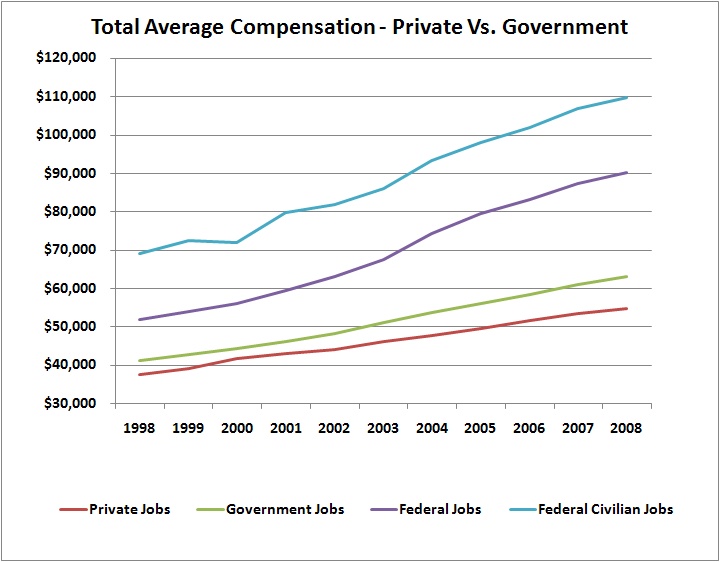
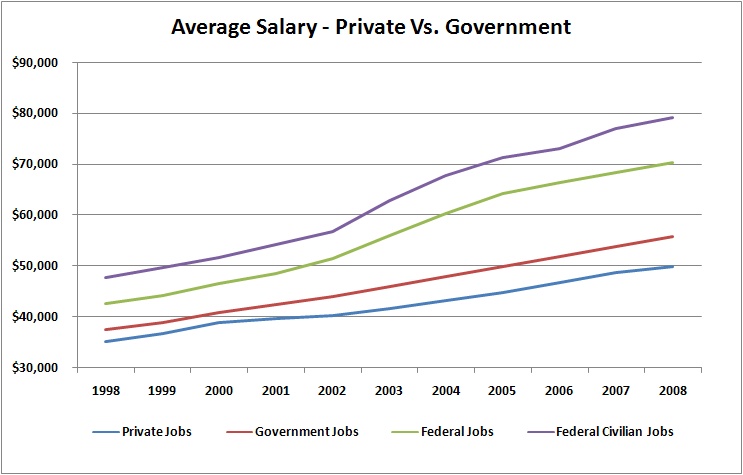
As we look at the efficacy of government programs in general, I think it is important to take a step back and look at the government as a corporation.  The government can be viewed as an all powerful monopoly that has control over its own income, something that every other corporation operating in a competitive industry should be envious of.   The government is an organization like many others and therefore requires many of the same mundane positions: secretaries, accountants, financial analysts, project managers and other paper pushers.  That being said, there are definite differences between government positions and private positions so it is difficult to tease out true apple to apple comparisons.  For instance, there might be quite a few cafeteria workers in government jobs but not nearly as many as in the private restaurant businesses.  Such a percentage difference can overstate average government salaries because there are not as many low salaries dragging the average down.  Likewise, there might be more college educated jobs in government spots versus the private sector, though I would argue that this difference should have decreased dramatically as the US economy has become more driven by intellectual property and less by manufacturing.  With all of these caveats in place, let us dig into the numbers:

Is a government worker worth more than a private worker?

Is a government worker worth more than a private worker?

How fast can the differential grow?

How fast can the differential grow?

These two charts bring two very important questions to my mind:

  1. How much more valuable is an equally skilled government (particularly federal) worker than a private worker?
  2. How far and fast can the gap between the two grow?

If the two charts above do not make you uncomfortable, then I am pretty sure that this one will:

Double the compensation?

Double the compensation?

The average federal civilian worker earns double the total compensation of the average private worker.  As I stated earlier, there can be reasons for a gap between the two and they should all relate back to the skill and education  of the average federal civilian worker versus the skill and education of the average private worker.  Unfortunately, I do not have access to granular enough data to make a concrete statement regarding the differential between two like workers, one in the federal workforce and the other in the private workforce because the bureau of labor statistics does not release that data (how convenient).

I can, however, point to a facts:

  • private workers quit at a rate of 7 times that of federal workers
  • private workers are laid off at a rate 5 times that of federal workers

This tells me two things:

  1. Federal workers are more satisfied with their employment than private workers
  2. Federal workers have safer jobs than private workers

If an individual possesses a government job that has less risk than a comparable private job, how is it that he/she is entitled to a salary that is twice that of the private worker?

Posted in Politics.

Tagged with , , , , .


The True Cost of Government Subsidies

Preliminary sales numbers came out for August at 14.1M cars.  Last month came in at 11.3M so we so quite a bump due to the Cash for Clunkers program.  The real question is: how many cars did we actually incentivize the public to buy because of the cash for clunkers program?  We do not care about the guy who was already going to buy a car in August, we only care about the marginal buyer who was coerced into buying a car due to the program.  The sad truth is not very pretty.

There were about 940,000 cars sold in July of 2009 and we can assume that about that many cars would have been sold in August had there not been a government sponsored program.  Let us assume that the difference between what was actually sold (14.1M/12)= 1.175M and what would have theoretically been sold in August of 950k was only due to the government subsidy found in the cash for clunkers program.  That means that the government (taxpayer) spent $3B to incentivize (1,175,000-940,000) = 235,000 car sales.  That equates to $3,000,000,000/235,000 = $12,766 taxpayer cost per car sold because of the cash for clunkers programEven if we were to assume that August was going to be as bad as the worst month this year (April ’09) at 760,000 cars, that would still mean that we, as taxpayers,  spent $7,230 per additional car sold.

Better still, only 4 of the top 10 cars purchased under the cash for clunker program were American.

What a fantastic use of taxpayer dollars.

Posted in Media, Politics.

Tagged with , .


Genetically Modified Trees?

As posted in Bloomberg:

“Aug. 28 (Bloomberg) — International Paper Co., the world’s
largest pulp and paper maker, plans to remake commercial forests
in the same way Monsanto Co. revolutionized farms with
genetically modified crops.
International Paper’s ArborGen joint venture with
MeadWestvaco Corp. and New Zealand’s Rubicon Ltd. is seeking
permission from the U.S. Department of Agriculture to sell the
first genetically engineered forest trees outside China. The
Australian eucalyptus trees are designed to survive freezes in
the U.S. South.”

Do any of these genetically modified trees or crops concern anyone?  I am pretty sure that we go to extended lengths to keep foreign plants and animals from inhabiting our country for fear of them disrupting our rather fragile ecosystem.  Why would it possibly make sense to create genetically modified plants that are engineered to be stronger than other plants and throw them out in the wild to see what happens?

“Engineered eucalyptus trees could be an ecological
disaster, bringing increased fire risk and extraordinary water
consumption to a new environment, said Neil J. Carman, an
Austin, Texas-based member of the Sierra Club’s genetic
engineering committee. Easier-to-pulp trees will be weak, and
hurricanes will spread their pollen and contaminate native
forests, he said.”

Posted in Conspiracy, Media.


Copyright © 2009-2013 SurlyTrader DISCLAIMER The commentary on this blog is not meant to be taken as an investment advice. The author is not a registered investment adviser. There is no substitute for your own due diligence. Please be aware that investing is inherently a risky business and if you chose to follow any of the advice on this site, then you are accepting the risks associated with that investment. The Author may have also taken positions in the stocks or investments that are being discussed and the author may change his position at any time without warning.

Yellow Pages for USA and Canada SurlyTrader - Blogged

ypblogs.com