Skip to content


The Fed Confirms its Fight on Deflation

As I just suggested in my previous post, the Fed is convicted in its quest to stifle even the hint of deflation.  They find that inflation is a fight for another day:

“With substantial resource slack likely to continue to dampen cost pressures and with longer-term inflation expectations stable, the Committee expects that inflation will remain subdued for some time.

In these circumstances, the Federal Reserve will continue to employ a wide range of tools to promote economic recovery and to preserve price stability.  The Committee will maintain the target range for the federal funds rate at 0 to 1/4 percent and continues to anticipate that economic conditions are likely to warrant exceptionally low levels of the federal funds rate for an extended period.”

The interesting piece of news in the release is that they have slowed down the pace at which they are buying mortgages by about 3 months.  Considering that the $8,000 tax credit is no longer available in November, the fact that the Fed will stop buying MBS, foreclosures will be increasing and the slow season will be starting should provide for some interesting price action in the real estate market this fall and winter.

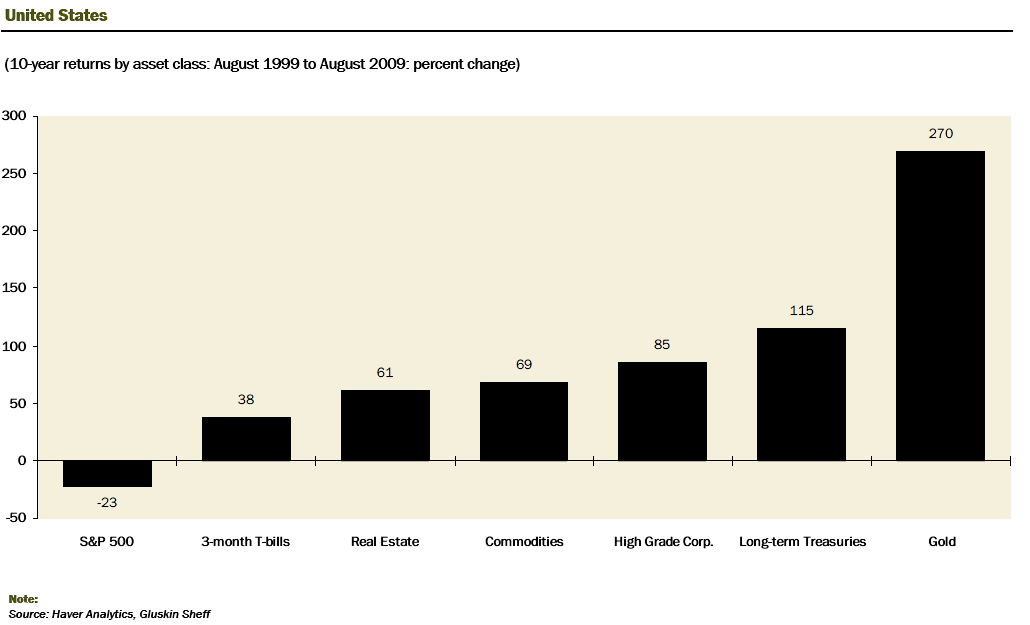
As a parting shot, how about Gold over the last 10 years versus every other asset class?  The poor, poor George Washington.  Just look what a Federal Reserve can do with a decade of easy money.

The Lost Decade

The Lost Decade

Posted in Markets, Politics.

Tagged with , , , , , .


Protecting Against Inflation While the Fed Prints Away

I recently heard a top economist from Goldman Sachs suggest that the Fed has not done nearly enough in the current crisis and that the true fight is still the fight against deflation.  That can only mean one thing: print more money.  As the Fed looks at further ways to pump more liquidity into the market, I think it is important to find ways to protect wealth against an almost certain future of higher interest rates, a falling dollar, and some rampant inflation.

As Obama would say, “Look, Listen, Let me be clear” – I do not think inflation is coming soon.  I do believe that the consumer has to step back into the mix in order for prices to be driven higher.  That being said, if you pump enough money into the economy (and we have already pumped a lot!) then we should expect that banks will eventually start to feel comfortable enough to start lending to American consumers again.  That could happen as early as mid 2010 which implies that those with access to credit might start spending again because the dollars that continue to be printed start to flow freely to everyone.  I have also heard many suggest that the Fed will most likely keep the discount rate low through 2010 and will only start to shut off the spigot when they truly believe there is inflation.  The problem is that inflation often comes on like a burning wildfire and it takes a bit of time to stamp it out.  In addition, the programs that were put in place will be difficult to unwind quickly(reverse repo anyone?) – especially those that involved the purchase of securities from the market place.  The Fed will have a difficult time selling those back to the market at a loss which would effectively tax the US Citizen.  Good luck explaining that to congress Chairman Bernanke.

With all of this as the backdrop, what do you do? Inflation is only good for companies that are able to pass on the higher costs to the consumer or benefit from higher priced commodities.  Over time equities often are a decent hedge against inflation, but in the short run they will be impacted strongly from rising interest rates and their inability to pass costs on to an America with 17% real unemployment.  Commodities generally provide a good hedge against inflation, but individual commodities can see strong technical and supply/demand imbalances which overpower inflationary forces (take a look at natural gas).  Diversified commodity plays can be found by investing in the ETF’s DBC, DJP, and GSG.

Over the long haul, real estate in the form of REIT’s generally provides a decent inflation hedge but over the short-term the hedging quality is strongly counteracted by supply/demand imbalances.  If there is a glut of recently built office spaces and high vacancy rates then the structural imbalances in the market will make returns suffer regardless of the level of inflation.  Only use REIT’s as an inflation hedge if you believe that we have hit a balance between supply and demand in the commercial real estate market.  Considering that commercial real estate is still plummeting in value and office vacancy trends are still negative, I would hold off on the REIT play as a pure inflation hedge.

Now that we have addressed commodities, REIT’s and equities the other large lingering asset class is fixed-income.  The key problem with most of fixed income is just that, that it’s fixed.  A coupon payment of $10,000 is not nearly as attractive after a few years of rising costs via double digit inflation levels.  Treasury Inflation Protected Securities (TIPS) act as a hedge against inflation, but their coupons are usually quite low due to their minimal credit risk.  A portfolio of corporate bonds has attractive yields, but can be utterly exposed to rising inflation rates.  All else equal, longer bonds will be hit harder than short-term bonds so high inflation environments are best combated with short maturity fixed income securities.  The alternative is to be long corporate bonds and hedge rising rate and inflation risk by shorting treasury bond futures or buying put contracts on treasuries by buying put contracts on the long term treasury ETF with the ticker TLT.

By hedging with treasury futures or buying put options on treasuries you do two things:

  1. You immunize your corporate bond interest rate exposure which hedges against inflation and rising rates
  2. You make a bet that the US Government’s cost of borrowing will go up in the future as we have an ever increasing amount of sovereign debt

Two things that seem to make a lot of sense.

Posted in Educational, Markets, Trading Ideas.

Tagged with , , , , , , , , , , , , , .


True Cost of Government Subsidies (Part II)

In my previous post I addressed the true cost of the cash for clunkers program. If you thought that was ugly, let’s analyze the new homebuyer’s subsidy…

According to the National Association of Realtors:

“NAR estimates that about 1.8 to 2.0 million first-time buyers will take advantage of the $8,000 tax credit this year, with approximately 350,000 additional sales that would not have taken place without the credit.  Buyers have little time to act because they must complete the transaction by November 30 to qualify for the credit.  Unless extended, contracts signed but not completed by that date will not be eligible – it is taking approximately two months to complete home sales in the current market.”

They actually made the math pretty easy on this one…

If there are 1.8M buyers who take advantage of the $8,000 credit that equates to 1.8M*8,000 = $14.4B cost to the program via taxpayers (I had to write it out because there were so many zeros).

The key here is that they estimate only 350,000 additional buyers came to market because of the tax credit.  That means that for each marginal sale the taxpayer is paying $41,142 per additional house sold.  So we are spending $41,142 for an $8,000 tax credit….Brilliant.

Posted in Economics, Markets, Politics.

Tagged with , , , , , , .


Covered Call Options as Investment Strategies

An investment strategy that is highly underutilized is the selling/writing of call options on individual stocks or ETF’s that are owned within an investment portfolio.  I will cover three different S&P 500 option strategies which could all be implemented simply by using the S&P 500 ETF (SPY) and its underlying options.

All three strategies were invented and are tracked by the Chicago Board of Options Exchange (CBOE) and most are now being mimicked by mutual funds for personal investors.

The first strategy involves buying the S&P 500 and selling 1 month call options at the money every month and letting them expire.   This means that systematically if you own $1M of the S&P 500 and the index closes the month on the level 1,000 you sell $1M notional of 1-month call options with a strike of 1,000.  This would equate to $1,000,000/1,000 = 1,000 written 1-month call options on the S&P 500 at a strike of 1,000.  This process would be repeated every month upon expiration of the 1-month options.  This strategy is the simple At-The-Money (ATM) Buy-Write index which trades under the symbol BXM.

The second strategy is a simple extension of the BXM called the 2% Out-of-The-Money (OTM) Buy-Write Index under the symbol BXY.  As you could guess, the BXY simply sells 1 month call options 2% out of the money instead of at the money.  This provides the S&P 500 room to go up 2% per month without capping returns.

The last strategy is the Put-Write Index.  This strategy simply sells 1 month put options at the money while holding the equivalent notional amount in cash while earning interest.  Without getting into details, due to “Put-Call Parity“, the Put-Write index is theoretically equivalent to a covered call strategy.  The return/risk characteristics of this strategy are often more attractive than a simple covered call and I will cover those details at another time.

Hopefully you stuck with me to the meat of the matter – the results.
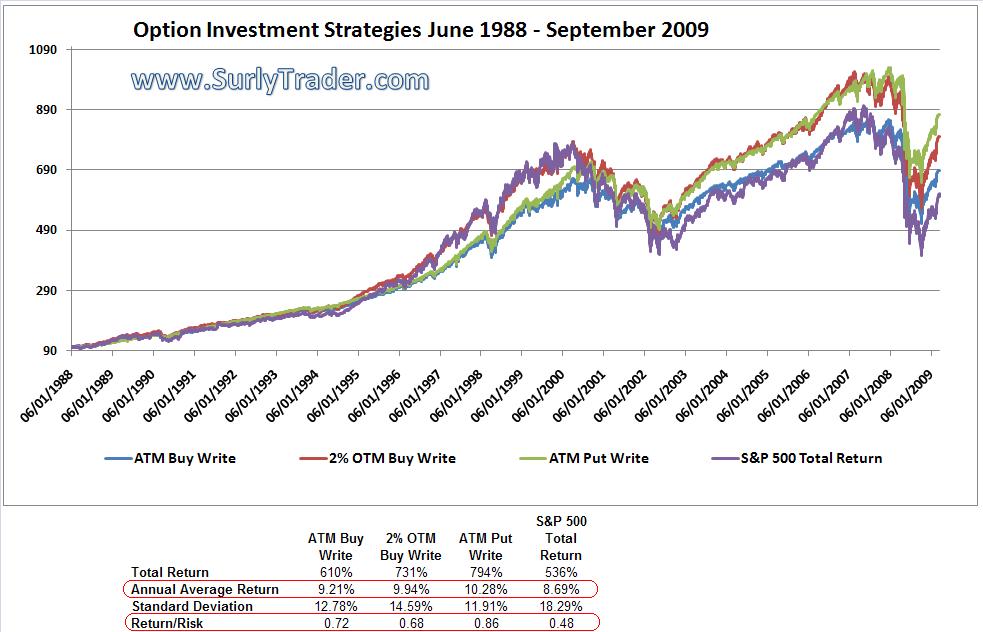
All of the option investment strategies exhibit *higher* returns and *lower* risk than simply investing in the S&P 500.

All of the option investment strategies exhibit *higher* returns and *lower* risk than simply investing in the S&P 500.

As much further proof for the efficacy of these option overlays, I looked at the period between January 1, 2000 and September 15, 2009.  We all know that this period was filled with the collapse of the internet bubble along with the recent credit crisis.  Two tumultuous times packed into less than 10 years.  The results for these strategies become even more endearing.
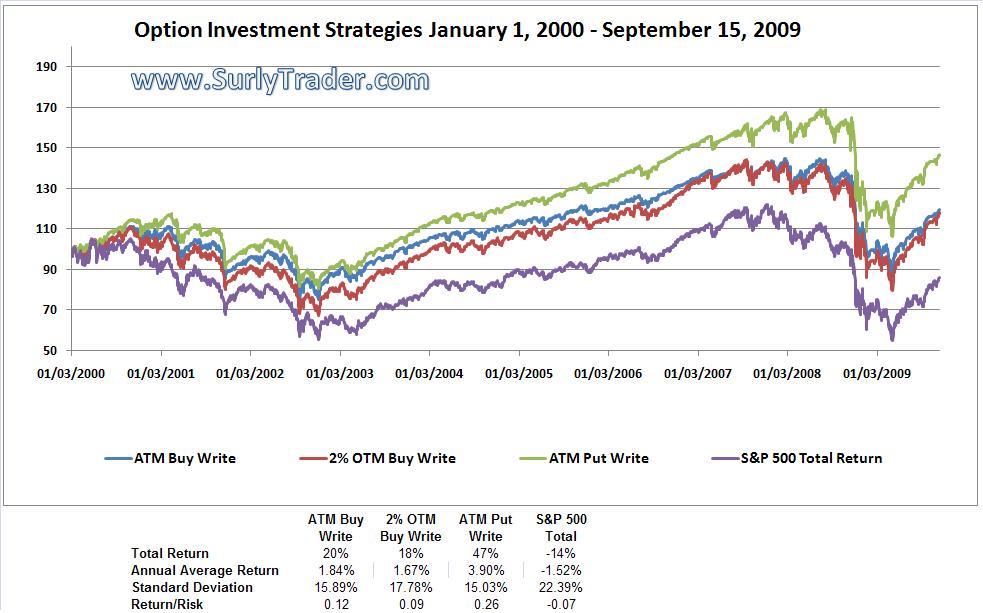
Under choppy market conditions, option overlays dramatically increase returns

Under choppy market conditions, option overlays dramatically increase returns

During the time period between January 2000 and now, you would have earned significant positive returns of 15% or greater with option overlays versus a loss of 14% by investing in the S&P 500 alone.  The put writing program would have generated returns that were 60% greater with a standard deviation which was 2/3 that of the S&P 500 alone.

This is only the tip of the iceberg of course, because we can always add complexity to these programs to increase their risk adjusted returns.  I just wanted to show that even the simplest introduction of options into a long only portfolio can dramatically increase its risk profile while adding income.  I will go into more complicated strategies in the future, but for now, why don’t you look at selling some call options on some of those stocks you own?

Posted in Educational, Markets, Trading Ideas.

Tagged with , , , , .


Regulatory Arbitrage

Arbitrage within the capital markets used to be a simple term that described a mostly risk-free profit in the mispricing of an asset in different markets.  For example, if wheat futures were trading on two different exchanges at two different prices you would simply buy the lower priced wheat contract and short the higher priced contract thereby locking in the pricing differential as an arbitrage profit.  True arbitrage trades have gotten more complex over time and happen in fractions of a second, so for all but the fastest market making computers in the world true arbitrage is dead.

The term arbitrage has morphed to cover many more realms of trading such as:

  • Merger (risk) arbitrage: buy a takeover target’s stock and short the acquirer company’s stock
  • Convertible arbitrage: buy a convertible bond, short interest rate futures to hedge interest rate exposure, short company stock to hedge embedded equity option exposure, short company CDS to hedge credit exposure all to lock in a slight premium
  • Statistical arbitrage: a term that can encompass many things but usually implies trading the spread between two like securities on a short time scale as discussed before
  • Municipal Arbitrage: trading the spread between LIBOR (London interbank offering rate-liquid AA rated yield curve) and the tax adjusted SIFMA (Security Industry and Financial Markets Association-Municipal Yield Curve)

I could go on and on about different strategies that have indoctrinated the word “arbitrage”, but needless to say the term covers a much broader spectrum of trading.  It has become as meaningless as the term “hedge fund” in describing hedge funds as hardly any of them are truly hedged.  The one area that I would like to discuss in detail is “Regulatory Arbitrage”.  I heard on NPR the term Regulatory Arbitrage being used to describe institutions playing the SEC (Securities Exchange Commission) versus the CFTC (Commodities Futures Trading Commission), but I would say that is not the standard definition of Regulatory Arbitrage.

In general, regulatory arbitrage is used to describe the play between regulatory capital requirements and security ratings.  Insurance companies and banks are required to hold different amounts of capital depending upon the ratings of the securities that they hold.  For example, if an insurance company holds AAA rated bonds from Johnson and Johnson, they hold significantly less capital than holding CCC bonds from CIT.  Since the insurance company only has so much capital at hand, this effectively limits how much low-quality debt they can hold on their balance sheet.  This problem is the same for banks and creates massive imbalances in the market when there are large amounts of downgrades in ratings.  When S&P and Moody’s cut the ratings of many securities, banks and insurance companies are forced to sell which quickly forces prices down (just look at bond prices at the end of 2008).

Regulatory arbitrage is effectively trying to “game” this system.  Before the credit crisis the trade du jour was the CDO.  By packaging a bunch of crappy loans together and slicing the structure into different tranches with subordination levels, the investment banks were able to create AAA rated structures that paid  BB yields.  With a AAA rating the insurance companies and banks held very little capital and with the BB level yield they made tremendous profits.  The problems arose when the AAA ratings were downgraded to CCC levels in one swing of the axe by Moody’s and S&P, the same two who gave the structure a AAA rating in the first place.  You can read more about that problem here.

The second aspect of regulatory arbitrage happens in reverse.  If an insurance company has a boatload of crappy commercial mortgage loans on its books, it can get capital relief by creating its own structured product with the help of an investment bank (and by paying hefty fees).  Basically you take all of the crappy loans on your balance sheet, give them to the investment bank, have the investment bank create a fancy complicated structure with different tiers of risk levels, have the investment bank get a blessing from S&P or Moody’s to rate the highest tranche a AAA and voilà!  We have capital relief for the insurance company even though it holds the same crappy loans as it did before.

You tell me if any of this makes sense.

Posted in Educational, Markets, Politics.

Tagged with , , , , , , , , , , , , .


Copyright © 2009-2013 SurlyTrader DISCLAIMER The commentary on this blog is not meant to be taken as an investment advice. The author is not a registered investment adviser. There is no substitute for your own due diligence. Please be aware that investing is inherently a risky business and if you chose to follow any of the advice on this site, then you are accepting the risks associated with that investment. The Author may have also taken positions in the stocks or investments that are being discussed and the author may change his position at any time without warning.

Yellow Pages for USA and Canada SurlyTrader - Blogged

ypblogs.com