Skip to content


Option Players Not Buying Rally

I learned long ago that you do not fight the tape.  That’s rule #1.  There are lots of anecdotes of traders who were convicted that the market in the late 1990’s was waaaaayyyyyy overbought and that the valuations were ridiculous.  These traders placed shorts on the market, told their underlings that if they did not have a short trade idea they were not interested.  Many of these *smart* traders went bankrupt.  As we all know the market continued to run skyward regardless of what valuations were.  A market only is overbought when the last chump is willing to throw his money at the ponzi scheme.  You are only right if you are able to stay solvent until the market confirms that you are right.

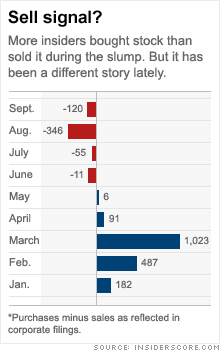
With that being said, I want to look at a few indicators from the markets that can help us get a handle on this now nearly 60% rally in equities.  The first and most prominent indicator from my perspective is whether those with intimate knowledge of their companies are buying their own stock (put your money where your mouth is).  CNN posted a good article showing the insider selling versus buying by aggregating some different data sources.  What it tells you is that the insiders are not feeling the wind behind their backs…
Buy at the Lows, Sell at the Highs

Buy at the Lows, Sell at the Highs

The second thing to look at is how the market is trading and what the option traders are suggesting will happen in the future.  If you look at the dramatic run-up in the S&P 500 of about 25% between July 8th and September 23rd you will see that during that time implied volatility (VIX) initially sold off, but has remained flat since about the middle of July and has traded in a range between 22% and 30%.  This does not mean that the market will fall dramatically, but it does mean that option traders expect volatility to come back.   Volatility can only come back if the market corrects and is choppy, not if the market continues to grind higher or trade in a mild range.
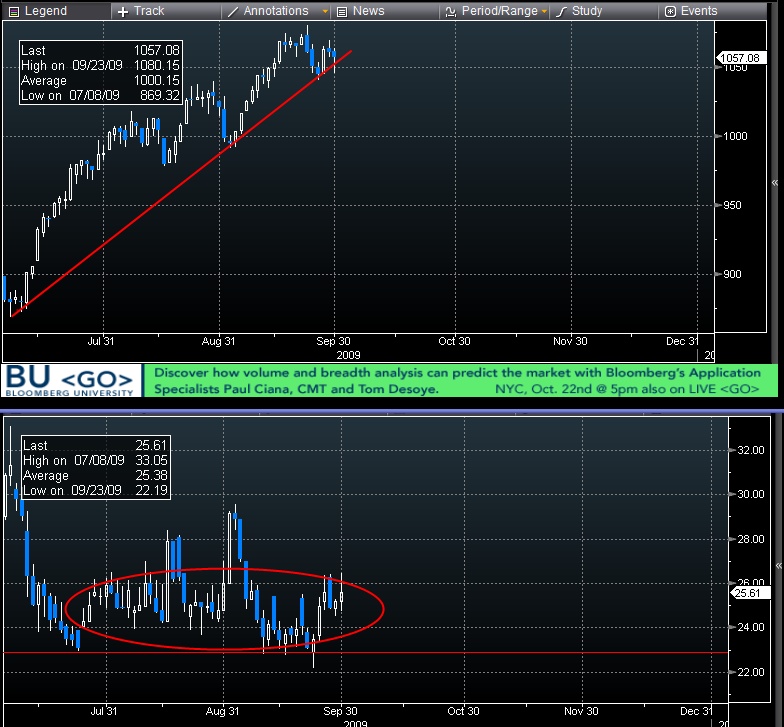
The VIX disagrees with the S&P 500

The VIX disagrees with the S&P 500

The next place to look in the option market for indications is within the option volatility skew.  The skew tells you at what option implied volatility an option with a strike 10% up trades versus an option with a strike 10% down.

Nearly a 6% gap in implied vol between +/-10% OTM

Nearly a 6% gap in implied vol between +/-10% OTM

Putting this into a more meaningful perspective, this means that traders are more willing to pay for puts 10% out of the money than they are willing to pay for calls 10% out of the money.  Credit Suisse has turned this metric into a “Fear Barometer” because they believe that it captures more fully the fear in the market versus a simplied at the money implied volatility level.

Credit Suisse Fear Barometer shows continued and elevate fear in the market

Credit Suisse Fear Barometer shows continued and elevate fear in the market

The fear barometer of 17.8 means that if you sell a one month call option that is 10% out of the money, you afford to buy a put option that is 17.8% out of the money.  This is just a way to translate the steepness of the skew into something more tangible.  Does an 18% CSFB indicator mean that the market is definitely going to crash?  Absolutely not, but it does tell you that many of the smarter investors are a little bit cautious in this rally.  But always remember, do not fight the tape.
Posted in Derivatives, Educational, Markets, Trading Ideas.

Tagged with , , , , , , , .


Does the PPT (Plunge Protection Team) Control the Market?

As a synopsis to my earlier post, there was an executive order from the president to create the “Working Group on Financial Markets” which was tasked with “maintaining investor confidence.  The mandate was given after the crash of 1987 and there have been many whispers that the Working Group on Financial Markets (AKA Plunge Protection Team) has stepped in to buy S&P 500 futures to support the market at times of distress.  It really makes quite a bit of sense for the fed to manipulate stock markets because the confidence impact would be large and the dollar amounts that the Federal Reserve would have to put at risk would be minimal compared to all of the TARP related support out there.   Besides, they already manipulate just about every other market in existence right now so what would stop them rom going after stocks.  Japan is doing it and they probably were not the first to come up with the idea… Without further interruption, I have attached a rather amusing video of one of the few outspoken and against the grain politicians that is asking for an audit on the Federal Reserve.

On Friday, September 25th, Alan Grayson questioned(badgered) the General Counsel of the Federal Reserve about whether the Federal Reserve has purposefully manipulated the stock market.  He did not get much of a response out of his victim, but for anyone who analyzes body language I would love to hear an evaluation on this guy…

Posted in Conspiracy, Markets, Media, Politics.

Tagged with , , , , , .


Collapsing Volatility

Trading options as a directional bet can be a very tricky game.  Unlike stocks and futures, you do not need to just get the direction right but you also need to get the volatility and timing right.  Back in the middle of March as the S&P was collapsing to its low of 666, one month volatility was trading in the mid 50% levels.  If you would have bought 6 month call options struck at 676 on March 9th (the low) at an implied volatility of 40%, you would have lost 36% of your option value just because volatility collapsed from 40% to 25% during the subsequent rally. Implied and realized volatility generally falls as prices rise and generally rise as prices fall which adds an extra dimension to directional trading with options.

For that reason, I do not usually recommend using options as the primary vehicle to make directional bets.  It is difficult enough to find short-term conviction in the price direction of a certain asset so why add the extra layer of complexity to your decision by creating time decay and vega exposure.  Simple stop/loss risk management decisions can effectively  protect the trader in nearly the same way as the protected nature of loss caps on long positions in puts in calls.

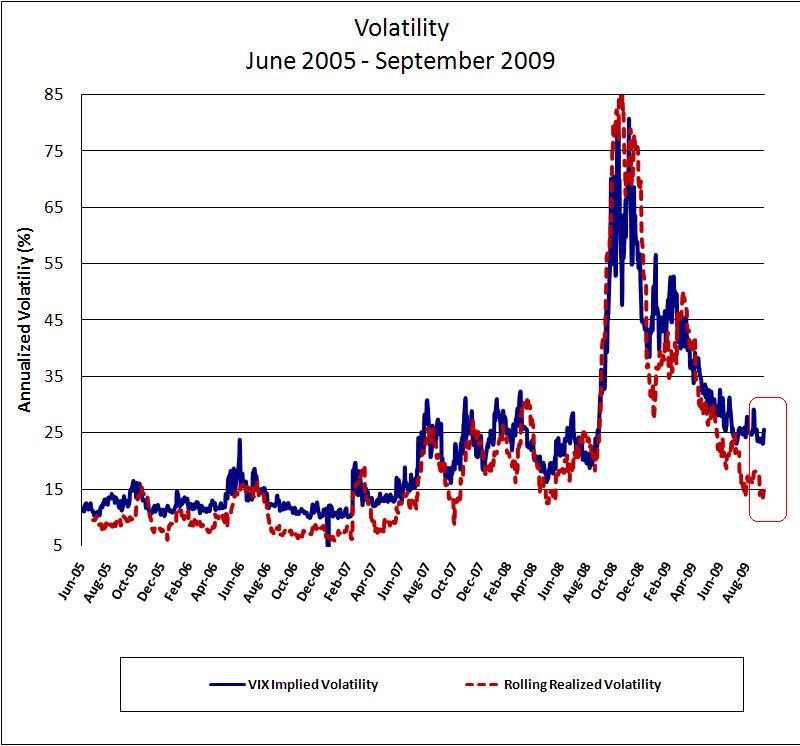
What I do think adds a lot of value to investment portfolios is the use of short option positions for income generation.  I focused on simple covered strategies in my previous article and I have offered evidence of how much option writing strategies outperform over time in “Volatility Selling Strategies“.  In general, the spread between implied volatility and realized volatility has historically been about 1% for the S&P 500.  That means that option buyers are usually overpaying for the risk characteristics of option contracts and providing a pretty hefty risk premium to those who are willing to consistently sell option volatility.  The real winners in the recent rally from March through September were those traders who were willing to get long the market via futures and sell implied volatility by selling option contracts (specifically puts) to those who were scared of a further financial collapse.

There was a complete collapse in volatility from the end of last year and the spread between implied and realized has gapped to historic wides

There was a complete collapse in volatility from the end of last year and the spread between implied and realized has gapped to historic wides

The key to selling options is to be a defensive player.  When realized and implied volatility kicked into the stratosphere last fall the option writer should have taken his losses (at pre-determined levels if possible) and stepped aside.  Volatility occurs in regimes, meaning that it is persistent through months of time as information is disseminated through the market.  When the rough waters start beating your boat around, it’s time to turn around and anchor in the bay until conditions calm down.

The current gap between implied volatility and actual volatility is providing very fat profits for option sellers.  The key is to remember your risk management discipline and be cautious after a 50% equity market rally.  Just because the last few months have been tame does not mean that volatility has left the ballpark.

Look below for a few ETF’s that are trading at very wide 3-month implied to realized spread levels.  There is opportunity, but be sure to stick to your loss limits.

Plenty of opportunity with very large spreads between the volatility levels that options are trading at and the actual volatility that the underlying ETF's have exhibited.

Plenty of opportunity with very large spreads between the volatility levels that options are trading at and the actual volatility that the underlying ETF's have exhibited.

Posted in Derivatives, Markets, Trading Ideas.

Tagged with , , , , , , , .


Bubbles and Crashes

All endeavors to maintain asset prices above fundamental valuations are doomed to failure.

This is a fact that never seems to be learned.  Whether you look at the Tulip Mania of 1637, England’s South Sea Bubble, John Law’s Mississippi Bubble in France, the Great Crash of 1929, the Nikkei Implosion, the Nasdaq Tech Bubble, or the Housing market bubble…history has provided us with plenty of examples.  Wealth cannot be created and sustained through easy money ponzi schemes.  If a bubble is created it can only be truly fixed by letting it correct itself.  Unfortunately we are a society entrenched in the idea that any problem can be pushed off to another day.

The basic underlying problem can be framed with a simple analogy: the typical American consumer has consumed more over the last few decades while real incomes have been stagnant be becoming burdened with debt.  The reason that the American consumer was able to become indebted was because the Federal reserve kept interest rates at artificially low levels which stimulated investment in all available risky assets.  If cash flows endlessly through the doors of a bank (picture the federal reserve shoveling in cash) then the bank has to do something with that cash so they lend out to all the credit-worthy clientele they can find.  When they run out of the credit-worthy clientele they turn to the bad creditors and then figure out a way to repackage the toxic heap into a salable product.

The problem comes when all of this easy cash chases a certain asset.  In 1637 it was tulips (I know, how ridiculous right?), in 1711 it was shares in the South Seas Company, in the 1920’s it was Florida real-estate, in 1929 in was stocks, in 1999 it was tech stocks, in 2007 it was real-estate.  Once the investment is chosen the frenzy hits a Malcolm Gladwell “Tipping Point” until the last idiot puts his last dollar at the very highest price reached and then it all unravels like a deck of cards.

As a tribute to the past, I would like to share with you the books that I have found most enlightening when trying to learn from our historic mistakes:

Manias, Panics, and Crashes: A History of Financial Crises by Charles Kindleberger

The Panic of 1907: Lessons Learned from the Market’s Perfect Storm by Robert Bruner

Devil Take the Hindmost: A History of Financial Speculation by Edward Chancellor

America’s Great Depression by Murray Rothbard

Posted in Economics, Markets, Media.

Tagged with , , , , , , , .


Stocks (Not) for the Long Run

Financial Follies pervade the personal finance arena and a lot of those fallacies stem from misaligned incentives. Financial professionals’ primary incentive is usually to make the largest commission possible for the least amount of work.  Many financial advisors receive hefty fees for pushing certain mutual funds on clients and many of those advisors who sell insurance products are more than happy to push equity indexed annuities on the unknowing elderly so long as they receive their fat 10% plus commissions versus a much lower commission on a fixed annuities.  Incentives are powerful devices that often do not work in the best interest of the investor.

The misconception about equity returns and the statement “stocks always outperform over the long run” is as misleading as it gets.  The problem is that we can all simply calculate the average return from stocks for the last two hundred years and make a generalization that on average stocks have returned 8 or 9% per year.  What this does not tell you is what happened during that period.  Were there periods where you would have been much better off owning government securities or corporate bonds had higher returns?  The simple answer is yes.  As Robert Arnott pointed out in his rather enlightening piece entitled “Bonds: Why Bother?“, treasuries have outperformed stocks the last 41 years between 1968 and February 2009.  There goes the rather pervasive assumption that stocks are a better long-term investment.

Stocks were trampled by bonds for over 41 years!

Stocks were trampled by bonds for over 41 years!

The aspect that is missing in nearly every analysis regarding the long-term performance of equities is the intraperiod volatility.  If we assume that in any given year stocks should earn 8-9% with an annual volatility assumption of 20%, then in any given year let us suggest that we could earn a high of 30% or a low of -10% but on average the middle of the distribution will be 8-9%.  If we lose 10% one year we could lose 10% the next year and so on…  As we go further out in time the probability that we will lose money will go down, but that does not mean that it cannot happen – just what we saw in the 10 year period between 1999 and 2009.  The problem comes in the random draw.  If that 10 year period where you lose 70% of your assets in stocks occurs right before you are ready to retire, then is it truly correct that over a 30 year period you are smart to invest in stocks because on average they have high positive returns?

A few more financial fallacies that have generally been debunked are as follows:

  1. Most mutual fund managers outperform their benchmarks
  2. Housing prices never decline over multi-year periods
  3. The expected risk premium for holding stocks is always 3-5%
  4. Investing in international and domestic equities provides good diversification
  5. We would never see volatility in equities like that experienced during the great depression

Posted in Educational, Markets, Trading Ideas.

Tagged with , , , .


Copyright © 2009-2013 SurlyTrader DISCLAIMER The commentary on this blog is not meant to be taken as an investment advice. The author is not a registered investment adviser. There is no substitute for your own due diligence. Please be aware that investing is inherently a risky business and if you chose to follow any of the advice on this site, then you are accepting the risks associated with that investment. The Author may have also taken positions in the stocks or investments that are being discussed and the author may change his position at any time without warning.

Yellow Pages for USA and Canada SurlyTrader - Blogged

ypblogs.com