Skip to content


Taking Advantage of Interest Rates

Risky assets have taken the front stage as investors clamor to increase the yields within their portfolios.  Because of the flight away from quality, treasury securities have fallen slightly out of favor and 30 year yields have crept up to about 4.3%.  There have been many comparisons between the current US economic environment and that of Japan in the 1990’s and I want to explain where that comparison falls apart.  Japan entered their malaise as a country of savers whereas the United States entered its crisis with a heavy burden of debt.  That is a very important distinction that has swayed me towards a trade that I think has a very high probability of being right.

If we believe in any recovery in the world economy then I think it is safe to say that we will not see 30 year treasury yields hit 2.5% as they did on December 18, 2008.  Those yield levels were crisis levels.  That occurred when there was an extreme flight away from all risky asset classes and into safe assets such as treasury bonds and agency backed mortgage securities.  At the time, it did not seem that shorting treasuries was a “no-brainer” because we all know that the crisis would unleash many more months of pain.
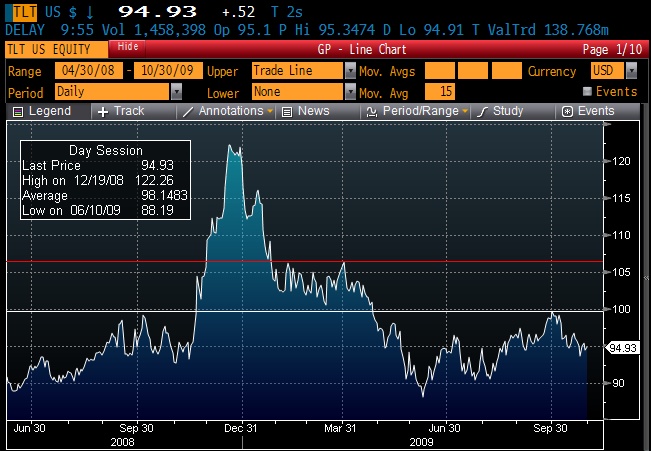
Treasury securities sky-rocketed when there was a flight to quality

Treasury securities sky-rocketed when there was a flight to quality

The rising prices in risky world assets is a signal that risk-appetite has returned and fear has subsided.  Now is the time to assess what that means going forward.  The harsh reality is that the United States has a massive amount of debt and is currently paying very low interest rates for that privilege.   It is my opinion that will change, and it might even occur very rapidly if consumer demand picks up and inflation scares spike.  Betting that interest rates will increase can be done very easily by shorting treasuries (TLT or Bond futures) or by buying put options on those same underlyings.  I am not going to make that bet outright, instead I am going to take a more agnostic view and just make some bets on where interest rates should not go.  It is helpful to look at where yields were and what that meant for the price of the instrument I want to use to facilitate this bet.

Long rates hit 2.5% at the low and now hover well above 4%

Long rates hit 2.5% at the low and now hover well above 4%

Now that we have both the yield and price charts, we can make some statements regarding the relationship.  At a yield of about 4% the TLT (20+ year treasury ETF) traded at about 100 and at 3.5% TLT traded at about 106.  I believe that both of these levels provide good barriers to sell call options on TLT.

When I sell options I generally look at selling options that are 3-6 months out.  I find that a longer option gives you more breathing room so that you do not get stopped out of the position.  When selling very short options you get fantastic time decay (theta) but small changes in price can stop you out of a position more quickly.  This would lead me to recommend looking at March or June 2010 contracts.
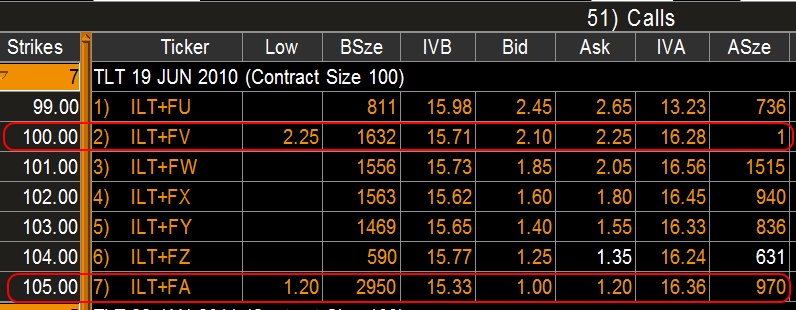
100 and 105 strikes trade for 2.25 and 1.20 respectively

100 and 105 strikes trade for 2.25 and 1.20 respectively

If you sell these call options at the ask price, then you receive $2.25 for the $100 strike or $1.20 for the $105 strike.  This will pay you $225 or $120 per option sold as long as rates do not go lower than 4% or 3.5% by June of 2010.  I think this is a high probability trade.  If you want to make this more aggressive then you can look at selling the calls and buying put options.  That way the purchase of the puts would be partially paid for by the written calls.

I like this trade because it makes good economic sense and because it provides protection against a rising interest rate environment.  Remember that rising interest rates are generally bad for equities and very bad for fixed income investments, so you can view this as a partial hedge against your other fixed income assets.  The risk is that interest rates plummet as there is another flight to quality.  In that case all assets besides treasuries are declining and we probably have more important things to worry about.

Trading options in some brokerage accounts is expensive, so if you only have a Charles Schwab, E-Trade, or TD-Ameritrade account and are interested in trading options more often I suggest you open up an account at a specialty broker.  TradeKing is one of the best and the link at the top of your screen will take you to a special $50 promotion for opening an account.

Disclosure: Short TLT
Posted in Educational, Markets, Trading Ideas.

Tagged with , , , , , , , .


Bank Losses Continue

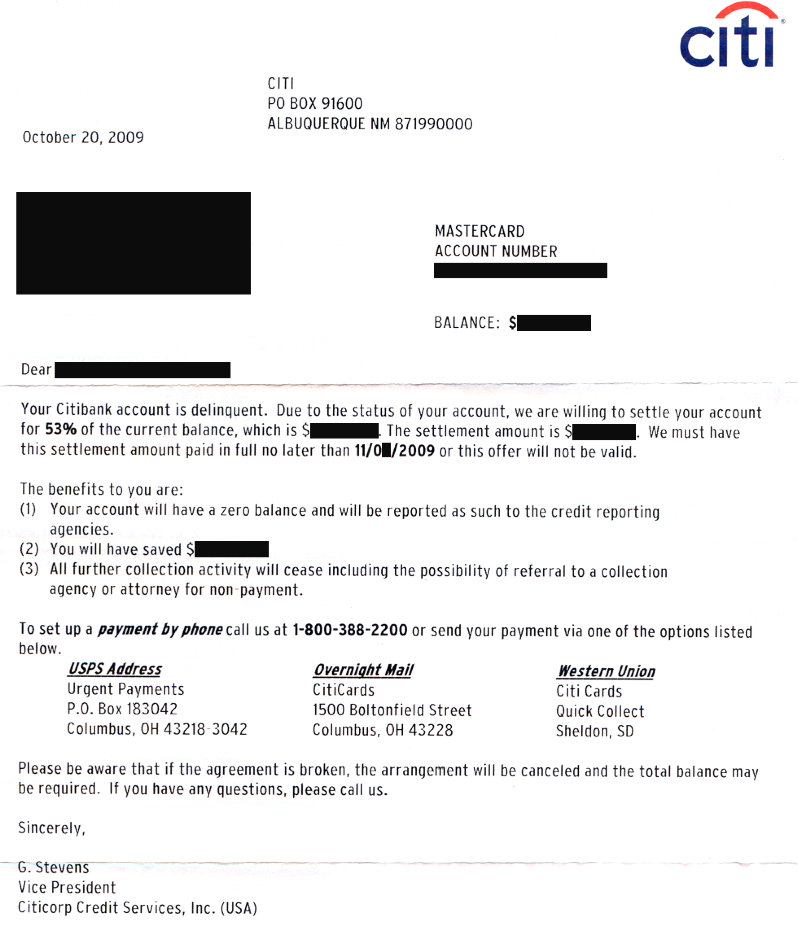
I have heard a lot of anecdotal evidence that the banks are settling mortgages and credit cards at unheard of terms that are extremely friendly to the borrowers.  The backdrop is that banks have so many losses in so many places that they will do anything other than send a credit card to a collection agency or a house through the foreclosure process.  There are a lot of costs associated with these venues, so the first stop is to haggle with the consumers.  In the case below, posted by zerohedge.com from a reader, Citibank is willing to settle for 53% of the outstanding credit balance.  This is representative of the losses that are being realized with consumer credit cards.  The banks might seem like they have weathered the storm, but I think the issue is all about timing – can they earn enough with the steep yield curve and fixed income trading before the next wave of asset price declines continue?  I guess what I would like everyone to get out of this is a fact that seems to be missing in the media: fundamentals on the consumer side are still very negative and in some areas continue to decline.   Liquidity and federal backstops can stem asset price declines, but they cannot immediately reverse the hemorrhaging that continues to occur in the residential real estate market and consumer credit.  Read the letter below and see if it sounds like everything is rosy to you?  And what about the repercussions that this message sends?  If you are struggling to pay your bills and you see that Citibank offered someone else a 53% settlement, then why wouldn’t you wait for the same deal? On the other side, why not rack up credit card debt and see how the banks react when you stop making payments.  Moral hazard?

A 47% loss on a credit card and everything is hunky-dory?

A 47% loss on a credit card and everything is hunky-dory?

Posted in Economics, Media.

Tagged with , , , , , , , .


Option Wednesday

As the market seems to be correcting and my advice yesterday was to use options to express directional views, I have decided to introduce option data into the mix of what I post on SurlyTrader.  This data is a meld of different data sources (free) and I will try to make this more useful as time goes by. The idea is that if you have access to the data, then it can help you make better investment decisions and screen for good opportunities.

Please read all of what is posted on the Disclaimer page.  I will be calculating implied volatilities using available dividend data and interest rates, please let me know if you see errors. For now, you can download the data below.

[Download not found]


Posted in Derivatives, Markets, Trading Ideas.

Tagged with , .


Options to Express Directional Views

The VIX has popped from its lows as it was unable to break below 20% while the Credit Suisse Fear Barometer has hit levels not seen since June of 2008.  Many are questioning whether this reversal is the onset of a massive correction that is long overdue, or simply the market taking a breather before making new highs.  Depending on your outlook, now is a good time to take advantage of the option markets to express your view.

It does not take the VIX long to retrace its grind lower

It does not take the VIX long to retrace its grind lower

Credit Suisse Fear Barometer hitting one year highs

Credit Suisse Fear Barometer hitting one year highs

Slightly Bullish Outlook:

Take advantage of a covered call options.  The markets have retraced 60% since the bottom in March and stocks appear that even with the most optimistic earnings assumptions that prices are more than fair valued.  Look to sell call options on the stocks that you own with expirations 3-6 months and strikes that slightly out of the money (5-10%).  This allows appreciation if the stock makes a move higher while providing some premium if the market stands still or retraces a bit.

A Correction is on the Horizon:

Use the covered calls as you would in the bullish scenario, but sell the call options 5-10% in the money.  This position can protect you on a loss of up to 10% and you can capture a premium above and beyond selling the stock outright.

We are Going to Hit the March Lows Again:

Forget about covered calls, you need more protection.  Sell a call slightly out of the money (3-5%) and buy a put 5-10% out of the money. This is a collared position and the written call will partially pay for your long put (protection) position.  With this type of position you are able to sell some implied volatility in the call to subsidize the implied volatility you are buying in the put option.

Posted in Derivatives, Markets, Trading Ideas.

Tagged with , , , , , , .


American Retirement Crisis

The United States faces a massive retirement deficit that has not yet been acknowledged by the media, individuals, the government, or even pension funds.  According to Ernst & Young, only 4% of middle-income married couples without a pension who are nearing retirement have enough money to last their lifetimes.  The overall problem is complex with many different contributing factors, but I will try to summarize the key issues that are causing a crisis in America.

Those without pension plans are most at risk

Those without pension plans are most at risk

According to the Ernst & Young July 2008 study, those without defined benefit (pension) plans will need to reduce their pre-retirement standard of living by 20-50% in order to bring the probability of outliving their assets down to 5%.  Can you cut your income in half comfortably?  According to the Organisation for Economic Co-Operation and Development, over 24% of Americans older than 65 live below the poverty line.  The United States, Ireland, South Korea and Mexico have the highest old-age poverty rates among the 30 OECD countries.

The median family does not have enough assets to retire

The median family does not have enough assets to retire

The most recent snapshot of individual retirement balances is provided by the Employee Benefit Research Institute in an August 2009 study, but only includes data through 2007.  Among all families with a defined contribution plan in 2007, the median (mid-point) plan balance was $31,800.  According to EBRI estimates, the average defined contribution plan balance dropped to $26,578 from year-end 2007 to mid-June 2009.

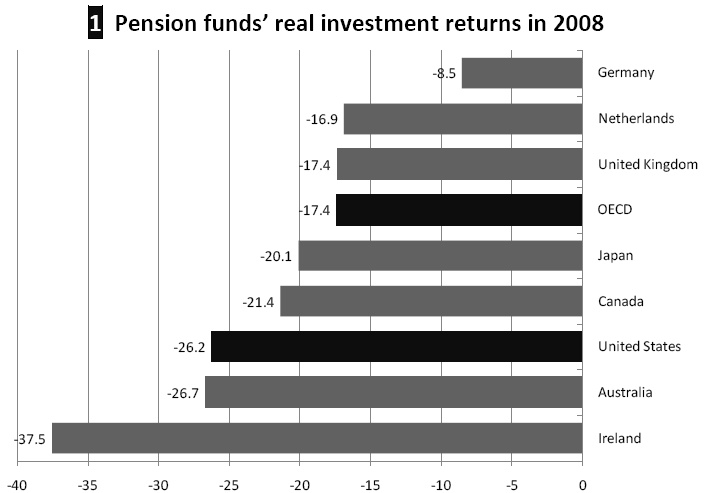
On the other end of the 401(k) self-directed retirement plans are the private, company run defined benefit (pension) plans.  As we can see from the Ernst & Young study, it appears that individuals with traditional company run defined benefit (pension) plans are much better off than those without; showing much lower expected probabilities of outliving their assets.  The problem lies within the solvency of these pension plans themselves.  In 2008, U.S. private pensions had real losses of 26.8% due to their high exposure to the equity markets.

US Pensions took some of the heaviest losses during the crisis

US Pensions took some of the heaviest losses during the crisis

This 26% real hit that U.S. pensions took in 2008, only worsens an already large pension liability deficit in the United States.  According to Watson Wyatt and Mercer Consulting, private pension plans started 2009 at 75% funding levels leaving a $400B gap between assets and liabilities.  Even if legislation is passed to provide some relief to corporate defined benefit plans, Watson Wyatt still expects them to be 74.5-77.1% underfunded by 2011.

At Least the United States DB Landscape is better than Japan's...

At Least the United States DB Landscape is better than Japan's...

The good news about defined benefit plans is that they outperformed defined contribution plans by 0.8% annually, on average, between 1985 and 2001. If you had only $10,000 in an account and earned 7.8% versus 7%, that would be a $50,000 difference in account value or a 35% difference in ending value over 40 years.

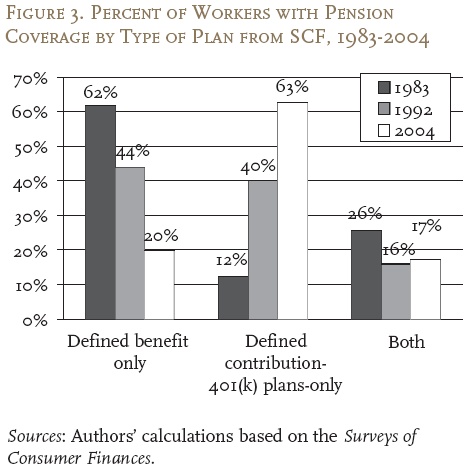
This illustrates the fact that many defined contribution plan participants simply do not have the skills, investment experience, or interest in managing their retirement plan assets. In addition, most plan providers are not equipped to provide the education and training required to assist employees in making the transition to self managed retirement plans.  On the flip side, companies have been racing to exit the defined benefit arena and pushing defined contribution plans because it reduces the risk of their own balance sheets.

The number of individuals covered by pensions has dramatically decreased

The number of individuals covered by pensions has dramatically decreased

Who exactly is going to foot the bill for underfunded individuals and companies?  Welcome to our bailout nation.  I just hope China is willing to fund all of our retirements…

Posted in Economics, Media, Politics.

Tagged with , , , , , .


Copyright © 2009-2013 SurlyTrader DISCLAIMER The commentary on this blog is not meant to be taken as an investment advice. The author is not a registered investment adviser. There is no substitute for your own due diligence. Please be aware that investing is inherently a risky business and if you chose to follow any of the advice on this site, then you are accepting the risks associated with that investment. The Author may have also taken positions in the stocks or investments that are being discussed and the author may change his position at any time without warning.

Yellow Pages for USA and Canada SurlyTrader - Blogged

ypblogs.com