Skip to content


Insurance as a Business

In order to understand the AIG debacle or any other possible seizure or bailout of an insurance company, it is important to understand the inner-workings of the insurance industry.  The insurance business, whether property/casualty or life, is a spread business.  A spread business in one in which you borrow at an interest rate that is lower than the interest rate that you earn.  In the insurance world the insurance companies borrow from policy holders.  When you pay the insurance premium on your automobile, house or life insurance policy the insurance company is effectively borrowing from you.  The insurance company takes that money, invests in bonds, stocks, and private equity but promises to pay you when something tragic happens.  The investment return that the insurance company earns on the money that it borrowed from its policy holders minus the payments made to policy holders is the spread or revenue for the insurance company. The profit comes when deducting all taxes and business expenses.

This idea can be seen most directly in an annuity policy in which the life insurance company agrees to pay you 4% per year until you die.  They make an actuarial assumption on your mortality, or how long on average they expect you to live.  Let us assume that on average they believe your will live for 20 more years.  If you, and a group very much like you will live for 20 more years, then they can take all of the money you gave them for the annuity and invest it in 20 year corporate bonds.  If they can earn a yield of 5% on their investment, then the insurance company is earning a spread of 1% on your money.  That is the heart of the insurance business in a nutshell.

The difficult aspects in running insurance companies come in the  the possible lumpiness of insurance claims, complexity of the products they sell, and the difficulty in effectively managing assets against liabilities.

The lumpiness of insurance claims is self-evident.  If you are a property/casualty insurer with a lot of exposure in Florida, a large and destructive hurricane in Florida can create devastating losses for you as an insurer.  Likewise, if you are a life insurer and there is a pandemic (more effective swine flu) killer, then you can lose substantial amounts of money off of life insurance claims.  These claims can be very lumpy and it can be tricky to correctly diversify your exposures and provide adequate capital for catastrophic events.

The complexity of the insurance products comes with “financial innovation”.  In the old days, insurance companies paid out if you crashed your car, found your house on fire, were robbed, or someone died.  Now insurance companies sell some of the most exotic financial options invented.  Variable annuities with embedded options with rate resets, floored guarantees, and numerous investment options.  The insurance contracts are flooded with characteristics that are determined by market conditions and policy holder behavior.  These complex products have gotten numerous companies in trouble (Hartford).  The complexity of property/casualty insurance contracts is much more sane, but have you ever tried to forecast the probability and number of hurricanes in the gulf region?

Lastly comes the asset/liability management.  This is the all-encompassing catchall for where most companies screw up.  The screw-up usually comes in the form of greed.  The insurance companies want to borrow as much money from policy holders as they can while earning as much return on that borrowed money as possible.  How do you do that?  By offering high crediting rates to the policy holders while taking more risk on the assets.  More risk can stem from investments in low credit quality bonds (high yield) but even there the return is limited.  When insurance companies run out of high yield cash products, they turn to the great people of wall-street for “financial innovation”.  That is basically how CDO’s, CDO^2, CPDO’s, CLO’s and synthetic bonds were created, as a need to satisfy spread-based businesses with higher return investments.  Why would an insurance company invest in a AAA rated 4% yielding bond when they could put the cash in a AAA rated tranche of a CDO that yielded 6%?  That extra 2% went straight to the bottom line….until the whole deck of cards collapses because that 2% difference truly represented a risk not captured by the AAA rating.

Up next:  AIG and its quick collapse…


Posted in Educational.

Tagged with , , , , , , , .


Senator Bunning Skewers Bernanke

I find it likely that Bernanke will be re-elected for a second term as the Chairman of the Federal Reserve, but Senator Jim Bunning from Kentucky gives a very precise list of reasons why we should all question the work of the Federal Reserve over the past two decades.  It is good to know that a few politicians still speak their minds.

Posted in Media, Politics.

Tagged with , , .


Pairs Trading: United States Vs. Emerging Markets

Directional market bets can be very tricky.  Many unpredictable factors can impact the performance of world equity markets which can make the “investment” process seem much more like a “betting” process.  For this reason, I usually play in more predictable arenas: mean reverting market risks such as volatility, interest rates, and currencies.  The other way to limit your directional risk and increase your ability to make educated investments is to enter into “pairs trades”.  Pairs trading generally refers to market neutral trading in which you go long stock X and short stock Y.  You enter this trade because you believe that stock X is going to outperform stock Y.  This trade mitigates a lot of your risk, because if the markets go down for some unforeseen reason you will lose on your long position in X but gain on your short position in Y as all markets decline.

Generally, the closer the relationship between the two investment that you place in a pairs trade, the lower your overall risk.  Earlier this year I entered into a pairs trade in which I shorted Wells Fargo and went long US Bank under the belief that US Bank as an investment was getting thrown out with bathwater just because no one seemed to want to own bank stocks.  Going long US Bank and shorting KBE (Banking ETF) is far less risky than going  long US Bank and short the S&P 500 because the S&P 500 can move very differently than the banking sector stocks.  This difference in movement is called “basis risk”.   It is important to understand the basis risk so you fully comprehend the hidden risks of a so-called “market neutral” trade. 

As we head into the new year I would like to propose a longer-term pairs trade (with a decent amount of basis risk) that I believe makes sense from an economic and fundamental basis.  The idea is to go long emerging market stocks (EEM) and short the S&P 500 (SPY).  There are a few reasons that I like this trade:

  1. The dollar has rallied from its lows as default of Dubai and downgrade of Greece has caused a flight to quality and a short cover on the dollar. The dollar will continue to fall over the longer term and buying emerging market currency exposure while shorting dollar exposure is a good way of capturing that.
  2. The new global growth engine is overseas and a rebound in the global economy means a spark of economic fire in asian countries such as China, South Korea, & Taiwan.
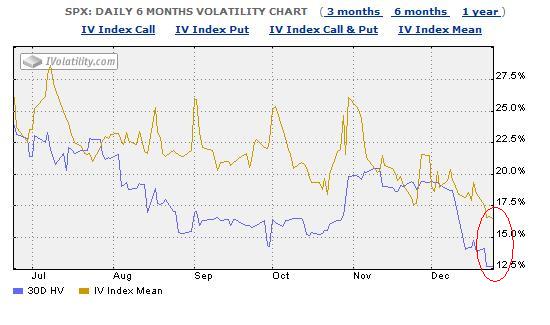
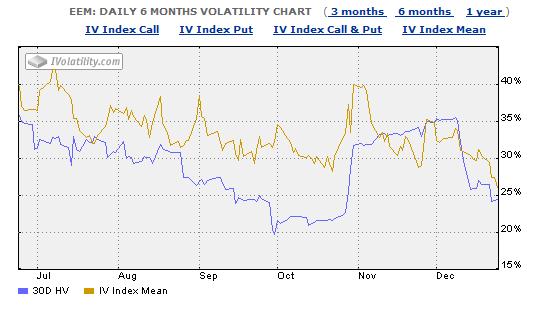
  3. Implied volatility for the emerging markets seems relatively cheap versus implied volatility for the United States.

All but the 3rd point might seem like simple reasons.  The third is based upon the way implied volatility on the options is trading versus realized volatility on the underlying.

The gap between historical volatility and implied volatility for emerging markets  is negligible

The gap between historical volatility and implied volatility for emerging markets is negligible

The gap between implied volatility and realized volatility for the S&P 500 is still significant - Good for option sellers

The gap between implied volatility and realized volatility for the S&P 500 is still significant - Good for option sellers

With this as the investment backdrop, it is my suggestion to buy 2-3 EEM at the money call options for every written at the money call option on the S&P 500.  The tenor of this trade should  be 6 months or longer, so look at June 2010 call options or options with expirations further out.  This allows the trade time to play out while reducing your concern over intra-month basis risk.  I believe that the risk to this trade is low, with the maximum loss only occurring if the S&P 500 rallies strongly while emerging markets are stagnant or declining.  I find that particular outcome a low probability event.  On the flip side, this trade gives you long exposure to a strongly rebounding global market while limiting the amount of money that you would lose if the global economy sputters. 

Disclosure: Short S&P 500, Long EEM

Posted in Economics, Markets, Trading Ideas.

Tagged with , , , , , , , , , , .


Merry Christmas!

Wishing you all a very Merry Christmas.

– SurlyTrader

Cartoon - Christmas

Posted in Politics.

Tagged with .


Rising Interest Rates

In a debt burdened economy like that of the United States, interest rates are the lifeblood.  In a previous article, I suggested selling call options on TLT (long treasury ETF) under the theory that interest rates probably could not go much lower and it has turned out to be a great trade.  Now the 30 year government bond is hitting the 4.6% level, only 20 bps or .2% away from a 2 year high of 4.8%.

Will interest rates spike above the barrier?

Will interest rates spike above the barrier?

The yield curve is currently at its steepest level in over 25 years.  The question becomes whether 20+ year rates are going to continue to rise as an economic recovery gains footing.  It is my belief that a 2.2% revised GDP with an estimated 2.5% boost from cash for clunkers and housing incentives shows that this recovery is feeble.  With that being the case, I cannot see a strong push higher in interest rates.  We also need to hope that interest rates do not continue to rise, because it can put a screeching halt to any foreseen housing recovery and make the terming out of US government debt all the more difficult.  So we can only hope that interest rates remain range bound.

Posted in Economics, Markets.

Tagged with , , , , , , .


Copyright © 2009-2013 SurlyTrader DISCLAIMER The commentary on this blog is not meant to be taken as an investment advice. The author is not a registered investment adviser. There is no substitute for your own due diligence. Please be aware that investing is inherently a risky business and if you chose to follow any of the advice on this site, then you are accepting the risks associated with that investment. The Author may have also taken positions in the stocks or investments that are being discussed and the author may change his position at any time without warning.

Yellow Pages for USA and Canada SurlyTrader - Blogged

ypblogs.com