Skip to content


The Fundamentals: How bad are they?

On a daily basis we all get confronted with a lot of data.  In that data resides many false signals and conflicting statistics.  Today, I would like to take a step back and look at the housing market as it resides today.  The housing market is where most of the trouble started and will most likely be a heavy burden for some time to come.

Housing prices seem to have stablized, but there are a lot of delinquencies that need to be worked through

Delinquencies on Subprime are declining, but what about prime borrowers?
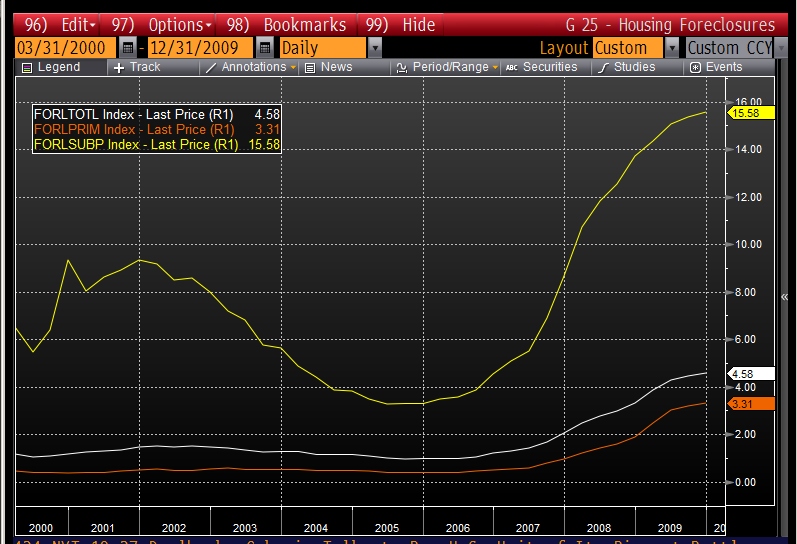
Housing Foreclosures still need to be worked through the system - Have the banks really realized the losses?

Do not expect new housing to provide the jumpstart in the economy. I would not want to be a homebuilder.

Existing home sales spiked, new home sales stagnant. What about after the homebuyer's tax credit?

Homeowners Versus Home Renters since 1965. Should all of those families really have owned a home? Are we going to realize the long-term average?

Homeowner Vacancy Rates since 1960. All-time highs.

This might seem like a depressing bit of statistics, but it is always better to be realistic rather than put your head in the sand.  The government will do everything in its power to support the housing market and stem any further declines.  The banks are still holding a ton of this risk on their balance sheets and have not realized all of the losses that the collapsed housing market has created.  The mortgage modification program was mildly successful and I believe that the next step will be for the government to reduce principal on outstanding mortgages of troubled borrowers.  The banks and the government will do anything to keep troubled borrowers in their homes, taking care of the property, and keeping the potentially foreclosed house out of the current housing supply.  Just how much has the government supported the mortgage market so far?  Just take a look at their trillion dollars of mortgages that they have already bought in a year’s time:

The fed has supported the market in 2009 and the recent Fannie/Freddie buyout programs will support the market for the next 3 months

So if you want to buy a house, by all means go ahead as prices are much more attractive than they have been for a long time.  If you are buying a house for a quick rebound in prices, I think you are looking in the wrong place.

Posted in Economics, Markets.

Tagged with , , , , , , , , , , , .


Depressing Speech from San Fran Fed

San Francisco Federal Reserve President Janet Yellen gave a speech today at the Burnham-Moores Center for Real Estate School of Business Administration, University of San Diego.  Not a lot of sunshine…

  • Core inflation may decline in 2010 and 2011
  • Economy to operate ‘well below’ potential for years
  • U.S. ‘May be close to a turnaround’ in the labor market
  • expects unemployment to be ‘painfully high’ for years
  • ‘commercial real estate remains a bleak spot’
  • predicts economic growth of 3.5% for this year
  • economic slack is ‘pushing inflation down’
  • ‘consumer mindset’ still in ‘fragile state’
  • ‘this is not the time’ to remove monetary stimulus
  • full impact of foreclosures, bank failures not yet felt
  • expect economic growth to quicken next year to 4.5%

Read the full speech [Download not found].

Posted in Media.


Noteworthy News – February 22, 2010

Politics:

Ron Paul for President, says Conservative Political Action Conference poll – NY Daily News

Majority says stimulus program has been negative for economy – Rochester Business Journal

Bailout Anger Undermines Geithner – Wall Street Journal

Spitzer Says Insurer Fees Fueled ‘Improper Practices’ – Bloomberg

Economics:

The euro will face bigger tests than Greece – Financial Times by George Soros

Economic outlook: Fed rise’s recovery signal– Financial Times

Flat Prices Bode Well for Economy – Wall Street Journal

Markets:

Mark-to-Make Believe – Still Toxic after all these Years! – Satyajit Das

Fed Officials Tell Markets They Aren’t Tightening Broadly – Wall Street Journal

Bond ‘Sweet Spot’ in Five- to Seven-Year Debt: Credit Markets – Bloomberg

Posted in Economics, Markets, Media, Politics.


Has the Greece Turmoil Subsided?

It seems that the equity markets are shrugging off a rather tumultuous few weeks.  The consensus is that the Greece situation is under control and the crisis mode has been put at bay.  The credit spread (default probability) for Greece has fallen dramatically from a peak of about 430bps (30% 5 year default probability) to about 350bps (25% default probability).  This is a large swing in a few days time, but actually par for the course as far as credit markets trade.

The credit default swap levels for Greece have fallen substantially, but the probability of default remains high

There are a few promising things that I have learned and the most useful is that the ECB has the capability of supporting Greece.  The European Central Bank is not allowed to purchase government securities as soon as they are issued (thereby supporting the demand part of the equation) but they are able to buy European government bonds on the secondary market.  What this means is that if Greece needs to raise money, then the ECB can purchase existing Greek bonds from banks and institutions so that when the new debt comes to market there is demand.  Effectively this means that the ECB can monetize the debt issuances of European governments even though the ECB’s mandate is to target a 2% inflation rate and nothing else.  The fact of the matter is that politics always over ride good decisions.

The Greece situation is a case study on multiple fronts.  Europe is basically confronted with similar problems to what the United States was confronted with in 2008/2009.  In the case of the United States, it was fairly easy to ascertain that financial backing of the banks would stem any catastrophic financial collapse.   In subsidizing US banks, we were effectively subsidizing the loose credit and poor financial investments that have occurred within our borders. In the case of European banks, these are separate countries with separate governments.  If the ECB supports German and French banks, then they are basically subsidizing a lack of financial responsibility within Greece.  And if you give the “A-OK” to Greece, then what sort of moral hazard does that introduce into the rest of European countries that have “flipped the bird” to Eurozone policies?

I am going to watch this entire spectacle with a bit of bemusement.  It is a dilemma that has never been confronted before and makes for fabulous economic discussion.  I hope that the Eurozone is able to dig its way out of this problem, but I suspect that the Euro will head lower and the entire situation will hit crisis mode before it is ever resolved.

Posted in Economics, Markets, Politics.

Tagged with , , , , , , , , , , .


SurlyTrader Joins Web 2.0

“Web 2.0” has been a hot phrase since social networking sites such as MySpace, Facebook, Digg.com, etc. have taken over the web.  Basically, Web 2.0 represents community involvement in developing content.  I have received many individual emails from readers, but instead of having two-way conversations I would like to increase the interaction between my readers and the content that is produced.  With that in mind I have added 3 ways to move towards that goal:

1) Reader Generated News: Reader’s are encouraged to submit news articles on the toolbar on the right side of the screen through the “Add News” form.

2) Reader Generated Content: On the top toolbar is a new page titled “Submit Article“.  Please feel free to write your own articles that you believe will resonate with the audience.

3) Reader Questions: On the top toolbar you will see a page titledFinancial Questions?“. Please feel free to ask me any financial questions that you feel would make good articles for SurlyTrader.  In addtion, you are always more than welcome to provide suggestions or ask questions that you would like personal responses to.

I hope that each of these additional features will help us interact in a more social way while also providing me with direction on financial topics that you would like to see addressed.

Posted in Media.


Copyright © 2009-2013 SurlyTrader DISCLAIMER The commentary on this blog is not meant to be taken as an investment advice. The author is not a registered investment adviser. There is no substitute for your own due diligence. Please be aware that investing is inherently a risky business and if you chose to follow any of the advice on this site, then you are accepting the risks associated with that investment. The Author may have also taken positions in the stocks or investments that are being discussed and the author may change his position at any time without warning.

Yellow Pages for USA and Canada SurlyTrader - Blogged

ypblogs.com