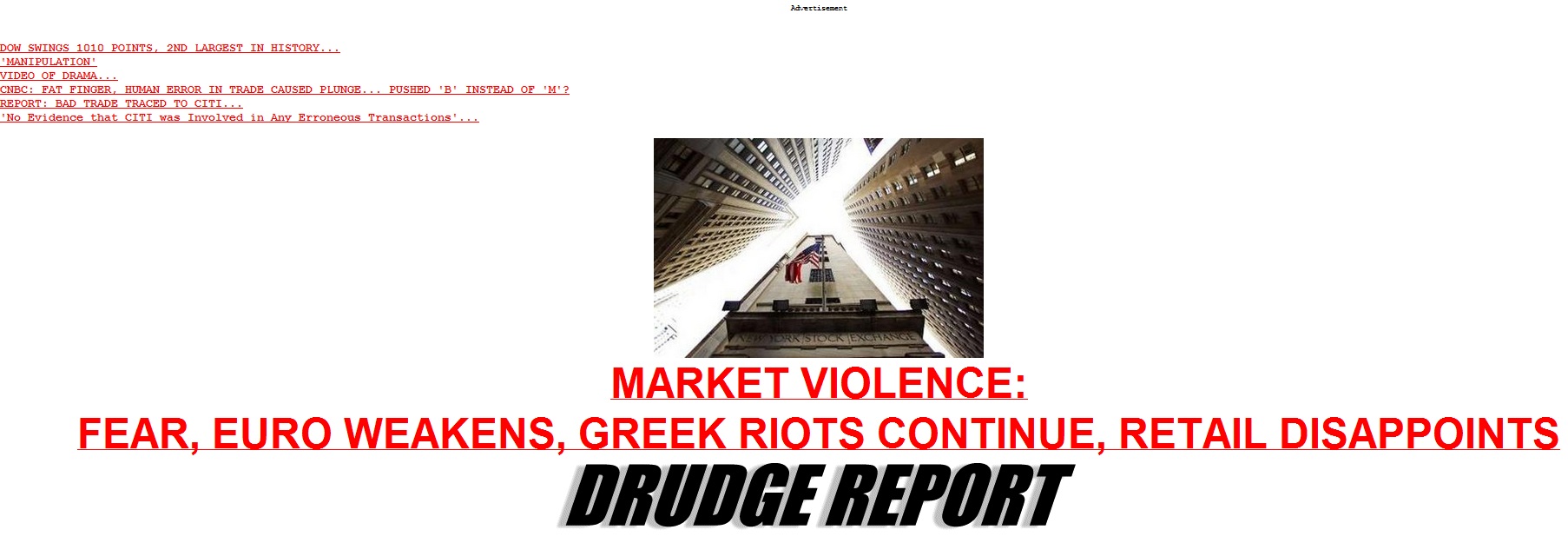
I enjoy the Drudge Report, but he certainly does have a way of adding fuel to the fire
A cynical look at our financial markets and the governments that support them
I enjoy the Drudge Report, but he certainly does have a way of adding fuel to the fire
Posted in Media.
Comments Off on RED & BOLD = FEAR!
– May 6, 2010
If you looked at today’s S&P 500 chart, you would have thought there was another massive terrorist attack. Instead, we have riots in the streets of Greece….the 28th economy of a world, making up a massive .57% of world GDP. And what about Portugal you say? They are the 37th. I am not trying to make light of this, but a weaker Euro is not so bad. It allows the United States to inflate its way out of its debt problems, the strength in the dollar reduces the disparity between the Renminbi and the dollar, and goods from Europe (along with European vacations) are much cheaper.
The downside? Fear, plus the fact that US goods look much more expensive to European consumers. I was curious about this factor and its magnitude to US global corporations. According to S&P, Global sales accounted for 45.8% of sales in 2007. Europe accounted for 28.8% of those sales and the UK made up 4.6% of that. Therefore, about 24% comes from the European Union. The Euro has dropped by about 11% from the average trading level since the beginning of 2007, so with some rough math we might be able to say that 2.64% of S&P 500 earnings could be hurt by a fall in the Euro? On the flip side, European goods have become much cheaper.

Euro average of 1.4078, currently trading at a discount of 11% at 1.26
So what actually happened today? The rumor floating around is that 1,000,000,000 shares of Procter & Gamble were sold by a Citigroup trader instead of 1,000,000. A billion instead of a million. The rather ridiculously common error known as a “fat-fingered” trade. You would think that risk monitoring would be put in place to stop such a heinous trade and it certainly does not raise your confidence in Citigroup. Citigroup denies the rumor.

I was looking for a bounce off of the 2008 trend line, but instead it blasted right through
The big news of the day was the massive bidding up of option volatility. The VIX spiked to an intraday high of 40%.

VIX spikes to 40%
You might call me stubborn, but I do not see this as a systemic failure of the markets, but the onslaught of technical volatility. I call it “technical” volatility because the markets have become very much self-fulfilling in the last decade. Much of the daily trading is done by hedge funds which jump on rallies or declines, by hedgers who push the market in whatever direction it is going and by mass exodus due to the rather recent ability to quickly move money in 401-k’s and brokerage accounts electronically. When the market declines, the selling drives further declines and when the market rebounds, it rebounds faster.
I am not crawling into my bunker just yet, as a strong unemployment number and a good outcome to the European voting tomorrow could spur a quick rebound.
Posted in Derivatives, Economics, Markets, Media, Technical Analysis, Trading Ideas.
– May 6, 2010
Very good short video that addresses our problem with visualizing just how massive the debt is.
Posted in Economics, Politics.
– May 5, 2010
It seems amusing that a contagion that has been known since the end of 2009 has just recently been embraced by the markets. Nothing in this story is new, yet equities act as if the end of the world has just been revealed. Long ago, I said that we can “Expect the Unexpected” and bouts of higher volatility will continue to persist for many months and even years to come. Private debt has been swallowed by public obligations and now we get to experience the many jitters associated with sovereign defaults…

If someone were to ask me where the next “crisis” will emerge, I would say that it would most likely be the municipal debt overload in the United States. Spreads on the new and beloved Build America Bonds (BABS) are in the low 100’s, but I expect that we will see a spike in that credit risk by the end of the year. What do you think the outcome will be? Do you think states and municipalities will actually cut costs associated with pension obligations and public “servant” salaries? The salaries and benefits of those doing the public good? The salaries of those who make up a large voting population for those seeking re-election?
One thing that I will make a bet on is that the dollar will not hold its lofty ground. Once the European crisis is settled, I expect that the dollar will lose favor rapidly.

The dollar is within spitting distance of financial crisis highs
Look for those countries with low debt ratios and sound fiscal policy. You can spot them easily by looking at current credit spreads on the sovereign nations.
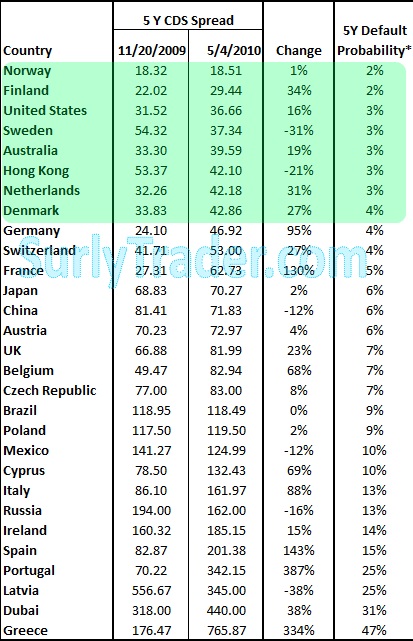
The Australian Dollar and the Norwegian Krone Still look enticing to me
Posted in Economics, Markets, Politics, Trading Ideas.
– May 4, 2010
The New York Times had a nice info-graphic that shows the scale and interconnectedness of the European Debt problem. What truly stands out to me is Spain. If Portugal defaults on the $86B owed to Spain, would that cause the cascade effect for Germany and France?
 As I have said, we need a very large bailout and then we can think about giving up the Eurozone.
Posted in Economics, Markets, Politics.
– May 4, 2010

Buy the print book in color and get the Kindle version for free along with all examples in a spreadsheet tutorial!


