Skip to content


Option Trading Blogs

For all of the option traders out there, it is important to keep an eye on the great posts coming from dedicated options trading blogs. I will start providing an aggregation on a regular basis so there is one place to keep track of all of the new material. You can also find this updated list at “Option Blogs” on the menu bar.

VIX and More Published Items

Syndicated from VIX and More.

Volatility Trader Published Items

Syndicated from Volatility Trader.

Condor Options Published Items

Syndicated from Condor Options.

Option 911

Syndicated from Option 911.

Options for Rookies

Syndicated from Options for Rookies.

Posted in Markets, Trading Ideas.

Tagged with , , , , , , , , , , .


The Story from Interest Rates

The fixed income markets are incredibly large.  According to the Bank for International Settlements, as of 2009, the world bond market stood at $82 trillion which was about twice as big as the global equity market.  Even though bonds may not seem like sexy instruments, they can relay plenty of information that is often overlooked by equity investors.  The simple truth is that the world is controlled by interest rates.  Governments, companies and individuals borrow at prevailing interest rate levels.  If yields are low, then borrowing costs are low and stimulate investment (as long as banks are willing to lend).  What has happened since the beginning of the European “crisis” has been a continuous decline in interest rates across all tenors.

The two year yield at .629% is making all-time Lows

With the two year government yield hitting an all-time low of .629%,  the two year treasury is relaying a bevy of information.  The most blatant observation is that the market believes that the federal reserve will keep its extremely accommodative monetary policy throughout 2010 and probably through 2011.  This means that “free money” will be available in the economic system for the foreseeable future.  The second observation is that the markets will not experience inflation and could perhaps indicate that we should expect to experience deflation.  As a follow-up effect to the first two observations, if the fed is not expected to raise short-term interest rates and inflation is expected to be low, then we should expect very low growth levels and a slow recovery in employment levels.

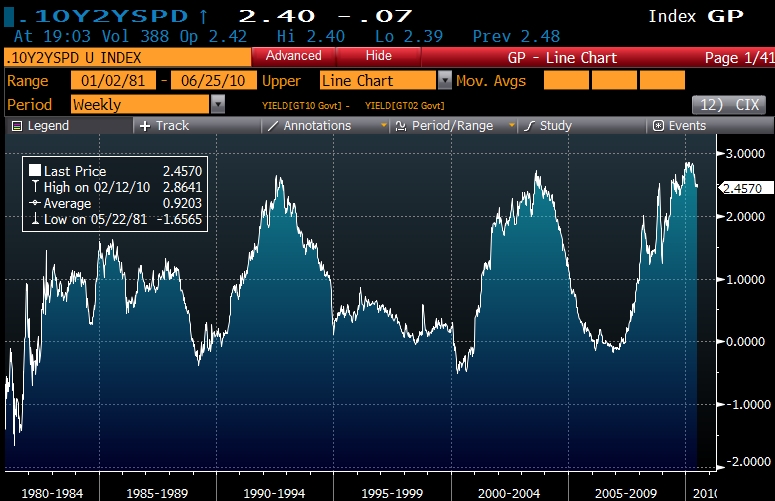
The two year treasury yield leaves us with depressing news.  What provides me with a glimmer of hope is the continued steepness in the yield curve.  Even though the two year rate has declined from 1.17% on April 5th to .629% today (54 bps decline), the steepness of the yield curve between the ten year treasury and the two year treasury has declined 42bps.  This might not seem like much of a change, but if the two year expects doom and gloom, then I would expect that the ten year and thirty year would price in the long-term Japanese deflationary scenario.

The Ten Year Two Year spread still remains historically high which is usually a bullish signal for asset prices

You might think that I am grasping at straws, but a steep yield curve is usually a very healthy signal.  It generally shows that future expectations for growth and/or inflation are much higher than they are today.  With the current 5 year treasury yielding 1.83% and the 10 year treasury yielding 3.02%, the yield curve is telling us that the 5 year interest rate in 5 years must be 4.44%.  A 5 year rate at over 4% would indicate anything but a Japanese outcome.  Aside from signaling, the current yield curve is providing plenty of opportunity to make money.  Just think of it this way:  If you can borrow at .629% and invest in a five year bond at 1.83%, how can you lose money?  The banks do not even have to think about that miserable return because they can lend to home owners at 4.75% for a 30-year mortgage.  That 30-year mortgage at 4.75% allows a first-time buyer to afford a house or it allows someone to refinance and save a large amount of money in interest per year which they can use to stimulate the economy.  The current interest rates are very conducive for a recovery and let us all hope that we can get this engine started once again.  After that, we can start worrying about how we will pay for it all.

Posted in Economics, Educational, Markets.

Tagged with , , , , , , , , .


Noteworthy News – June 28, 2010

Politics:

Britain unveils ‘unavoidable’ austerity budget – CNN

G20 offers no big boost for fearful markets – Reuters

Can politicians comfort the markets while hammering each other? – Washington Post

Economy:

AT A GLANCE: FOMC Stands Pat On Rates, Softens View On Economy – Wall Street Journal

U.S. Economy: Investment Picking Up, Claims Decline – Bloomberg

Economy in U.S. Expands 2.7%, Less Than Forecast – Bloomberg

CEOs’ View of Economy Brightens – ABC News

Jobs Picture Is Brighter For This Year’s College Grads – Hartford Courant

Summers says economy healthier now than year ago – Reuters

Recession, bear markets hit the rich, too – Reuters

Markets:

Double-Dip Recession Fears Putting Scare Back in Market – Yahoo News/CNBC

Europe’s Debt Crisis Exaggerated by Markets, PBOC’s Li Says – Bloomberg

Mortgage Bond Prices Rise to ‘Insane’ Records: Credit Markets – Bloomberg

Gundlach Sees 10-Year Treasury Yield at 2.5% as Economy Slows – Bloomberg

Oil rises to 7-week high as storm forces Mexico to cut exports – Reuters

Banks:

Financial Reform: Wall Street Wins, Investors Lose – Forbes

Whose Bank to Kick: A Tale of Two Tragedies – Huffington Post

Financial-Firm CDS Costs Drop After Reform Accord – Wall Street Journal

Posted in Economics, Markets, Media, Politics.


Let the Municipal Disaster Begin

California seemed to be in the spotlight for the longest time as the infamous issuer of I.O.U’s, but our next rival comes from the Land of Lincoln, Gangsters, and Political Corruption – Illinois.

Illinois Trumps California and New York for Default Risk

At a spread of 314 bps, Illinois is trading at a very similar default rate to Portugal at 319 bps.  Somehow this headline has been overlooked.  As reported by Bloomberg:

Legislators in Illinois passed a provisional $25.9 billion fiscal 2011 spending plan that’s about $13 billion short, and are resisting Governor Pat Quinn’s proposed $3.7 billion debt sale to make a pension payment and help close the gap. Lawmakers recessed last month without providing a way to cover the pension obligation and pay $4.5 billion in other bills.

What causes the dysfunction in state budgets is not the size of the deficits, but the dysfunction of the politics.  The politicians are less concerned with widening credit spreads and increased costs of funding and much more concerned with what the political fallout would be from cutting education expenses or state retirement benefits.  Get out the popcorn, because this might be an interesting entitlement show.

Posted in Economics, Markets, Media, Politics.

Tagged with , , , , , , , , .


Understanding the M.A.D. China/U.S. Relationship

The big news this week has been the revaluation of the Chinese Renminbi (Yuan) against the US Dollar.  The markets were euphoric early Monday morning, but have since tapered off.  The reason for the tepid response is due to the rather tricky relationship between the United States and China.  For the last 23 months, China has kept a peg of 6.8267CNY per $1.   US lawmakers are continuously blaming the peg of the Yuan as the main cause for high unemployment  in the US, manufacturing moving overseas, a stagnating world economy, high debts in the United States, and anything else you would like to blame on someone else.  The truth is quite a bit more complicated.

In order to maintain the fixed peg against the dollar, the Peoples Bank of China (PBOC) must supply the necessary renminbi to purchase dollars to hold the currency fixed.  China’s significant current surplus, recently increased by strong capital inflows, means that significant quantities of base money are required to make this peg work.  Without some sort of offset, this rapid expansion of the domestic money supply would create massive inflation.  The PBOC “sterilizes this money creation by issuing short term bills and increasing the reserve ratio of the local banking system to soak up the excess liquidity and decrease the amount of lending that the banking system can affect.

The large current account surplus, capital inflows and currency peg force the PBOC to accumulate a massive amount of dollars.   The central bank then invests the bulk of its dollar reserve accumulation back into US Treasury securities.  China is increasingly dominating the global demand for treasuries and has therefore become the marginal buyer and rate setter in the Treasury market.

So what effect does this have?  The primary way that people think about it is that Chinese goods are kept cheap.  By keeping the Renminbi undervalued versus the dollar, it is cheaper for Americans to buy Chinese goods.  This is why US lawmakers blame the peg on unemployment and shifting manufacturing…because Chinese goods are too cheap.  The flip side of this argument is that Chinese goods are cheap.  If you need to purchase a good, then it is much better to purchase it at half price.

The more insidious aspect of this relationship is the artificially low interest rates due to the PBOC buying treasuries.  During the boom time when the Fed was tightening interest rates, the purchases by the central bank kept long-term interest rates low.  And now, when the treasury is issuing debt at an alarming and record-breaking rate, the peg has provided stability to US interest rates and has made it relatively cheap for the US government to continue issuing debt.  This is merely financing, the cheap cost of credit for the US consumer (Chinese goods buyer) has been created by the reduced borrowing cost for the US via Chinese treasury purchases.

As with all things, nothing can last forever.  Any country that pegs its currency to the dollar is effectively tied to US monetary policy.  So even if China’s economy is fine, the mere fact that the US is trying to fuel its domestic economy forces fuel into China’s economic fire.  For China, that pressure has fueled inflationary pressure.  This is why China has recently announced its relaxation of the currency peg.

But wait…there is more.  China cannot revalue its currency by 20% overnight.  By doing so, it would dramatically reduce demand for Chinese goods from US consumers, destroy the value of their treasury holdings, and possibly cause a spike in US interest rates which could cause the global economy to enter a recession once again.  This is Mutually Assured Destruction (M.A.D).

So what will happen?  China will slowly allow its currency to float in hopes that Chinese domestic demand will replace US consumer demand.  If this currency revaluation is successful, then we should see higher interest rates in the United States which will cause our own government to step off of the debt-fueled government spending and adopt our own austerity measures.  Let us all keep our fingers crossed.

Posted in Economics, Markets, Politics.

Tagged with , , , , , , , , , .


Copyright © 2009-2013 SurlyTrader DISCLAIMER The commentary on this blog is not meant to be taken as an investment advice. The author is not a registered investment adviser. There is no substitute for your own due diligence. Please be aware that investing is inherently a risky business and if you chose to follow any of the advice on this site, then you are accepting the risks associated with that investment. The Author may have also taken positions in the stocks or investments that are being discussed and the author may change his position at any time without warning.

Yellow Pages for USA and Canada SurlyTrader - Blogged

ypblogs.com