Skip to content


Why You Should Hate VXX

I do not like to play games where the odds are consistently stacked against me.   When you play at a casino you know that over the long haul, you are helping to pay for the marble floors.  If you do want to play at the casino, you at least want to play the games where the odds are closer to even so that you can enjoy a few more watered down complimentary beverages.  In the trading world, I do not want to be swimming upstream.  If the market is rallying or tanking, I will generally go with the flow.  Likewise, when there are structural deficiencies in a strategy, I want to take advantage of those deficiencies or make sure that I am not on the wrong side of those deficiencies.

With any trading strategy where you are forced to systematically trade, you want to make sure you like the underlying system.  In the case of ETN’s that trade in the futures markets, you want to make sure that the strategy fits the way that the underlying futures trade.  In the case of most futures contracts where the curve is in contango, you do not want to be systematically rolling your long position, especially not at the points where the contango is at its steepest.  With natural gas we can see contango along with strong seasonality:
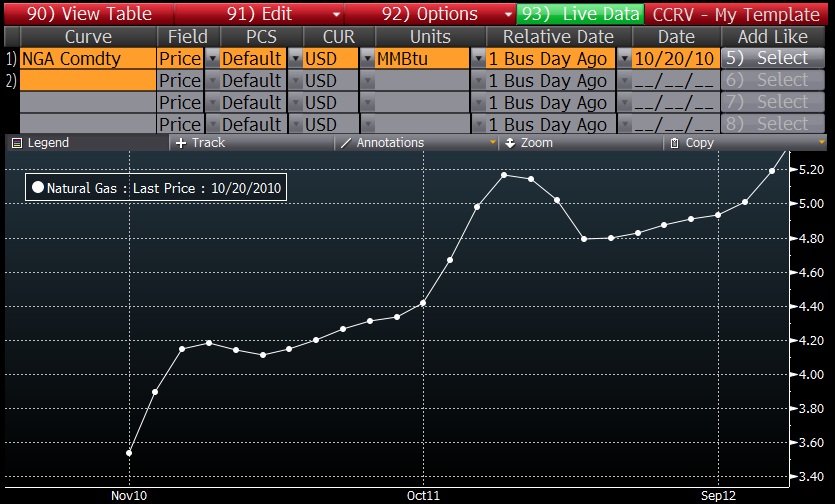
Do you benefit from holding Sep 2012 Natural Gas until expiration?

If you buy September 2012 Natural Gas contracts for nearly $5, what happens to you if the price of natural gas does not move between now and expiration?  You get killed because you lose over 50%.  You might suggest that natural gas is a finite commodity, therefore as currencies devalue, supplies erode and demand increases; the price of natural gas will most definitely rise over time.  You might be right, but what about financial contracts that have nothing to do with nominal prices such as the VIX?
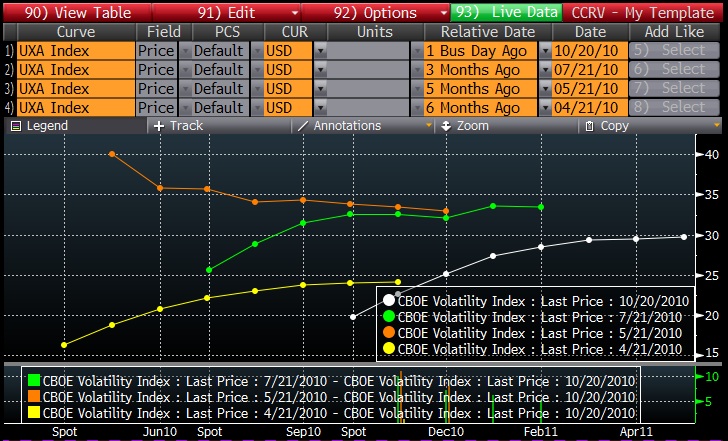
It turns out that VIX futures are mostly in contango

Except when the VIX is spiking (May 2010), VIX futures mostly stay in contango.  This means that it costs more to buy volatility in the future than it does to buy volatility today.  Volatility is a percentage, so unless you believe that volatility will rise in the future, this relationship should not last.  The true reason is most likely because the future is more difficult to predict.  It is much easier to predict what happens next week than it is to predict what happens three months from now.  I believe that this plays into the expensive pricing of longer dated VIX futures.

The problem with this relationship is that the exchange traded note, VXX, has become a very hot product for trading the VIX.  Unfortunately, VXX can only imitate the VIX by buying short dated futures and rolling the positions as they age.  Because of the downward sloping nature (contango) of the VIX futures curve, you will lose money over time by holding a long position in VXX.

VIX...not quite

This contango relationship is why I actually believe the best systematic VIX futures strategy is to purchase the longer part of the VIX futures curve (VXZ) and sell the short part of the curve (VXX).  Why stand in front of the bus when you can hitch a ride?
Posted in Derivatives, Markets, Trading Ideas.

Tagged with , , , , , , , , , , .


Vol Says to Buy the Dips

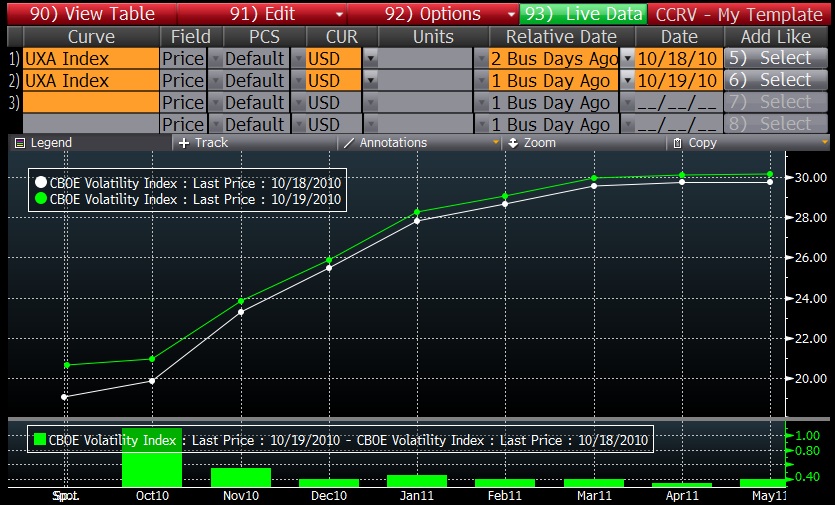
It was a rather ugly day in the cash markets with the S&P 500 down 1.59%, but volatility remained rather subdued.  We saw a nice move in the VIX of 1.54 vol points, but in the VIX futures curve action was very muted in longer maturities with most increasing about .4 vol points.

The front had action, but mild on the backside

We could argue that the longer dated VIX futures are already fairly inflated at the 30 vol level, but what about implied volatility of regular S&P 500 options?  It turns out that the skew on 6-month options moved in a timid way as well with ATM implied vol moving from about 22 to 22.5.  In addition, we saw a pretty parallel shift in vol which suggests that there was little “fear buying” of OTM put options.  In fact, I would even suggest that the fall in market prices gave traders an opportunity to sell puts or increase risky asset exposures at more attractive levels.

Option implied vols were muted as well

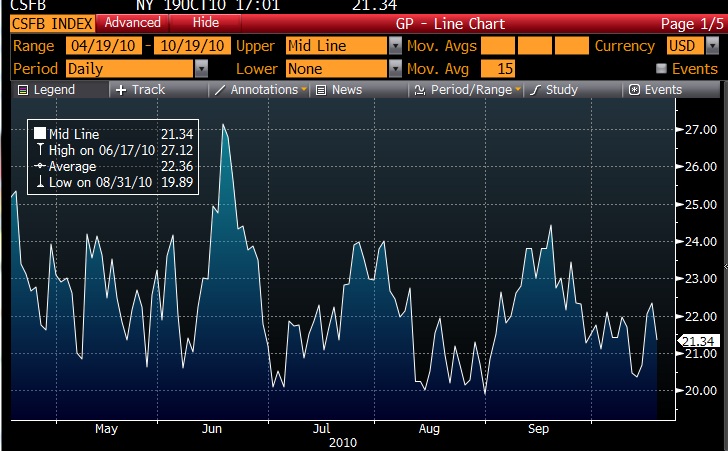
I take this to mean that the “risk-on” trade is still fully in force and we should see this as a pause and pullback rather than the start of a correction.  The mood could shift quickly with more news, but right now the vol markets are not telling me to run for the door.  In fact, they might just be telling me to add to my positions.  Do you see any fear in the Credit Suisse Fear Barometer?

Posted in Derivatives, Markets, Trading Ideas.

Tagged with , , , , , .


The Currency War

One very perverse aspect of our global financial crisis hangover is the fact that many developed countries want to devalue their currencies.  By printing money at alarming rates, countries burdened with debt can make their exports look more attractive and also make their debt obligations smaller in real terms.  The problem is that there are many players in the game.  Japan, Europe, the United States, and any country that pegs its own currency to one of the three…  I can assure you that the Euro at $1.40 is not making politicians in the Eurozone happy.  Germany profited handsomely from a weak Euro earlier in the year and is most likely losing much of those gains.  With Bernanke stating that a weak dollar is a goal and the Bank of Japan intervening in the currency markets and lowering their interest rate from .1% to 0% (will that really do anything), it seems like we are in a race to the bottom.  Just remember that currency devaluation is a tax on citizens within those countries.  Savers are punished while debtors are rewarded.  This does not seem like a system that we want to live by and if it gets too out of hand we might see a renewed interest in pegging currencies to hard assets.  The fiat monetary system is showing just how ugly it can get.

Posted in Economics, Markets, Politics.

Tagged with , , , , , , .


Noteworthy News – October 18, 2010

Economy:

Boomerang kids: 85% of college grads move home – CNNMoney

Japan Goes From Dynamic to Disheartened – New York Times

Markets:

Flashback to 1870 as Cotton Hits Peak – Wall Street Journal

Boom in Emerging Markets Has Some Fearing Backlash – Wall Street Journal

The Australian dollar has hit parity with the US dollar for the first time since it was floated in 1983 – ABC News

Dollar bears wary after reversal from lows – Reuters

Politics:

This Is What Runaway Government Spending Looks Like – The Atlantic

CNBC predicts Congress will retroactively legalize foreclosure fraud – RawStory

What would it really take to trim the deficit? – Yahoo News

Fed’s Bernanke signals new round of quantitative easing – BBC

Peter Schiff: “It’s Scary How Clueless Bernanke Is” – Business Insider

Posted in Economics, Markets, Media, Politics.


Please Sell My House

These comedic cartoons all started with the iPhone video posted by a former Best Buy employee.  Today we have a few more revolving around real estate and I am sure that most realtors would find it more than amusing.  The language is foul, but the underlying message hits home:

Please Sell My House

I want to Buy a House:

Posted in Economics, Markets.

Tagged with , , , , , .


Copyright © 2009-2013 SurlyTrader DISCLAIMER The commentary on this blog is not meant to be taken as an investment advice. The author is not a registered investment adviser. There is no substitute for your own due diligence. Please be aware that investing is inherently a risky business and if you chose to follow any of the advice on this site, then you are accepting the risks associated with that investment. The Author may have also taken positions in the stocks or investments that are being discussed and the author may change his position at any time without warning.

Yellow Pages for USA and Canada SurlyTrader - Blogged

ypblogs.com