Skip to content


The Value of Stock Replacement Strategies

In general, investors cling to rather boring strategies.  Very few investors short stocks so the vast majority of trades revolve around long positions with hopes of getting timing right via momentum or valuation plays.  When investors get scared about their long positions they tend to buy puts (even though long volatility might serve as more efficient protection) or sell out of positions.

Today, let us broaden our horizons.

First, let me say that I am tired of hearing and reading about fat tails.  I really liked Nassim Taleb’s Fooled By Randomness, but when Black Swan became a hit, the meme became overwhelming.  The book, along with the 2008 crash, gave everyone the full and utter knowledge about how fat tails happen often and how you would be stupid to believe otherwise.  When you talk about selling options, you often get harassed by those who know the truth.  I say bullocks and read through this link first if you want to argue about it.

Most things in life cannot be distilled to one sentence.  With  regards to the topic of fat negative return tails, this is also the case.

Positive and Negative Tails on the S&P 500

The chart above is extremely interesting because it depends on the time window you are looking at.  When I looked at daily returns, the distribution was definitely skewed towards negative returns.  When you look above you still see the effect in weekly and monthly returns.  With quarterly data you start to see this relationship break down with a greater number of +20% returns than negative 20% and nearly equal observations of +/-30% and +/-40% quarterly returns.

Looking further, when you compare the option implied quarterly return probabilities to the historical observations, put options look massively overpriced whereas some call options look underpriced.  Then you get the idea of stock replacement.

A stock replacement strategy can mean many things, but generally it means that you replicate a long stock position with derivatives.  The truest form would be the purchase of a call, sale of a put at the same strike and investment of the notional amount of the options in a risk free bond for the tenor of the options.  The strategy can be tweaked by selling puts of different tenors and strikes of the purchased calls.  By selling a longer maturity put that is further out of the money, you reduce the probability of losses by giving yourself a buffer for stocks to drop.  Regardless of what strikes and maturities you choose,  stock replacement strategies in which calls are purchased through a subsidy of written puts should outperform long only positions.

Posted in Derivatives, Markets, Trading Ideas.

Tagged with , , , , , , .


A Tale of Two Vols

Thus far, the S&P 500 seems to be holding onto its relative strength.  Despite some stable footing, we continue to watch the VIX and shorted dated implied volatility march higher.  With this trend we have seen a fairly strong divergence between historical volatility and implied volatility:

Which one can be trusted?

This same phenomenon occurred back in August/September 2009 after the rally off of the lows was a few months old.  It is often an artifact from investors’ disbelief in a rally and their subsequent purchase of crash protection as fear is still top of mind.  We will see if this pricing holds any truth, but right now I feel as if this rally can hold up through year’s end because despite the poor sentiment the market does seem to have legs.

Posted in Derivatives, Markets, Media.

Tagged with , , , , , .


Noteworthy News – November 1, 2010

Economy:

US economic growth rate quickens – BBC

German Unemployment Dips to 18-Year Low in October – CNBC

More than decoupled, China is in league of its own – Reuters

Markets:

Marc Faber: Anything Less Than $1 Trillion From Bernanke Will Trigger A Market Correction – Business Insider

Election, jobs report and Fed all will have impact on stocks – USA Today

Emerging-Market Stocks Gain on U.S. Growth Data; Currencies Rise – Bloomberg

RATE FUTURES REPORT: Market Sees Fed ‘Love’ For Buying Bonds – Wall Street Journal

Politics:

Why We Should Eliminate the Corporate Income Tax – The Atlantic

Capt Bernanke on course for icebergs – Financial Times

The Elephant In The Room: Debt Grows Exponentially, While Economies Only Grow In An S-Curve – Washington’s Blog

Krugman’s prophecy of doom – The Economist

Robert Kiyosaki – The Rise and Fall of American Democracy – Yahoo Finance

U.S. on track for “fiscal train wreck”: Roubini – Reuters

Banks:

How the Banks Put the Economy Underwater – New York Times

Ohio Attorney General to Mortgage Banks: Sorry, Boys, No Do-Over – Crooks & Liars

Posted in Economics, Markets, Media, Politics.


Happy Halloween

Posted in Markets, Media.


Pray for Higher Rates

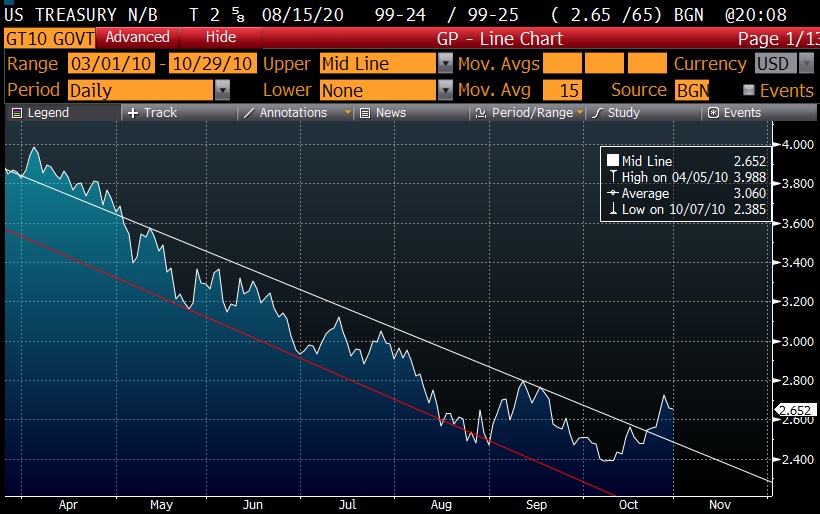
It seems like chanting for the opposing team, but I find myself hoping that higher interest rates will come.  I have commented that the rate and equity markets seem disconnected; that rates seem to decline while equities rally.  Low interest rates make bonds look very unattractive versus stocks which implies that one of the markets is wrong.  Either a strong second dip in earnings is coming, or bonds are overvalued versus stocks.   Low interest rates signal slow to negative growth with slow to negative inflation.  Those two items make the fed take more action which means that they print more money in an effort to “stimulate” growth, the economy and inflation.  I am hoping that this is not needed.  I am hoping that we can slowly grow our way out of trouble without dousing smoldering ashes with gasoline.  The other issue that comes into play is that with a low interest rate environment, we often see investors making stupid investments.  When we all want to earn 5% in a 2.5% 10 year treasury market, we tend to invest in riskier and riskier ventures until everything is overpriced….then pop!  We saw it with the internet bubble and we saw it with the housing crisis.  We do not want to stimulate more stupid investments, we want to stimulate employment, deleveraging, exports, savings, and education.  We do not stimulate those areas with cheap financing.  So cheer with me and let us hope for higher rates so that we do not have to witness another bubble form and burst.

Could it be that rates are breaking out to the upside?!

Posted in Economics, Markets.

Tagged with , , , , , , .


Copyright © 2009-2013 SurlyTrader DISCLAIMER The commentary on this blog is not meant to be taken as an investment advice. The author is not a registered investment adviser. There is no substitute for your own due diligence. Please be aware that investing is inherently a risky business and if you chose to follow any of the advice on this site, then you are accepting the risks associated with that investment. The Author may have also taken positions in the stocks or investments that are being discussed and the author may change his position at any time without warning.

Yellow Pages for USA and Canada SurlyTrader - Blogged

ypblogs.com