Skip to content


Interest Rates on the Move

It was very difficult to continuously suggest that interest rates were unattractive even as they grinded lower month after month.   From April of this year until mid-October, the ten year treasury rate dropped from its high of about 4% to a sobering low of 2.38%.  I consistently suggested that buying a 10 year corporate bond for a measly 3% yield would be a mistake in the long run.  On the other side of the fence, a multitude of prognosticators were suggesting that we were just on our own trajectory to a Japanese normal of 1% 10 year rates.

The interesting aspect of interest rates is that they often go up much quicker than they move lower.  It took the 10 year treasury yield about 4 months to move from 3.3% to its low, but it has taken only two months to retrace its steps back up to 3.3%, and the majority of that has happened in a few days.

Are we spiking or taking a breather?

The current dart upwards is related to the extension of tax cuts and especially the unexpected compromise from Obama that is predicted to add $148B to the deficit.  This tax cut extension was most likely priced into the market, but the compromise was not.  The interesting question is whether the market is interpreting this as a spur to growth (bad for bonds via inflation) or because it is a signal of the United State’s lack of fiscal discipline.  The recent economic news, especially the sub-par employment report, certainly does not support our rapidly rising interest rates from a fundamental sense.

Another interesting question to ask – how fast and far would interest rates have to spike in order for politicians to understand the harm that they are causing?

Posted in Economics, Markets, Politics.

Tagged with , , .


Noteworthy News – December 6, 2010

Economy:

The Problem with Men: A Look at Long-term Employment Trends – Brookings

Participation Rate of 25 to 54 Age Men at Record Low – Calculated Risk Blog

Fed Chairman Bernanke On The Economy – 60 Minutes

U.S. Employers Add Fewer Jobs Than Forecast, Bolstering Fed Stimulus Plan – Bloomberg

We Lost 8 Million Jobs. Only 1 Million Came Back – NPR/PlanetMoney

Markets:

The Euro Has No Clothes – New York Times

Dotcom Bubble 2.0www – Newsweek

Politics:

Bernanke Says Fed May Take More Action to Curb Joblessness – Bloomberg

Nassim Taleb: Bernanke ‘Beyond Unwise, He is Immoral’ – MoneyNews

Ireland ‘likely’ to leave Euro – Irish Times

Mounting Debts by States Stoke Fears of Crisis – New York Times

Banks:

Banks Are Healthier, Credit the Fed – Dealbook

Are WikiLeaks Rumors Making Bank of America a Better Buy? – DailyFinance

Posted in Economics, Markets, Media, Politics.


Today’s Option Blogs December 4, 2010

  • Economic Data Frozen Until Next Thursday
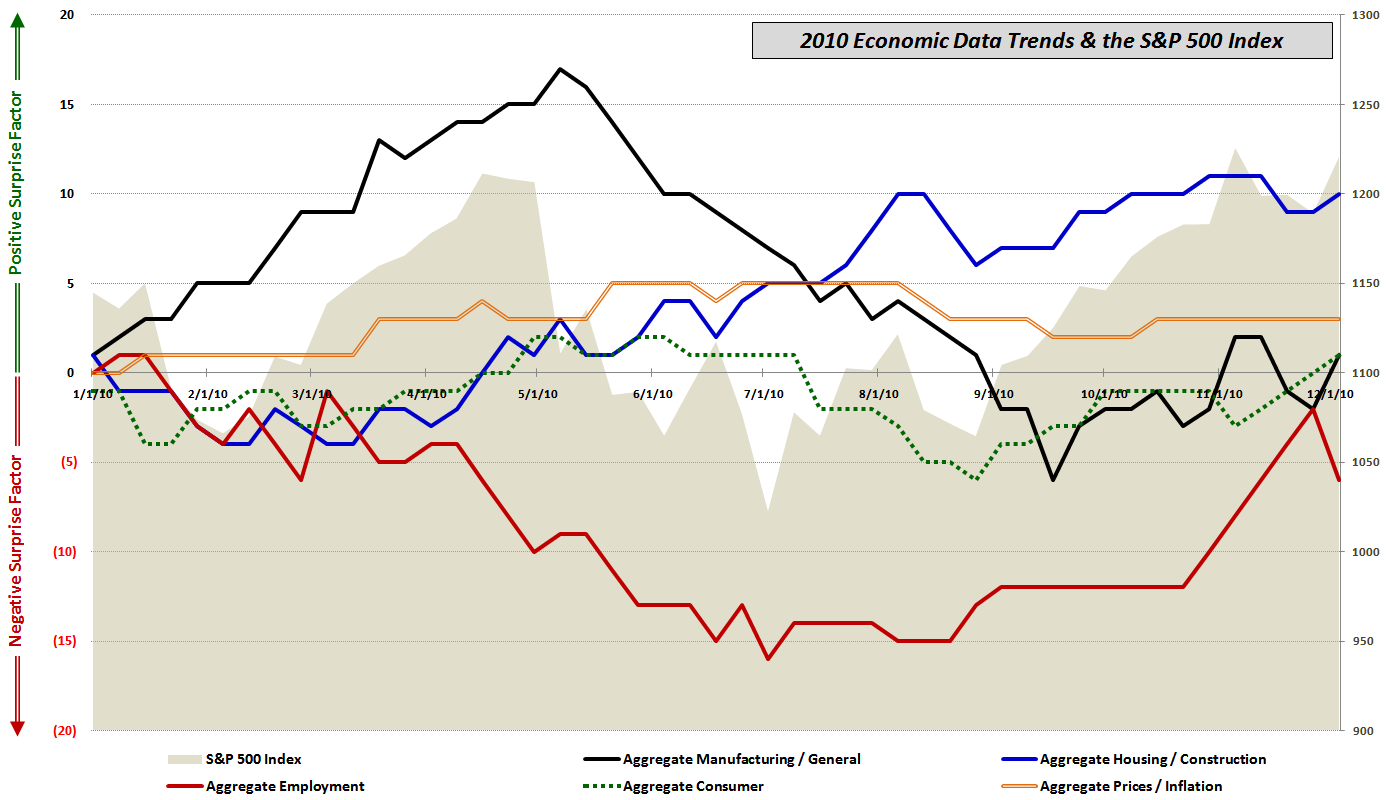
    Today’s data dump of nonfarm payrolls, the ISM non-manufacturing survey and factory orders caps a big week for economic data and since there is an unusually long stretch until the next data points are released ( next Thursday’s jobless claims), this seems like a good time to update my ongoing chart of economic data relative to expectations.

    The last time I updated this chart, in late October, I observed, “There has been a noticeable uptick in positive reports since the beginning of September – one that just so happens to coincide with the upturn in stocks.” Today’s nonfarm payrolls report notwithstanding, the pattern of positive surprises has been repeated through November and into the first week of December. While employment continues to be the biggest story, the recent uptrend in the consumer and resurgence in manufacturing mitigates some of the bad news on the labor front and hints at the possibility of a job market that may show signs of improvement soon.

    The other big story in this chart is that as bad as housing and the construction market seem, the data has consistently been coming in higher than the lowered consensus expectations.

    Finally, it is rare that there is dearth of data in the U.S. for such an extended period of time. Among other things, this lack of new data points means that any investing trends that are currently in place will have little in the way of evidence to undermine their validity during the next week. It also means that the Fed will have little in the way of additional new information in front of them when the FOMC meets on Tuesday, December 14th.

    Related posts:

    Disclosure(s): none


  • VIX List-a-Palooza
    Remember not that long ago when you could only trade volatility by actually trading options? Well, those dark days are a thing of the past as every financial institution known to man seems to have a volatility product they’d like to list. In the past week alone, we’ve had six offerings from Velocity Shares, one […]
  • Your VIX Sonar
    There’s actually a spike in volatility going on. Volatility OF volatility I should note. Most confusing concept ever? Possibly. What that means is options ON VIX have seen implied volatility spike. Specifically in January and February. Jamie notes VIX put buyers, and 1:2 call spread buyers. There’s almost a permanent bid on cheapo VIX call […]
  • Two More VIX ETNs Makes It a Baker’s Dozen
    In addition to the six new VIX-based ETNs launched yesterday by VelocityShares, two new VIX-based ETNs also traded yesterday for the first time.

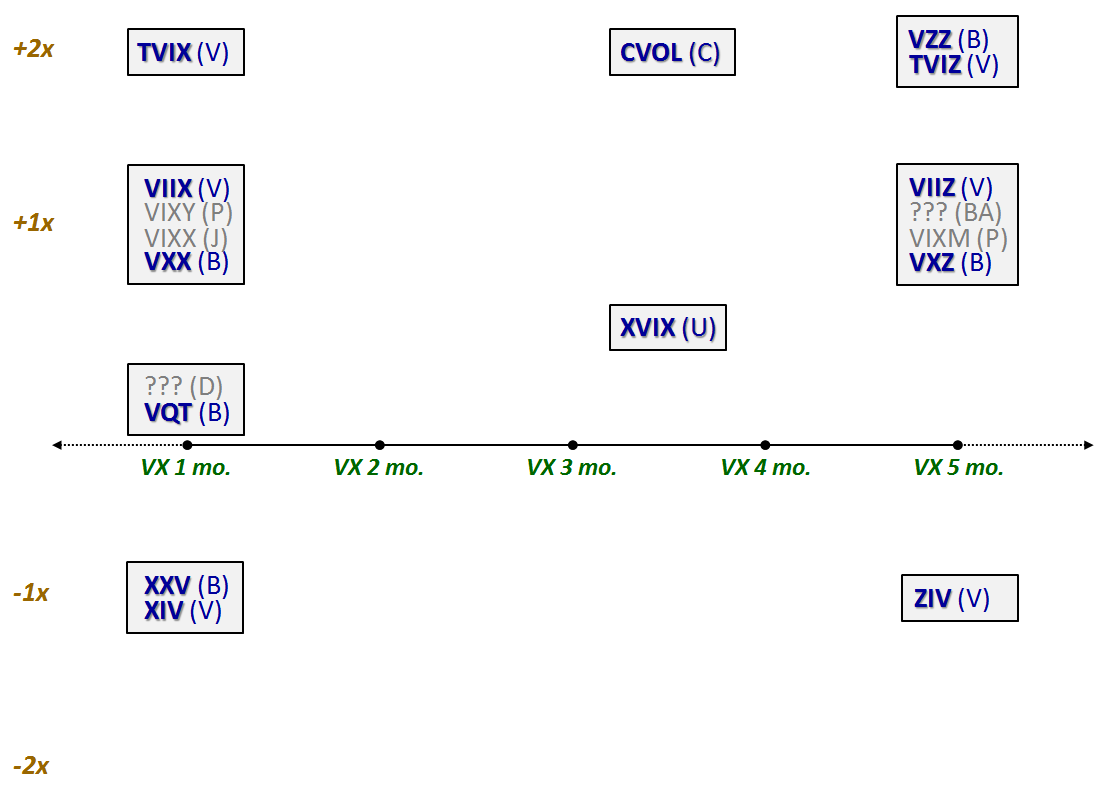
    Barclays added VZZ to their product lineup, bringing the total number of Barclays products in the space to five. VZZ is essentially a +2x version of VXZ, with a target maturity of five months.  VZZ is the first leveraged volatility ETN from Barclays and is interesting in that the absence of a corresponding +2x VXX product suggests Barclays does not see the need for a leveraged VXX equivalent or perhaps finds the combination of leverage and high contango at the front end of the VIX futures term structure to be a daunting combination.

    Elsewhere, UBS makes its entry into the VIX-based ETN fray with a huge splash. Their new product, XVIX, ups the innovation ante by combining a 100% long position in the S&P 500 VIX Mid-Term Futures Excess Return Index with a 50% short position in the S&P 500 VIX Short-Term Futures Excess Return Index. Translated into Barclays terms, this would be roughly the equivalent of two units long VXZ and one unit short VXX. Depending upon the shape of the VIX futures term structure, UBS is hoping that XVIX will benefit from contango and also get a lift from an increase in volatility. The performance of XVIX going forward will be particularly interesting to watch.

    I would expect the land grab in the volatility ETP space to settle down for a little while as investors evaluate the new menu of options.  In the meantime the chart below should help.  I have grayed out those products which have been announced, but not launched.

    The most difficult part may be unlearning Roman numerals in the process. I’m sure on some trading floor, however, some joker is yelling out, “I’m long 25 and 15, but short 70.”

    Related posts:

    Disclosure(s): short VXX at time of writing


Posted in Markets.

Tagged with , , , , , .


Value in Municipals

As I previously mentioned, Muni’s have been thrown under the bus with European sovereign debt.  The fear is that the politicians will never have the discipline to cut budgets and tighten belts, just what we would expect from self-interested politicians.  The truth is that municipalities are in far better shape than many sovereign nations and they are actually required to balance their budgets unlike their large brethren.  Standard and Poor’s thinks the outlook is far better than perceived:

We believe the crises that many state and local administrators find themselves in are policy crises rather than questions of governments’ continued ability to exist and function. They’re more about tough decisions than potential defaults. This is because, for the states in particular, debt service generally holds a priority status relative to other obligations. Indeed, a state’s spending cuts in a recession may actually serve to protect debt service. The revenue declines that we think would likely cause default in many instances would need to be double what they were during the Great Depression.

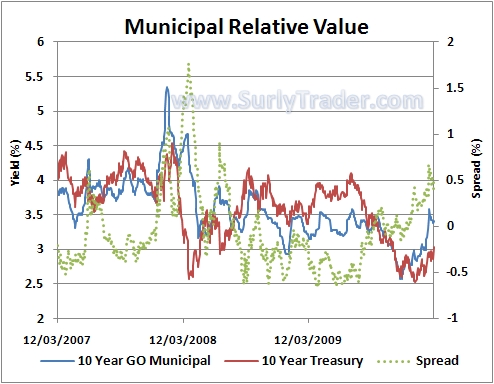
What has the fear done to the fixed income markets?  As a simple measure we can look at 10 year general obligations from municipalities versus 10 year treasury yields:

The spread is at levels not seen since the global financial crisis

The spread between general obligation tax-exempt municipals and treasury yields of similar maturity is at very attractive levels.  In fact, municipals blow the lid off of most corporate bonds on a tax adjusted basis.  The yields might become even loftier, but it seems like a good opportunity to scale in.

Posted in Economics, Markets, Politics, Trading Ideas.

Tagged with , , , , , , , , .


Rebellious VIX

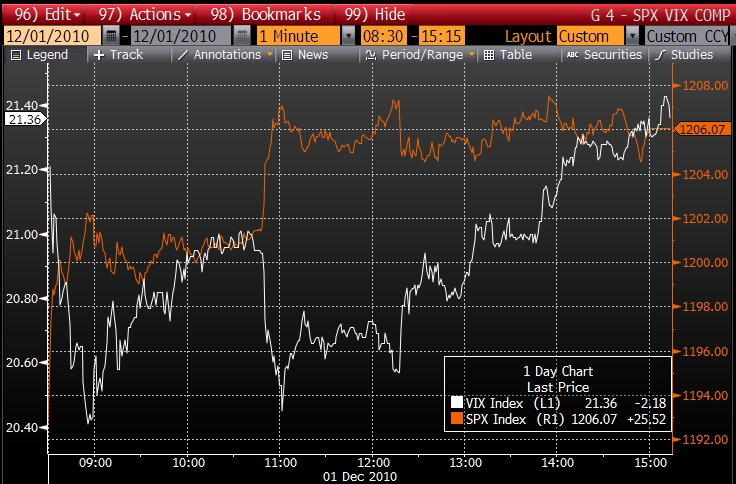
Stocks jumped on good economic news but the VIX shows contempt.  The ADP Employment Change came in at 93k vs an estimate of 70k, ISM came in slightly better than expected, vehicle sales better than expected, and the Fed beige book is consistent with modest acceleration in activity for 4th quarter versus third quarter.  As a response, stocks jumped over 2% nearly across the board and interest rates rose over 10bps.  One issue that was interesting was a steady rise in the VIX as the day marched onward:

VIX and S&P moving in the same direction?

It almost seems that when bonds, the dollar, and equities start to move in directions that make sense – then the VIX needs to step out of line and start protesting.  I do have to admit that we are in a precarious situation.  Even though economic data is making more sense and interest rates are no longer plunging, it does not seem that there is much fuel for stocks to skyrocket.  Today was a euphoric day, but we are not breaking into new territory but only teasing the 1200 level on the S&P 500.  Maybe the fear is warranted and maybe the sovereign debt crisis is only in its infancy.

One interesting divergence that I have noticed has been the VIX versus the credit default levels (market embedded default probabilities) of the Eurozone PIIGS.  As you can see, the VIX followed the Eurozone fear in the summer, but during the fall we have seen a very muted response from the VIX.  Maybe we should be more scared that Europe is only a spotlight into the future of Great Britain, Japan and the United States and that the  BRIC countries are not strong enough to pull us out of the ditch.

Did the VIX figure out that the Eurozone doesn't matter or is it fooling itself

Posted in Derivatives, Economics, Markets.

Tagged with , , , , , , , .


Copyright © 2009-2013 SurlyTrader DISCLAIMER The commentary on this blog is not meant to be taken as an investment advice. The author is not a registered investment adviser. There is no substitute for your own due diligence. Please be aware that investing is inherently a risky business and if you chose to follow any of the advice on this site, then you are accepting the risks associated with that investment. The Author may have also taken positions in the stocks or investments that are being discussed and the author may change his position at any time without warning.

Yellow Pages for USA and Canada SurlyTrader - Blogged

ypblogs.com