Skip to content


Noteworthy New – February 14, 2012

Economy:

Where and What Is U.S. Trading Internationally? – Wall Street Journal

Home Seizures Rebound 12% in January – The Atlantic

Postal Service warns of default as losses mount – CNNMoney

Which economist is doing most to shape post-crisis thinking? – The Economist

Productivity Wars: Europe vs. The USA – Focus

US unemployment to remain high for years, says Bernanke – BBC News

A damning post-mortem of the financial meltdown – LA Times

Markets:

Is Oil Output Peaking or Not? Either Way, Cheap Oil Is Gone for Good – DailyFinance

US silver term structure inverts as supply tightens – Reuters

Treasuries Rise as 10-Year Note Sale Draws More Foreign Central Bank Bids – Bloomberg

Politics:

Fannie, Freddie Mortgage Role Would Be Wound Down Under Treasury Proposals – Bloomberg

IMF calls for dollar alternative – CNNMoney

Abraham Lincoln, Inflationist – NY Times (Paul Krugman)

Banks:

Four U.S. banks fail, punching hole in fund – Marketwatch

FDIC Shifts Burden for Assessments to Bigger Banks – Bloomberg

Fed Says Banks Would Have Two Years for Volcker Rule – Bloomberg

Posted in Economics, Markets, Media, Politics.


High Altitude Bombing in Oil

Guest Post: J.W. Jones from Options Trading Signals

At the risk of stating the obvious, the recent market action in the commodities has been manic with wild gyrations of price in a wide variety of basic materials, metals, and energy. Given these wild fluctuations in price, I thought we could look at an options trade in USO that gives a high probability of success.

In order to give a bit of a conceptual framework for this sort of trade, let me share the way I look at these. Development of precision high altitude bombing during World War II resulted in a dramatic reduction in casualties while inflicting devastating consequences to enemy forces. I view the sort of option strategy described below as the equivalent of high altitude precision bombing. We will extract substantial profit without putting ourselves at high risk of damaging anti-aircraft fire.

As is shown on the daily price chart below, there is substantial support in the region of 35.60-36 provided by a recent swing low and the 200 period moving average.

In selecting the structure of option trades, I usually like to consider the volatility environment in which we currently operate. This is important because a very strong tendency of implied volatility is reversion to its mean. The knowledgeable trader factors this into his trades in order to put the wind at his back as much as possible. Trades can be selected and constructed to benefit (positive vega trades) or suffer (negative vega trades) from increases in implied volatility. As you can see in the chart below, implied volatility is currently in the lower quartile of its historic value for this specific underlying:

Given the current low volatility, let us look at a strategy that gives us substantial profit from an altitude of 50,000 feet and the ability to roll the trade forward for additional substantial profit. This trade is structured as a “ratio calendar spread”.  Now don’t go getting hung up on the name, it is simply a two legged trade in which we buy a longer dated in-the-money call and sell a smaller number of out-of-the-money calls. The trade is diagrammed below:
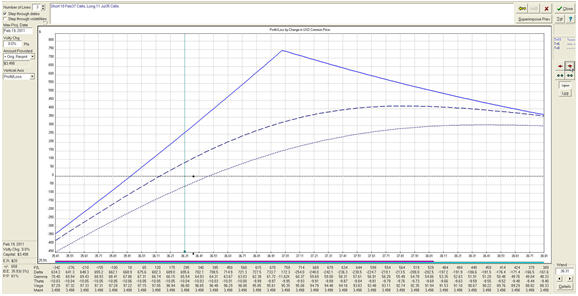
For those getting used to these sorts of trades and trying to form an organizational framework, the trade can be thought of as a basic calendar spread where an additional contract of the long options is purchased. The addition of this extra contract removes the upside limit on our profitability which would exist in an ordinary calendar spread. As is often the case in option trading, this trade can also be thought of as a “first cousin” to a covered call structure where the long in-the-money contracts serve as a surrogate for long stock. I find it helpful to think of the various option constructions as individual members of several different families. Each family has a number of “family traits” that help make sense of the large number of potential constructions available to the options trader.

One of the characteristics of this family under discussion is the “Sham Wow” factor- “but wait-there’s more”. The “more” in this trade is the ability to “roll” the short calls forward as they expire or, more prudently, as they reach inconsequential value. For example, this trade would have been initiated by selling the February 37 calls at a value of around 57¢.  When these calls reach minimal value, let us say 10¢ for discussion, they could be bought back, and the March calls sold to capture substantial additional premium. This process can continue for April, May, June, and July. These additional sales give the opportunity to reap additional profit for the trade.

The risks in the trade are:

1.USO breaks support and continues to sell off

2. Volatility collapses on the long leg of the trade

I have discussed both of these factors in the price chart and volatility chart above when I was developing the logic of the trade. While no guarantees exist for the behavior of either price or volatility, the current trade represents a reasonable balance between risk and probability in my opinion.

As with all our discussions, these considerations are presented for educational purposes and do not represent a recommendation. This is not a solicitation nor should it be considered financial advice. I am simply trying to demonstrate how to use the knowledge of option behavior to construct trades that benefit from high probability events. Bombs away!

Posted in Markets, Trading Ideas.

Tagged with , , .


The Commodity Bubble

In the future they might coin this the “Bernanke Effect” or maybe the great commodity bubble of 2011.  The truth is that commodity prices are rising…dramatically.  You might have started to notice this disconnect in your grocery store shopping or in gasoline prices, but if you were to ask our government they would tell you that a basket of goods consumed (CPI) is rising modestly.  How modest do these numbers appear to you?

Sugar and Corn? Those are luxury goods.

If the basic ingredients to food are skyrocketing, then prices of food will eventually have to keep pace which will directly hurt consumers.

Of the 853 ETF’s that I looked at, which unleveraged funds do you think had the greatest return over that same time period?  It is not a trick question:

Are you noticing a theme?

My conclusion is simple:  this time is NOT different.  Commodity prices cannot go up forever and China will not continue to support the market regardless of prices.  What is this “Bernanke Effect” doing to farmland prices?  Well, according to a survey by Farmer’s National Company:

“non-irrigated crop land in central Kansas averaged $3,000 an acre, up 50 percent since June

Crop prices have seen an extraordinary run since early July. A bushel of wheat priced about $4 a bushel on July 4 is now more than $8.50. Other crops have experienced similar increases.

As the land generates more income, it puts more cash in the pockets of the most likely buyers, nearby farmers. It also provides an attractive return for investors who then rent it out to farmers.

The result: Auctions are drawing twice the number of bidders as before, said area agents.”

As with all hot speculation, the commodity run will surely come to an end and will probably have repercussions for all financial markets.  We should have learned by now that large financial dislocations tend to not occur in isolation.

Posted in Economics, Markets, Politics.

Tagged with , , , , , , , , , , , .


Steeper Every Day

If the Fed has succeeded at just one thing, it has been to create a steep yield curve.  The spread between the 10 year treasury yield and the 2 year yield is flirting within basis points of its all time high of 2.91% set in February 2010:

Fuel for Inflation

Sit on cash earning 0% or lock up a the money by taking advantage of the steep yield curve.  This is exactly the dilemma that the Fed wants you to face.  They want you to become an investor further out on the yield curve which allows all debt burdened entities to term out their debt at lower yields.  It also fuels speculation as financing becomes dirt cheap for everyone with a pulse – “Just promise me a return greater than zero….”  Reinflate, Reinflate, Reinflate.

Posted in Economics, Markets, Politics.

Tagged with , , , .


Noteworthy News – February 7, 2011

Economy:

Why Did Economists Not Spot the Crisis? – Chicago Booth School Of Business

When Irish Eyes Are Crying – Vanity Fair (Michael Lewis)

Manufacturing shares surge as economy revvs up – Bloomberg

Nearly 11 Percent of US Houses Empty – CNBC

Markets:

Silver backwardation is here – FT Alphaville

Nasdaq Hackers Target Service For Corporate Boards – NPR

Rethinking Stocks for the Long Haul – Bloomberg

Gold Falls as Recovering Economy Curbs Alternative-Asset Demand – Bloomberg

Politics:

As money leaks out, Ireland must show we can restructure debt – IrishTimes

Germany, France push euro-zone policy changes to help stabilize regional economy – Washington Post

Banks:

Treasury almost in the black on bank bailouts – The Hill

The Ruinous Fiscal Impact of Big Banks – New York Times

Posted in Economics, Markets, Media, Politics.


Copyright © 2009-2013 SurlyTrader DISCLAIMER The commentary on this blog is not meant to be taken as an investment advice. The author is not a registered investment adviser. There is no substitute for your own due diligence. Please be aware that investing is inherently a risky business and if you chose to follow any of the advice on this site, then you are accepting the risks associated with that investment. The Author may have also taken positions in the stocks or investments that are being discussed and the author may change his position at any time without warning.

Yellow Pages for USA and Canada SurlyTrader - Blogged

ypblogs.com